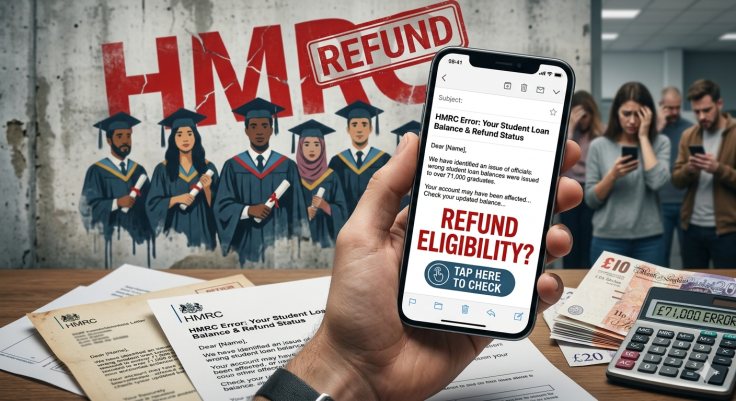
Britain's student loan administration has confirmed that roughly 71,000 graduates were issued incorrect loan balances due to a combination of an income reporting error by the national tax authority and a separate technical glitch. Of those affected, 41,000 saw their balances wrongly inflated. The remaining 30,000 had their balances incorrectly reduced.
The errors primarily affect Plan 2 student loans, the repayment scheme that applies to graduates who began undergraduate courses in England and Wales between 2012 and 2022. The Student Loans Company (SLC) confirmed the problem, caused by a technical issue within its own systems and a separate error in income data provided by His Majesty's Revenue and Customs (HMRC).
Both the SLC and HMRC apologised for the errors. The SLC began directly contacting all 71,000 affected customers to inform them of the corrections. Affected borrowers were told they do not need to take any action and that their regular monthly repayment amounts will not change as a result of the balance adjustments.
'SLC and HM Revenue and Customs (HMRC) are very sorry that this happened. Affected customers won't need to take any action and regular repayment amounts will not change as a result of these issues. SLC will contact customers whose balance has increased due to these issues,' SLC said in a statement.
The 71,000 figure represents approximately 1.3% of all current Plan 2 customers.
What Is the Refund Process for Overcharged Graduates
For the 41,000 graduates whose balances were wrongly increased, the correction means their outstanding loan total has been brought down to reflect what it should have been. Interest that was incorrectly applied to inflated balances will also be corrected going forward.
The overcharging traced in part to HMRC's income reporting pipeline is not a new pattern. Accounting and insolvency firms flagged a comparable HMRC-linked overcharging issue as far back as October 2023, when income data errors similarly pushed loan repayments above their correct levels for a subset of borrowers.
The current errors arrive at a moment of unusually high public and parliamentary scrutiny of how Plan 2 loans are administered. The UK Treasury Select Committee launched a formal inquiry into student loan fairness. The inquiry drew more than 52,000 individual submissions, with graduates citing extortionate interest rates and repayment terms they described as unreasonable. The committee's own findings described 'frustration and upset' as evident throughout the testimonies it received.
Dame Meg Hillier, chair of the Treasury Select Committee, accused successive British governments of providing misleading information to graduates about how their loans would work in practice. 'That's partly because when they took out the loans they did not realise what they were signing up to and the full implications of that,' Hillier said. She also pointed to a specific broken commitment on repayment thresholds, noting that borrowers were originally told 'the thresholds will be adjusted annually in line with average earnings,' a promise that was not kept when the repayment salary threshold was frozen.
A survey conducted in connection with the Treasury Select Committee found that a majority of Plan 2 loan holders said the combined weight of repayments and current tax levels was worse than they had anticipated when they enrolled. Separate research from Oxford Economics identified London graduates as facing the steepest burden under Plan 2, due to the compounding effect of high marginal tax rates alongside the loan's interest structure.
The SLC has not publicly specified a timeline for completing all balance corrections or for issuing refunds to borrowers who made repayments against an inflated balance. The body confirmed that interest will be applied correctly going forward once the corrections are in place.