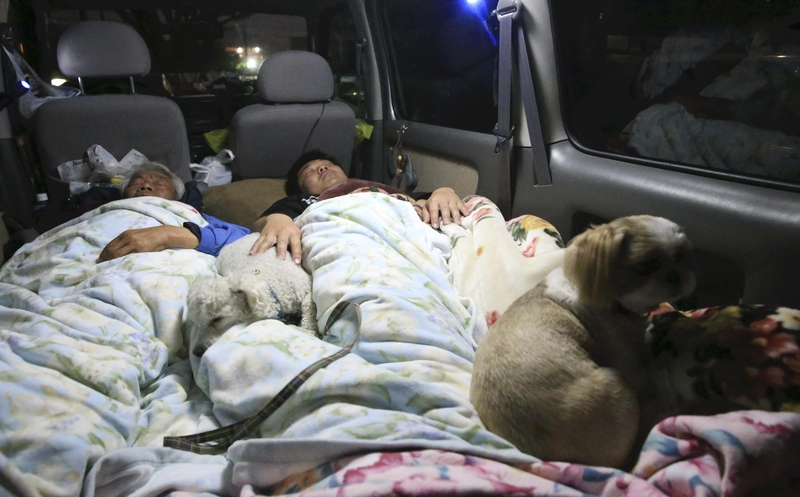
About 70% of major local governments are preparing for situations in which residents spend nights in their cars due to natural disasters, according to a Yomiuri Shimbun survey of 131 such governments. Thirty-four of those governments, including Saitama Prefecture, have taken new measures or strengthened existing measures since April last year, when the spread of the novel coronavirus became serious.
In the 2016 Kumamoto Earthquake disaster, many evacuees who spent nights in their cars for fear of aftershocks experienced discomfort caused by their prolonged car stays. One person died and 54 were hospitalized in Kumamoto Prefecture at that time because of the condition commonly known as economy-class syndrome, which causes people sitting in the same position for a long time to experience ill effects due to blood clots forming in their veins.
Among these victims, 43 had spent nights in their cars, but local governments did not identify such people and could not deliver relief supplies to them.
However, the survey revealed that nearly half of prefectural and major city governments think it is inevitable for their residents to spend nights in their cars to avoid infections at evacuation centers.
The Yomiuri Shimbun interviewed officials from 131 local governments, including the governments of all 47 prefectures, prefectural capitals and other major cities, in March and April, to ask about their preparedness for situations in which residents spend nights in their cars due to disasters. Among them, 92 local governments, including those of Tokyo, Osaka Prefecture and the cities of Sapporo and Fukuoka, have taken measures to prepare for such situations.
As for specific measures, 33 prefectures and cities, including Kumamoto City, answered that they would try to identify evacuees who are staying in cars during disasters, while Tokyo and 15 other local governments said they had concluded agreements with commercial and other facilities to secure parking spaces.
Many local governments said they stockpiled compression stockings to help prevent economy-class syndrome, and that they would have public health nurses visit evacuees staying in cars in the event of disasters.
Of 131 local governments, 28 prefectures and cities including Fukushima Prefecture and Nara City said measures are "under consideration," and 11 prefectures and cities, including Kagoshima Prefecture and Kyoto City, said they have not taken any measures, citing reasons such as "It is difficult to identify evacuees [staying in cars]."
While 62 local governments, or nearly 50% of the total, answered that evacuation in cars should be an option amid the pandemic, only six, including Gunma Prefecture, said they actively promote such a mode of evacuation.
Read more from The Japan News at https://japannews.yomiuri.co.jp/