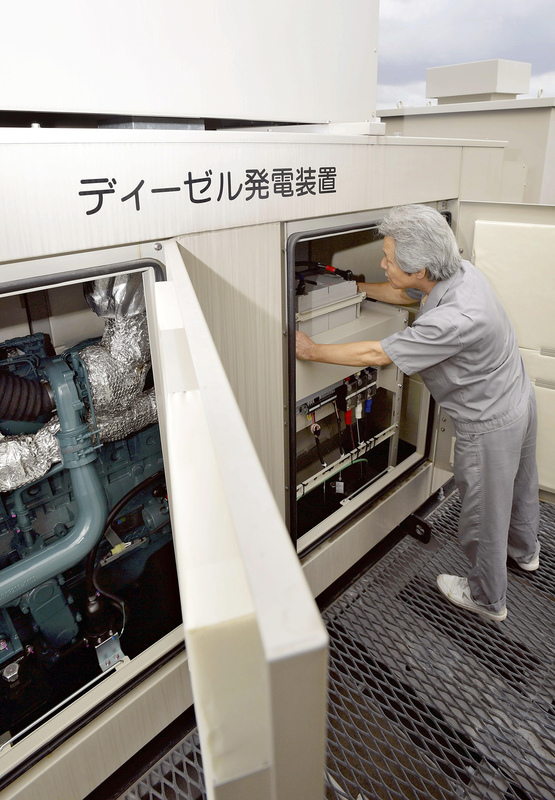
Nearly 40 percent of municipal governments in Tokyo, as well as 60 percent of municipalities across the nation, are not prepared enough to deal with insufficient power supplies, according to surveys.
Research conducted by the Tokyo metropolitan government revealed that about 40 percent of its municipal government offices and other buildings had failed to fulfill the central government's guideline of securing at least a 72-hour-long supply of electrical power, despite the possibility of a major earthquake directly hitting Tokyo.
In another review by the Fire and Disaster Management Agency (FDMA) of the Internal Affairs and Communications Ministry, more than 60 percent of municipalities across the nation were found to be in a similar situation as of June 2017.
Referring to the recent blackout in Hokkaido due to a strong earthquake, an FDMA official asked municipal governments to "recognize that securing electric power would become one of the most important tasks in case of emergencies."
The Cabinet Office tells local governments that it is "desirable to take measures to generate secondary supplies of electrical power without support from other areas for the first 72 hours" in its guideline on business continuity plans.
The FDMA is also asking local governments to install power generators, as well as stockpile fuel, citing the first 72 hours as "a critical timeframe" for saving lives and rescue operations.
According to a survey by the Tokyo metropolitan government on all the municipalities in Tokyo -- 62 ward, city, town and village governments -- in February this year, the Koganei city government did not have any power generators for emergency use in its office building, where a disaster management headquarters would be set up. A total of 24 municipalities, besides Koganei, were only capable of providing power for less than 72 hours. Of the 24, 12 were only able to generate power for less than 24 hours.
An official of Koganei city explained it was planning to install the generator five years from now when it will move from its 50-year-old office building, which is currently "too old" and built on a land plot that is "too small." An official of Chuo Ward, which is capable of providing power for about 24 hours, said there is not enough space to set up a large fuel tank.
On the other hand, some offices are proactive.
Taito Ward, which has secured fuel for electricity for the first 72 hours in the basement of its office building and other places, said it is planning to set up a new power generator on its roof to prepare for large-scale flooding.
In the FDMA survey as of June last year, 162 -- or about 10 percent -- of the 1,741 municipalities nationwide lacked electrical power generators.
Among the 1,579 municipalities that said they had them, 581 -- or 37 percent -- admitted they would only work to support power for less than 24 hours.
Only 598 municipalities -- or 38 percent -- said they were capable of operating for 72 hours or more.
An FDMA official pointed out that it is desirable for offices to conduct disaster management activities for nearly a week. "We want [the municipalities] to secure conditions for the generators to operate for at least 72 hours and to get this done as soon as possible."
Read more from The Japan News at https://japannews.yomiuri.co.jp/