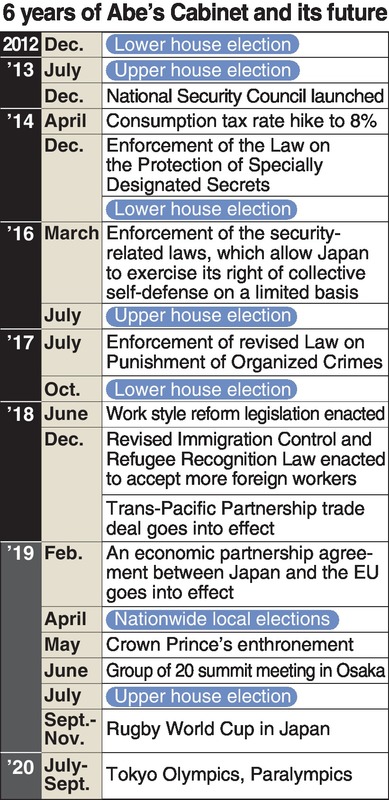
Six years have passed since Prime Minister Shinzo Abe's second Cabinet was inaugurated in December 2012. Since making a comeback in that year, he has overseen three consecutive wins in House of Representatives elections, achieving a total of five consecutive national election wins (including House of Councillors elections) as the president of the Liberal Democratic Party, and maintaining a strong sense of unity.
There are no signs of Abe slowing down as he continues to face issues from both within the nation and abroad.
Economy top focus
"After reflecting on my first Cabinet, I was able to implement a strong, positive feedback loop for the economy and create an environment early on with no deflation."
On Dec. 26, 2018, Abe reflected on the past six years at a Japan Business Federation meeting in Tokyo, underlining the positive results of his Abenomics economic strategy.
Abe has been consistently placing the economy as a top priority, and Abenomics has resulted in improvements to corporate performance and the employment environment. These improvements have kept the economy growing for 58 months -- the second longest period of growth for the economy in postwar history, surpassing the famous Izanagi Boom (1965-70). This growth has brought stability to the daily lives of many citizens, contributing to solid approval ratings that the Cabinet has benefited from.
Elections and personnel
Those around Abe say he has been propelled to a dominant position of power by his unprecedented strength in elections. While the administration was accused of abusing its power with the issues of school operator Moritomo Gakuen and the Kake Educational Institution in 2017, the administration managed to restore its power in a landslide House of Representatives election victory.
These consecutive national election victories can be attributed to not only a failure on the part of the opposition to properly organize, but also largely to cleverly managing personnel, according to an LDP executive. The main pillars supporting Abe's dominance are Deputy Prime Minister and Finance Minister Taro Aso and Chief Cabinet Secretary Yoshihide Suga, who have not been replaced once in these six years.
The Cabinet Bureau of Personnel Affairs, established in 2014, has also played a role in keeping control over the ministerial organizations in Tokyo. The bureau consolidates control of executive positions at the ministries, which has allowed further control by the Prime Minister's Office.
Causes for concern
On the other hand, debates over constitutional amendments remain at a standstill. At a previous extraordinary session of the Diet, the party was forced to abandon its plans to present its draft of constitutional amendments. This presents a large obstacle to Abe's desire of enforcement of a new constitution in 2020.
There are also concerns surrounding the planned consumption tax rate increase to 10 percent, which had been delayed until October 2019. Voices within the party have expressed fears that the tax increase could impede the economy's growth. Abe intends to take 2.3 trillion yen-scaled countermeasures against the consumption tax hike to leave no stone unturned. Yet fluctuations are beginning to be seen in the global economy.
Fate lies in talks with Russia
Since his return to power in 2012, Abe has taken a proactive approach to foreign affairs, visiting a total of over 150 countries and regions. In restructuring the Japan-U.S. alliance, Abe has taken measures such as establishing security related laws in 2015, which allow Japan to exercise its right of collective self-defense on a limited basis. He has scored achievements on issues that divide public opinion.
In the Asian region, Abe's visit to China in October was the first official visit by a Japanese prime minister in seven years. Abe holds firm with regards to relations with South Korea, which are beset by friction over wartime requisitioned workers and other issues.
His biggest worry in regards to foreign relations lies with the Japan-Russia peace treaty negotiations, which include the northern territories issue. The government is hoping for a general agreement on the issue by this summer, before the upper house elections, as it is believed "the outcome of negotiations can make or break the administration," according to one government official.
Close attention should be paid to future moves by U.S. President Donald Trump, with whom Abe has built a sound relationship. If relations between the United States and China were to deteriorate, negative side effects on Japan would be inevitable. Abe will likely face pressure when negotiations start this month on the Trade Agreement on Goods (TAG), which is expected to place tough demands on Japan.
Read more from The Japan News at https://japannews.yomiuri.co.jp/