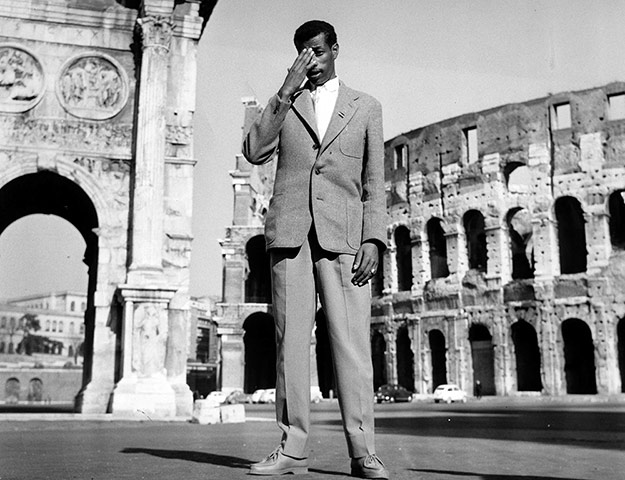
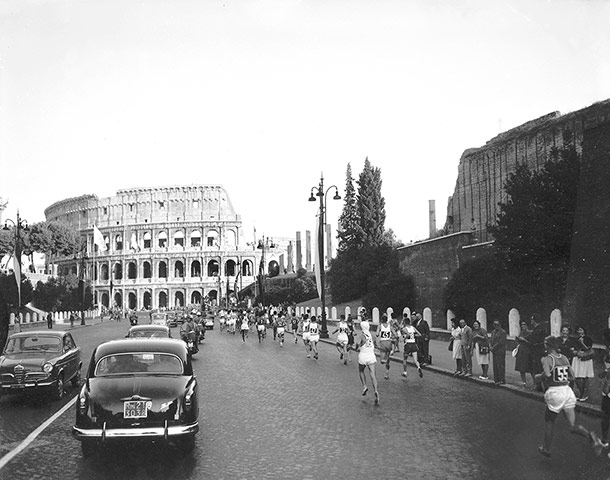
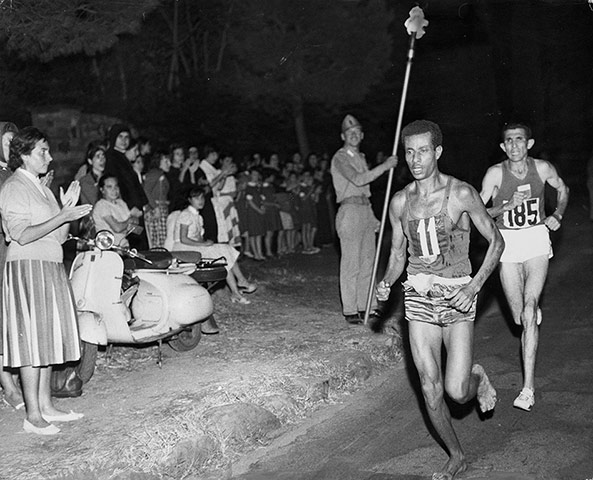
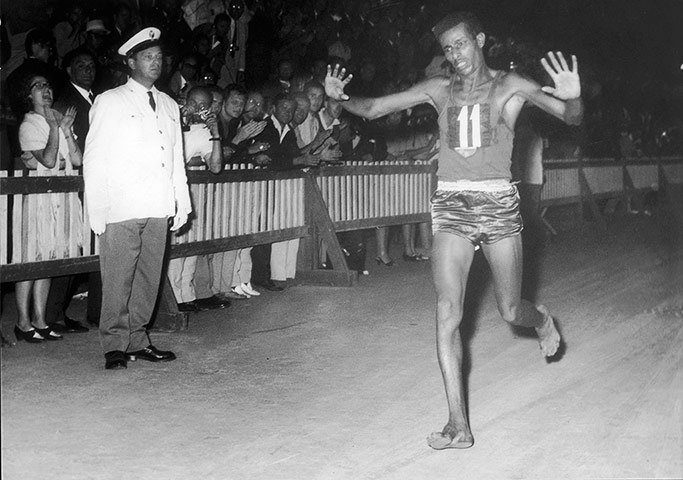
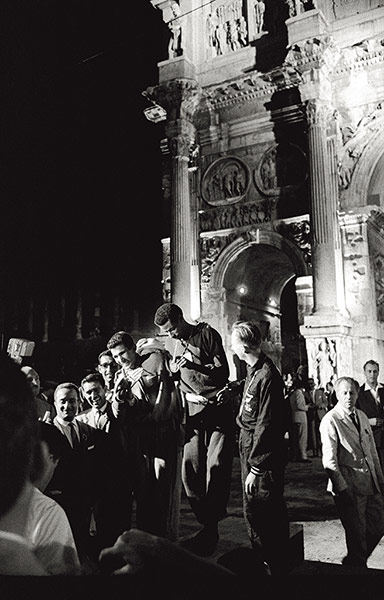
Abebe Bikila was born on 7 August, 1932 in the village of Jato, 9km outside the town of Mendida, in Ethiopia. Bikila decided to join the Imperial Bodyguard to support his family and walked to Addis Ababa where he started as a private. Onni Niskanen, a Finnish-born Swede, was hired by the Ethiopian government to train potential athletes and he soon spotted the young man's talent. However, Bikila was only added to the Ethiopian Olympic team at the last moment, just as the plane to Rome was about to leave. He was a replacement for Wami Biratu, who had broken his ankle in a football match. Niskanen entered Bikila and Abebe Wakgira in the marathon.Photograph: KeystoneUSA-ZUMA /Rex FeaturesThe late-afternoon marathon had its start and finish line at the Arch of Constantine, just outside the Colosseum.Photograph: Gamma-Keystone via Getty ImagesAdidas, the shoe sponsor at the 1960 Olympics, had few left when Bikila went to try some on and the athlete ended up with a pair that didn’t fit comfortably, so a couple of hours before the race, he decided to run barefoot, the way he'd trained. By the 20km mark Bikila and his main rival Rhadi Ben Abdesselam had drawn clear of the pack and stayed together until the final 500m ...Photograph: Central Press/Getty Images
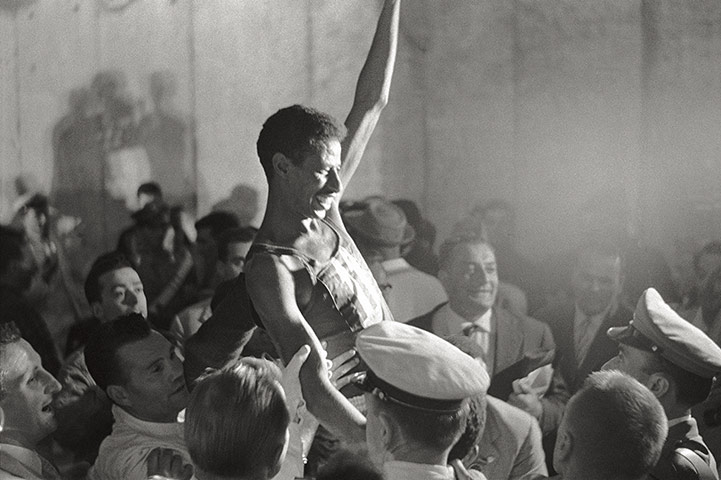
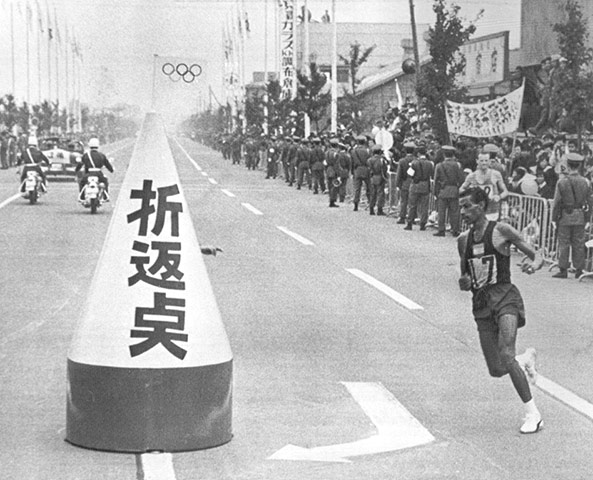
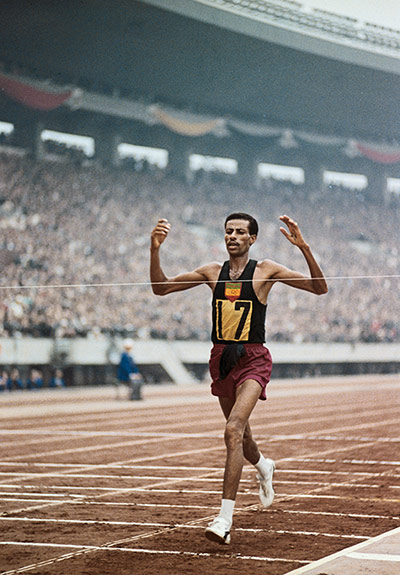
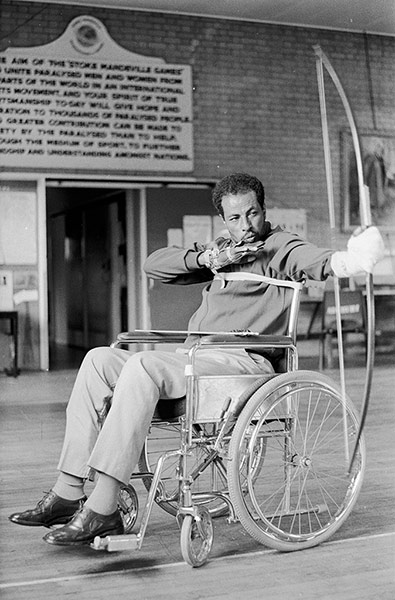
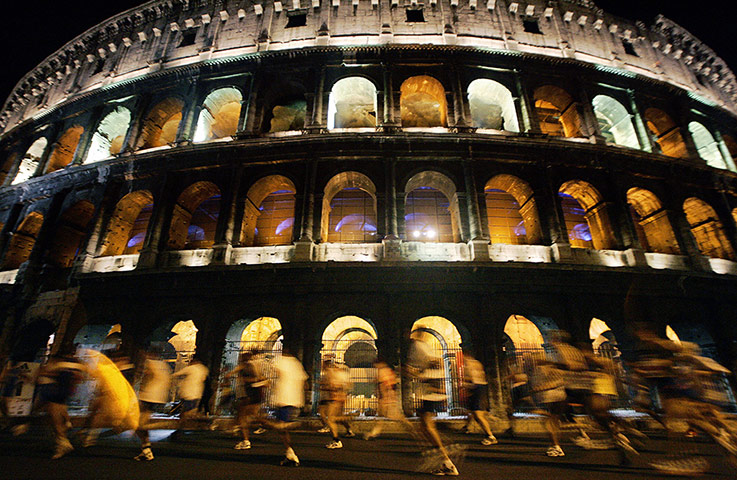
Which is when Bikila started to pull away – he won the race in a record time of 2hours, 15minutes and 16seconds. He was the first Sub-Saharan African to win an Olympic gold medal. After the race, when Bikila was asked why he had run barefoot, he replied: “I wanted the world to know that my country, Ethiopia, has always won with determination and heroism."Photograph: Gamma-Keystone via Getty ImagesA jubilant Bikila is hoisted shoulder high by an exultant crowd.Photograph: Mondadori via Getty ImagesThe three winning athletes celebrate after receiving their medals under the Arch of Constantine. Bikila (centre) has gold, Rhadi Ben Abdesselam (left) silver and Barry Magee (right) bronze.Photograph: Mondadori/Mondadori via Getty ImagesIn 1964 Bikila traveled to Tokyo, he was not expected to compete but did choose to enter the marathon. He used the same strategy as he had in 1960: to stay with the leaders until the 20km mark, then slowly increase his pace. After 15km he had only the company of Ron Clarke from Australia and Jim Hogan from Ireland. Shortly before 20km only Hogan was still in contention and by 30km, Bikila was 40 seconds in front of Hogan and two minutes in front of Kokichi Tsuburaya of Japan, who was now in third place ...Photograph: APBut Bikila entered the Olympic stadium alone, to the cheers of 70,000 spectators. He finished the marathon in a new world record time of 2hours, 12 minutes and 11seconds – 4minutes, 8seconds in front of the silver medallist, Basil Heatley of Great Britain. Kokichi Tsuburaya was third. Bikila was the first athlete in history to win the Olympic marathon twice. After the finish he went on to astonish the crowd. Not appearing tired, he began a routine of stretching exercises. He later said that he could have run another 10km. Photograph: Bettmann/CorbisIn 1969, during civil unrest in Addis Ababa, Bikila was driving his Volkswagen Beetle when he had to swerve to avoid a group of protesting students. He lost control of the car and it landed in a ditch, trapping him. He was freed eventually but the accident left him quadriplegic. He was operated on at the Stoke Mandeville hospital in England and his condition improved to paraplegic. Niskanen convinced him to take up archery and Bikila entered competitions for athletes in wheelchairs, including the International Paraplegic Games, for which he was practicing in this picture, at the Stoke Mandeville stadium.Photograph: Roger Jackson/Getty ImagesOn 25 October 1973, Abebe Bikila died in Addis Ababa at the age of 41 from a cerebral haemorrhage, a complication related to the car accident. He left behind his wife and four children but his funeral in Addis Ababa was attended by 75,000 people and Emperor Haile Selassie I proclaimed a national day of mourning for his country's national hero. After his death, his memory has been honoured. A stadium in Addis Ababa is named in his honour and numourous schools and awards bear his name. During 2005 in Rome, the city where the world first laid eyes on the talented Abebe Bikila, runners staged a night race in memory of him.Photograph: Andreas Solaro/AFP/Getty Images
Sign up to read this article
Read news from 100's of titles, curated specifically for you.