Wrapping up a strange and chalk-y 2026 Australian Open that featured peak tennis, but not exactly a drenching of drama … until the final weekend. And then exploded with theater. A reminder that you can DM me if you want weekly columns and tennis content delivered directly to your inbox.
Without further ado, here are 50 parting thoughts from the 2026 Australian Open:
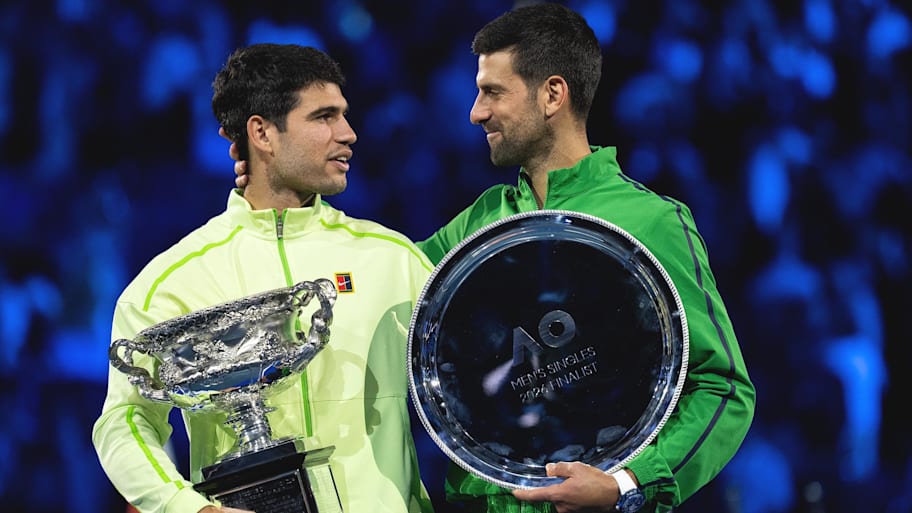
1. Carlos Alcaraz is your 2026 Australian Open men’s singles winner. Now the youngest man to win the career Grand Slam in the Open Era, he solidified his spot atop the rankings—just a dazzling tournament. We are watching greatness. We are watching a tennis maximalist play the sport at perhaps its most elevated level.
2. Elena Rybakina won—and we mean won—the women’s event. Down 0–3 in the third set of the women’s final against Aryna Sabalenka, she reeled off six of the last seven games to close the match like a champion. As a bonus, she is now a shoo-in for the Hall of Fame. More immediately: Can we agree that Rybakina’s serve is the biggest weapon in women’s tennis?
3. Novak Djokovic came within two sets of winning a 25th major. He finally started looking his age late in Sunday night’s final, but he reminded the world—and more importantly, perhaps, himself—why he is still playing. (This was his final major as a 38-year-old, as he turns 39 in May.) I was struck by this: So often, aging athletes throttle back in every way, divorcing themselves from the culture as well. Djokovic was ubiquitous here. When he wasn’t taking out the two-time defending champion to reach his first major final in 18 months, he was counseling young players and congratulating wheelchair players. Meeting fans, joking on social media, etc.
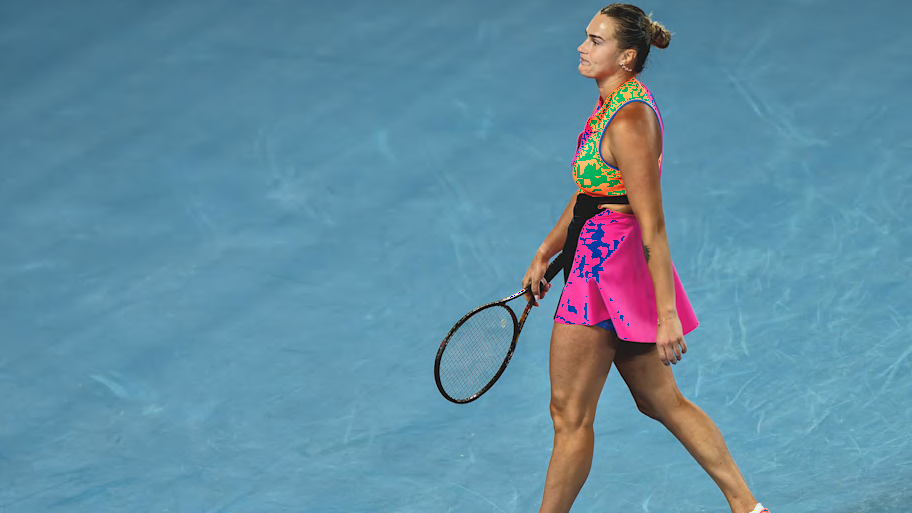
4. What to make of Sabalenka? She is a generational player and a champion of the highest order. For a player once known for her sinuous results, she is a reliable winner. In five of the past six majors, she’s reached the final. (In the sixth, she lost in the semifinals.) But for the third time in 12 months, she suffered a heartbreaking loss in a winnable final match. If history is a guide, she’ll win Roland Garros. But this marks another strong event for 12 days, ending with tears and a runner-up trophy.
5. “Mental scar tissue” is a voguish, sometimes lazy tennis term. But how else can one explain Alexander Zverev’s failure to serve out the fifth set of the semifinal instant classic against Alcaraz? He was four points from the biggest win of his career, and it was clear that memories of the 2020 U.S. Open came flooding back. We can break down the X’s and O’s of Zverev’s game—gorgeous class backhand, unreliable forehand, volleys that need shoring up, etc.—but it’s all so mental right now.
6. Jannik Sinner, the two-time defending champion, never quite summoned his best tennis in Melbourne. He survived a physical test against Eliot Spizzirri on a punishingly hot day. In Sinner’s night semifinal, Djokovic got the better of him mentally. That Sinner couldn’t cash 16 of 18 break points was especially surprising. This is a generational player; there’s hardly a crisis here, but he leaves with a sting.
7. It’s hard to find a more admirable player than semifinalist Elina Svitolina. She’s a mother and wife (to the popular and soon-to-be-retired Gaël Monfils), who bears the weight of her besieged and beleaguered country with strength and grace. And, oh yes, she’s playing some of the best tennis of her career, north of age 30.
8. In the men’s doubles, sixth seeds Christian Harrison and Neal Skupski beat Aussie wild cards Marc Polmans and Jason Kubler. A discussion for another time: There were plenty of sessions when there were more doubles matches going on than singles matches. At some point, tennis needs to figure out how to market these players and partnerships. We can argue over the prize money split and the draw sizes, but as long as these matches are essential for filling sessions, you may as well help fans learn about the players they’re watching.
9. In the women’s doubles, Elise Mertens (who also won Wimbledon) and Zhang Shuai last played a Grand Slam together at Wimbledon in 2022. They reunited in Melbourne and won the title, beating Aleksandra Krunić and Anna Danilina, 7–6, 6–4. In the third set, Mertens and Shuai were up 5–0, lost four games, and then closed.
10. The most dominating player in tennis? It’s not Sinner, Alcaraz or Sabalenka, and it’s not even close. It’s Tokito Oda. All your wheelchair results and accounts are here.
11. In the juniors, Žiga Šeško became the first Slovenian to win a junior boys’ singles Grand Slam title with a 4–6, 6–3, 6–4 victory over American Keaton Hance. Ksenia Efremova of France won the girls’ singles title, defeating Ekaterina Tupitsyna in the final, 6–3, 7–5.
While we’re here: note that two of the top recent U.S. juniors—Tyra Grant and Maya Joint—play for Italy and Australia, respectively. (Joint, 18, was seeded in the women’s singles main draw.) The ease with which players can change countries and find new support creates one of two scenarios. Either it’s folly to judge coaches and executives based on national success. Or federations like the USTA need to enter the market, recruit players from other countries and address this trade deficit!
12. The mixed doubles doubled, validating the souped-up U.S. Open format. Populated mostly with doubles specialists and played in front of sparse crowds—this sounds harsh, but the truth is the truth—Aussies John Peers and Olivia Gadecki beat the French team of Manuel Guinard and Kristina Mladenovic in a 10–8 super tiebreak.
13. The great subtext to this tournament was the increasingly likely prospect of Craig Tiley leaving Tennis Australia for the USTA (the reverse Maya Joint, as it were). I spoke a bit about it here. The question is not about Tiley’s track record, political skills or instinct for innovation. Each and all are beyond reproach. The question is whether the USTA and its governance model can accommodate a changemaker.
14. Last year, one of the tournament’s great revelations was Learner Tien, especially after he beat Daniil Medvedev. This year, one of the tournament’s great revelations was Learner Tien, especially after he beat Daniil Medvedev. You can see him learning in real time. That is, accumulating knowledge, experience and nuance. He doesn’t turn 21 until December. He’s angling into the top 20, with an A+ coach in Michael Chang. If he wanted to spend some time with Andy Roddick to add some wattage to his serve, I suspect that could be arranged.
15. Lorenzo Musetti was leading Djokovic 2–0 and then injured his groin and had to retire. And it’s a reminder of all the sport’s blessings and curses, its trapdoors and sources of hope. There’s no clock that can run out. There are no backups to sub for an injured teammate. You can be up two sets against an opponent—as Musetti has been twice—and fail to come good. At the same time, there are three more majors this year. At 23, Musetti could play 50 more majors. One day, luck will favor him. And we must add: Wow, is his game easy on the occhi.
16. Iva Jovic, an 18-year-old Californian, became the youngest American Australian Open quarterfinalist since Venus Williams in 1998. And, apart from winning four matches, the best part about Jovic’s run was that she didn’t seem remotely surprised by it. Want to feel old? She told the story of how she funneled her attention into tennis—choosing it over team sports in which she also excelled—during COVID-19.
17. The story many thought would be a story wasn’t. Alcaraz played his first major without his former coach, Juan Carlos Ferrero, and it went well for all concerned. Alcaraz did not crash out, obviating the facing of intense questions and second-guessing. Ferrero has apparently moved on, both from Alcaraz and, improbably, from tennis. Samuel López, Alcaraz’s new coach, acquitted himself well. And everyone focused on tennis, not on personnel.
18. It wasn’t just the absence of upsets. It was the absence of bangers, of gripping matches, especially in the early rounds. Until the men’s semifinals, there was nothing resembling a classic—no white-knuckling cliffhanger. Greg Sharko will make another appearance later, but his first gem: Before Alcaraz-Zverev and Djokovic-Sinner, the previous five-setter to be played in Rod Laver Arena was Medvedev against Kasidit Samrej, now ranked No. 404, in Round 1 of the 2025 tournament.
19. I wasn’t able to confirm this independently, but I’ve heard it so often it’s hardened into fact: Roughly one in three fans who attend the Australian Open don’t watch a single point of tennis. They hang out. They drink beer. They drink the devil swill that is an Aperol Spritz. They hear the music and ride the rides. And if they never make it to see Yulia Putintseva, Rinky Hijikata, or whomever, so be it. There’s an old term in Hollywood: a “four-quadrant movie.” It describes a film that appeals to every demographic—men and women, young and old. That’s the Australian Open in its current incarnation. This is where tennis is going, and it’s probably healthy on balance. Build a tennis festival. Create it with designs of having a good time. If fans catch the fever and become more devoted to the sport, we all win.
20. It’s absolutely jarring to attend a sporting event in 2026 that does not have a betting partner, features no betting signage, and has no inundation of betting spots during commercial breaks in a country where in-play live odds are forbidden. To be clear: Australia does have sports gambling. But, as with kids and social media, this country and this event consider it a public health issue that needs to be confronted and regulated.
21. We bring this up at every major, it seems. Injuries are an inevitable byproduct of sports. By definition, physical activities demand physicality. But when do the suits confront reality, use data and start addressing the rash of injuries? What do João Fonseca, Jack Draper, Holger Rune and Arthur Fils have in common? For one, outside of Sinner and Alcaraz, they are perhaps the sport’s four most luminescent stars under age 25. And also: they won a combined zero sets here—three didn’t even post—because of injury. (Add 2024 Australian Open finalist Qinwen Zheng to the list, by the way.) This is not normal. Or acceptable. Or statistically probable. This is not the way to grow a sport. Is it the punishing, nay, sadistic, schedule? Is it string technology? Is it the best-of-five sets? When do the adults in a room undertake a meaningful investigation of why and how so many (young) players are being sidelined? And what can be done to improve working conditions and minimize injuries?
22. Coco Gauff, undeniably, backslid in this tournament, reaching the quarterfinals before losing comprehensively to Svitolina. And “losing” does not paint the full picture here. She had three winners against 26 unforced errors, hit passive targets and was in visible discomfort. Yet, the heat she received was wildly out of proportion. Waking up to bile, I made the mistake of responding to a troll and wrote this:
For the life of me, I cannot understand gratuitous trolling, but this player in particular …
A) Taking bad losses is part of tennis’s required curriculum.
B) She achieved a Hall of Fame résumé before she got a driver’s license.
C) The next person who encounters her and has a negative impression will be the first.
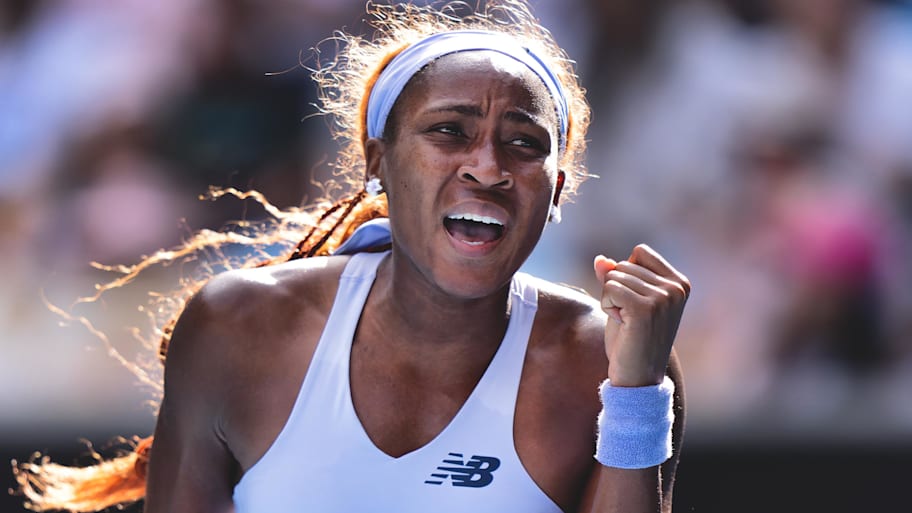
23. Gauff was, rightly, upset about the Severance-like surveillance situation and ubiquitous cameras at the Australian Open. And she was not alone. A player complained to me that he was chatting with his team in the warmup room and made a regrettable gesture. He picks up his phone a few minutes later, and it’s rocketing around social media as a meme. We are inclined to advocate for more access and content, not less. But the players’ point is well-taken. There must be some sacred spaces. And the WTA agrees.
24. Has there been a stranger tennis career than that of Naomi Osaka? She has won seven titles, four of which were majors (plus Indian Wells). She won those four majors in her early 20s. After entering her chronological prime, she had a child and hasn’t won a tour-level event since claiming the Australian Open title in 2021. She is, by her own admission, shy and skeptical of attention, and then takes to the court wearing this. Here, she won two rounds, looking formidable at times. Then, facing a qualifier in the third round, she pulled out, citing an abdominal injury she linked to body changes from her pregnancy.
25. Before the tournament, players received this guide to permissible apparel and patches. There was no mention of sponsored temporary tattoos or wearable technology. In the middle weekend, during his fourth-round match, Alcaraz was asked to remove his Whoop. This is strange as A) The ITF permits wearables, as do the tours. B) As long as coaches are courtside, they are able to communicate with players (and convey data) in real time. C) The tournament statement about the rationale behind the ban was word salad that, as a Whoop would indicate, was devoid of any nutritional value.
26. Plenty has been made of the One Point Slam, the pre-tournament smash, shotgun tennis that shrunk the sample size and gave everyone a chance. (The winner, of course, was Jordan Smith, an amateur.) Can the U.S. Open stage a version of this and the mixed doubles event? In any case, your serve, Roland Garros. So long as the majors are three weeks now, you need more than a qualifying draw.
27. There is probably a larger societal/life lesson here. But it’s remarkable how quickly tennis either adapts or normalizes. A few years ago, the salon (I plead guilty here) lamented the robots and the phasing out of officials. Automatic line-calling scarcely drew mention at this event. A few years ago, the salon (I plead guilty here) lamented Saudi Arabia and its lousy record on human rights and women’s rights, getting a WTA event. Now we talk of Riyadh results without pausing. A few years ago, the salon (I plead guilty here) lamented in-match coaching. In Melbourne, coaches were featured courtside, which drew little commentary and seemed to have minimal material impact on the match. Whether it’s best-of-five matches, the service let or adding a tenth Masters, it’s easy to get precious. But change goes down easier than we think.
28. This is not meant as a political statement; it is strictly an observation. As I picked up my media credential the weekend before play, I was asked for my choice of lanyard. Come again? It was explained that I could choose between a lanyard “honoring Aboriginal design” or one adorned with an LGBTQIA+ rainbow. Again, this is meant observationally. But I was imagining this exercise at, say, a Dallas Cowboys game, a New York Yankees game or Wimbledon. I was recalling the U.S. Open’s clumsy (at best) response to President Trump’s last-minute visit last year. Different sporting events take very different approaches to social and political issues.
29. College tennis made its mark again. Mighty Greg Sharko was the first to inform: “There are 25 players in the men’s main draw who have played college tennis, [the] most since 25 at the AO in 1989.” Michael Zheng, the two-time defending NCAA champion, qualified, beat Sebastian Korda, and then went back to school. Ben Shelton made a run to the quarterfinals before falling to Sinner. College players dominated the doubles. And the tournament was run by a former college coach. You wish the athletic directors considering cutting tennis programs would grasp the impact of the college game at the professional level.
Adjacency 1: The effort award goes to Columbia coach Howard Endelman, who flew to Melbourne to watch Zheng, arriving at 8:00 a.m local time. The second-round match against Corentin Moutet didn’t go as planned. Edelman was back at the airport for a midnight flight to fly 10,000 miles the other way and be there for Columbia’s next match against Illinois.
Adjacency 2: What do Jovic, Monfils, Brandon Nakashima, Amanda Anisimova (et al.) have in common? Each has/had a sibling in the college game.
30. The economics of college sports is the wild west. This is not a new analogy. We all—most of us anyway—believe athletes should be paid, markets should be free and amateurism is a farce. But, wow, can things get sideways in this new ecosystem, especially when NIL deals fail to materialize. With the caveat that this is a complaint, i.e., only one side of the story, allegations and not necessarily facts, herewith a tale of promises unfilled with … Dick Vitale catching strays?
31. Is there a more mystifying story in tennis (sports?) than the Professional Tennis Players Association and its federal lawsuit? No one operating in good faith can claim that the players are fairly compensated as a function of tournament revenue, that the tour model works for them, or that, especially in this age of athlete empowerment, their voices are sufficiently audible. Apart from the miserly revenue split, any of 100 specific examples (the Whoop controversy; the surveillance cameras controversy; the comical schedule; that Saudi Arabia, of all places, had to fund a maternity leave program; the prohibition on the same gambling sponsorship the tour itself enjoys) suggest players get a raw deal and need collective representation.
But then the PTPA drops this bombshell lawsuit without the support of the top players (most of whom expressly join another group to try and claw some more revenue at majors). Djokovic, the group’s founder, renounced his interest. Yet this lawsuit is before a capable, well-regarded Manhattan judge, appears to have Tiley’s support and has not yet been dismissed for lack of standing. The Republic of Tennis gets worked up about the prevalence of Panasonic cameras, heat rules and cramp policies, as this secular threat/opportunity looms. And no one—not least the top players—seems quite sure if it’s real or a bluff.
32. Shelton once said he signed with On because he “didn’t want to be one of 50 Nike guys.” Except, like other major brands, Nike has cut back on tennis, heavily investing in only a few stars and writing increasingly restrictive, bonus-dependent contracts for a select few. But this has opened the door for many other brands to enter the tennis market. That could be Shelton’s On, or New Balance, or Lululemon, or a start-up in which players take equity. If you’re into tennis apparel and who-wears-what, we happily refer you to this excellent substack.
33. What do these Americans have in common: Frances Tiafoe (Mark Kovacs), Nishesh Basavareddy (Gilles Cervara), Alex Michelsen (Kris Vliegen), Reilly Opelka (Craig Boynton), Sloane Stephens (Kamau Murray), Peyton Stearns (astonishingly, Rafael Font de Mora) and Hailey Baptiste (Eric Hechtman). Each made some sort of recent coaching change. Meanwhile, Tommy Paul and Brad Stine recently marked seven years together. I asked Stine about their longevity, and he shared an interesting theory: Time apart helps the relationship. Stine is based in Fresno, and Paul is in Florida. At the Australian Open, they stayed in separate neighborhoods. Insecurity can be a coin of the realm in tennis. Here’s proof you can have a healthy player-coach relationship and not eat every meal together.
34. After winning in Shanghai and authoring one of the great tennis stories of 2025, Valentin Vacherot was ranked sufficiently high to be seeded (30) in his first Australian Open. Happily, he played to seeding, winning a pair of matches, losing to fellow college player Shelton and offering yet another data point that last autumn was more of a breakout than a fluke. (Plus, he hit one of the sicker shots of the event.)
Even more insane in slo-mo 😮
— #AusOpen (@AustralianOpen) January 24, 2026
Valentin Vacherot • #AO26 pic.twitter.com/va3vyDAmqZ
35. Five players who failed to get out of Round 1 but impressed nonetheless: former UVA player Rafael Jódar, qualifier Arthur Géa (who beat Jiří Lehečka and perhaps should have beaten Stan Wawrinka), Indiana’s (and Stanford’s) Nishesh Basavareddy, Antonia Ružić (who was up a third-set break on Osaka, nearly pulling out the win), and all hail Spizzirri (Texas), who likely would have beaten Sinner, but for the heat rule.
36. He’s unlikely to win majors, but Moutet is fun to watch. I wish I could remember who said this. Jim Courier, maybe? But Moutet’s musical ability (piano) expresses itself in his touch, feel and creativity on the court.
37. Lacking in chemistry, as they are, Wally Masur and Andrey Rublev will not be having a second date.
38. Four years ago, Russia attacked Ukraine and should be condemned full-throatedly. Ukraine is the victim here and should be supported unconditionally. Ukrainian Oleksandra Oliynykova lost gamely to defending champion Madison Keys and then broke all taboos, speaking openly about politics and targeting Sabalenka in particular.
But at what point do we stop the (well-intentioned but perhaps now performative) gesture of blocking Russian and Belarusian flags? A) As global politics become ever more complicated, so too does the slippery slope. Certainly, there are other countries that also commit indefensible acts of aggression and disrespect sovereignty. B) Asking individuals—in this case, sometimes teenagers, nonresidents and dual citizens—to account for the actions of their government is wrong-headed. C) Four years in, surely tennis can devise more meaningful ways to voice objection to Russian aggression. Condemning players for playing in the Gazprom-sponsored event, for starters. But enough with the flag blackout.
39. This is inside baseball (tennis), but a story to follow—strange times for the Carson, Calif., facility. While the USTA owns the Lake Nona facility in Florida, the Southern California facility is owned by AEG and leased. Yet, as more players have a SoCal base (Taylor Fritz, Tien, Michelsen, Marcos Giron, Jovic, etc.) Carson—often dismissed by the USTA as a white elephant—is gaining popularity. It is also the tennis venue for the 2028 L.A. Olympics. (Aside: We will, no doubt futilely, lobby again for the Olympic tennis to be held at night at Indian Wells.) It would be interesting to see whether (and how) the USTA continues to fund this satellite facility.
40. Remember the “Polish paving executive” who, at the U.S. Open, snatched the ballcap of Kamil Majchrzak, depriving a kid of a souvenir? (“Hat Snatch Fever,” as Sports Illustrated put it.) I watched a similar episode unfold after a Karen Khachanov match. Here’s a new rule: If you are more than half the age of the player in question, you must disqualify yourself from reaching for a sweaty souvenir.
42. There were, of course, a lot of complaints from American audiences about ESPN’s coverage, and the premium tiers in particular. I reached out to the network for explanation/comment and—to their great credit—I received a series of statements. This is one from John Lasker, senior vice president of ESPN+:
- As part of ESPN’s broader distribution strategy, we’re continuing to align our premium live programming with the platforms that drive the greatest reach, engagement and revenue: our linear networks and the ESPN Unlimited plan. This decision reflects how live sports viewing continues to evolve and allows us to deliver broader, more complete coverage of the Australian Open across platforms. The ESPN Unlimited plan represents ESPN’s most comprehensive and valuable offering to tennis fans by offering coverage of all matches from all courts.
- We understand that change can generate questions and require more fan education. Access to the feeds on ESPN Unlimited in addition to the linear television feeds allows the most passionate fans to the most comprehensive coverage. We take fan feedback seriously, and our goal remains to serve a wide range of fans—those who want marquee matches and those who want wall-to-wall tennis. ESPN Unlimited allows us to offer expanded access while continuing to deliver high-profile coverage on our linear networks.
One of the first rules of negotiation: Make sure you are confronting the right person. You might hate the broadcast windows, the bait-and-switch avarice of the tiering, the streaming quality or the coverage decisions. But the on-air commentators don’t make those calls. Don’t direct your frustration or outrage at them. As for ESPN’s coverage, I watch none of it here, but I can recall few broadcasters getting higher grades from you all than Chris Eubanks. Amen to that. Yes, he knows the players (as he himself played until recently), but he also does his homework and research rather than relying solely on experience and preconceived notions.
43. For the first time since the weeks before COVID-19, Tennis Channel was, happily, back on-site at the Australian Open. Thanks as always for the observations and comments. Fashion police. Grammar police. I say this as someone who works for a big network in my day job: You might think of Tennis Channel as the Learner Tien of networks—modest in brute force and size; big on hustle, scrappy efficiency and talent maximization. Please know all comments are read and considered.
44. Not sure how much of this is witnessed outside Australia, but in a matter of minutes, night after night, Jim Courier went from peerless analyst to peerless on-court interviewer.
45. Your periodic reminder that exchange rates matter. Australia is a lovely country with so much to offer. A strong dollar is not at the top of that list (the Pacific Peso, they call it here). One Australian dollar is approximately $0.70 and €0.59. The free Uggs, travel voucher and $300 per diem players are provided by the tournament? Those are nice touches. But they are the equivalent of a cool office coffee machine, while wages stagnate. Hedge that currency, players!
46. Broadcast pet peeve: stats that mislead viewers. “We’ve already had X five-setters, and we’re only in the third round!” A major singles draw features 127 matches. After three rounds, 112 of those matches have been completed. Another one: “He’s 12–2 against lefties.” It would be nice to norm for quality, i.e., is he beating Tien and Shelton? Or Lenny, the southpaw reciprocal wild card?
47. Nick Kyrgios is, perhaps, too big a presence to ignore entirely. But at this point—to his benefit as much as anyone’s—the less said, the better. He admirably conceded that he wasn’t ready for best-of-five singles, so someone else got “his” wild card. He (and star-crossed good guy countryman Thanasi Kokkinakis) lost in the first round of doubles. Kyrgios is now in his 30s. His ranking has plumped into the triple figures. We all know how deeply polarizing a figure he cuts. But I’d submit that, more than loved or hated, this is a figure to be pitied. What a curse—and this applies beyond tennis—to be blessed with extraordinary talent, but not the inclination/motivation to honor it.
48. Heated Rivalry takes place, of course, in the world of hockey, but has triggered more conversations about openly gay male tennis players and the absence thereof. Note Edward Schmit’s debut novel, The Open Era, which comes out in June. He writes us, “It follows the first openly gay male tennis player to compete in a Grand Slam who must battle his mental health, media attention, and a handsome new rival during an electric two weeks at the U.S. Open.”
49. A number of you asked about the (leading) press conference questions put to American players about their thoughts on playing for their country during Trump 2.0 and in the wake of ICE. Would I have asked those questions, especially in an ambush-style press conference setting? No. Are reporters within their rights to ask it? Yes. Are the players within their rights to decline comment? Yes. That’s free speech in action.
50. Non-tennis good soldiering … Surviving Ohio State won a duPont Award last week. You can watch it here.
THANKS FOR PLAYING ALONG. IT’S ALWAYS FUN IMMERSING IN TENNIS WITH YOU ALL. BACK TO THE DAY JOB, BUT WE’LL REV THIS UP AGAIN IN PARIS!
More Tennis on Sports Illustrated
- Carlos Alcaraz Completes Career Grand Slam With Australian Open Win
- Novak Djokovic Still Believes He Could Win Major No. 25 After Australian Open Loss
- Novak Djokovic Gives Carlos Alcaraz High Praise After Australian Open Final
- Novak Djokovic Seemingly Hints at Potential Retirement After Australian Open Loss
This article was originally published on www.si.com as 50 Parting Thoughts From the 2026 Australian Open.