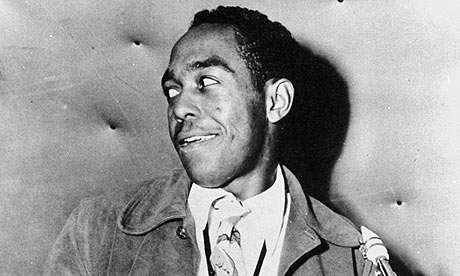
In this blog's last visit to the sublime and storm-tossed world of Charlie Parker we heard the saxophone genius in his dazzling prime by the age of 25. Parker had moved swiftly, from the revelations of his prototype style that first emerged with the Jay McShann swing band in 1942, through his first regular partnership with the trumpeter Dizzy Gillespie in pianist Earl Hines's band the following year, and on to the forward-looking, bop-oriented orchestra of singer Billy Eckstine in April 1944.
Parker ran the reed section in this powerful ensemble (check out Eckstine's bop technique, as well as Gene Ammons's rootsy tenor solo in a slightly later edition of the band) but he left in August 1944 to work with a variety of groups on New York's 52nd Street. Swing guitarist Tiny Grimes, a regular partner of piano phenomenon Art Tatum, liked Parker's new approach to jazz, and hired him for a series of recordings in autumn 1944. One of the tracks was the first Parker composition to make it on to disc – like many early bop themes, Parker's Red Cross took the standard I Got Rhythm as the basis for its chord structure.
In 1945, Parker recorded extensively with Gillespie and a young Miles Davis, before leading his own sessions for the Savoy label in November of that year. The young saxophonist was now beginning to compose prolifically – often on scraps of paper during warm-ups or on the way to gigs, but these casually concocted themes came to be regarded as some of the most memorable melodies in 20th-century music. Below we can hear Parker, with Davis on trumpet and Max Roach on drums, recorded on 26 November 1945. The track is Ko-Ko, Parker's intuitive remake of the Ray Noble tune, Cherokee.
Sadly, the New York bop scene that generated such dazzling music was about to go into decline. 52nd Street's drugs culture was attracting unwelcome attention from the authorities, as they tried to stop second world war veterans from hanging out there. Parker, Gillespie and other leading boppers found the going tough. They moved to the west coast, but Parker's heroin habit was harder to satisfy there, and his fragile psyche was destabilised by the move. Next time, I'll look at how Parker's move panned out musically, and how he ended up in a mental institution.