
On the morning of October 13, 2025, Moni woke up to another uncontrollable coughing fit. She reached for water, then more water, hoping the scratch in her throat would settle. It did not.
The 26-year-old had conceived in January 2025. Moni lives in Dakshinpuri, a dense, industrial and high-traffic neighbourhood in South Delhi where AQI levels were above 440 in the weeks before her pregnancy. What started as mild irritation and dry cough during the peak pollution months of December and January had turned incessant by her fifth month.
A few minutes after waking, she felt a sudden dampness between her thighs. Her water had broken. Her due date was still more than a month away. As Moni kept coughing and gasping for breath, the family rushed her to the hospital. The doctors had to deliver the baby preterm. The newborn struggled to breathe and spent over a week in the Neonatal Intensive Care Unit. The discharge summary noted “respiratory distress at birth”.
Newslaundry met Moni through Dr Ashutosh Kothari, Centre For Community Medicine at AIIMS Delhi, where researchers have been tracking several such cases to study the impact of air pollution on child birth. Dr Kothari told us, “Moni’s pregnancy is a clear case of preterm birth which could be linked to prolonged respiratory distress due to air pollution.”
Delhi’s air is impacting pregnancies, and the data shows it.
There are thousands of women like Moni in this city, and nobody in power is connecting the dots. We did. Five years of RTI data. A pattern that doesn’t lie. Doctors who’ve run out of other explanations. Read what those in power don’t want to acknowledge.
The number of preterm births in the capital have risen more than 51 percent over five years, from 21,134 in 2021 to 31,963 in 2025, according to an analysis of month-wise childbirth data obtained via RTI through the Directorate of Family Welfare.
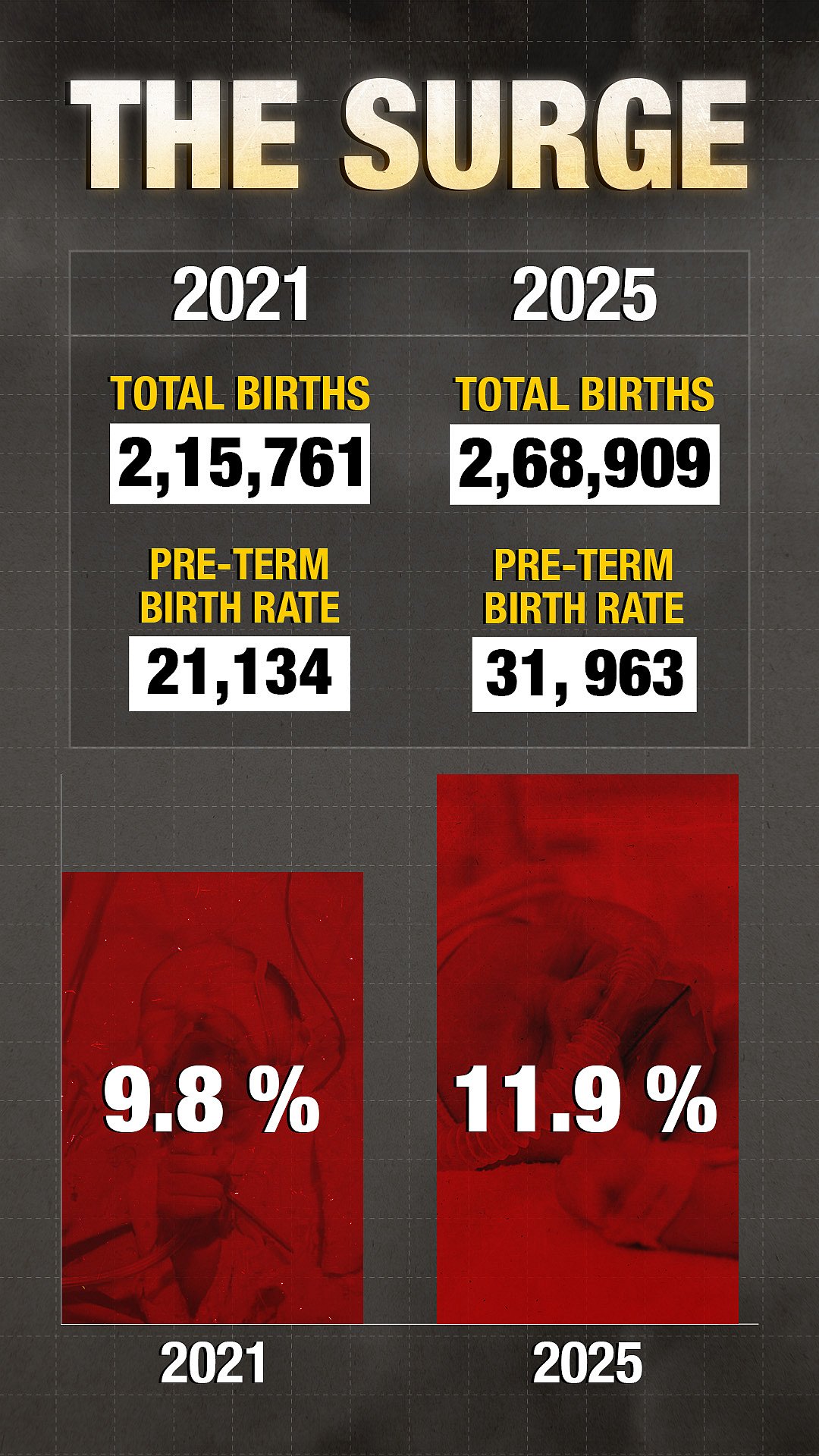
The premature birth rate as a share of all live births has risen too, from 9.8 percent in 2021 to 11.9 percent in 2025. This surge cannot be attributed merely to an overall increase in the number of live births or population growth. The premature birth rate itself rose by 21.4 percent over five years relative to where it started. Roughly one in eight babies was born premature in Delhi last year.
In fact, preterm births surge precisely among babies whose first trimesters coincide with Delhi’s most polluted months.
Preterm births peak every year in August or September without exception. September 2021 recorded 2,424 preterm births; August 2022 witnessed 3,341; August 2023 saw a brief dip to 2,998 before climbing again to 3,081 in August 2024 and 3,318 in August 2025.
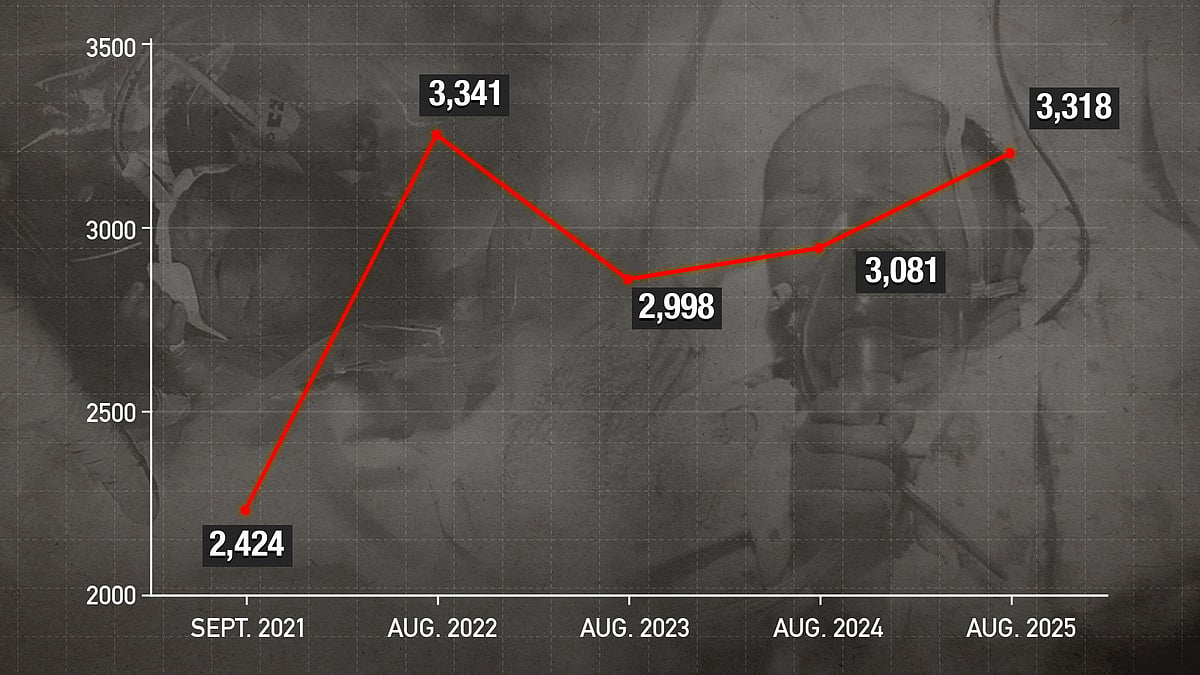
A baby born preterm in August or September would have spent its critical first trimester — the period of placental formation and early organ development — in November, December, and January. That is precisely when Delhi’s air is at its worst. During these months, PM 2.5 levels often cross 300 μg/m³. In fact, Delhi’s annual average PM 2.5 routinely crosses 100 μg/m³, which is about 2.5 times India’s annual standard of 40 μg/m³ and 20 times the WHO annual guideline of 5 μg/m³.
The pattern repeats across all five years without exception.
‘We are losing pregnancies with no explanation’
Dr Kothari, however, points out that even during periods when Delhi’s pollution is not at its peak, pollution levels remain far above the WHO-prescribed limits and the city’s overall air quality remains unsafe.
Though this is not just a Delhi problem.
Dr Ujjawala, a gynecologist currently practicing at the Rainbow Children's Hospitals and BirthRight by Rainbow, conducted a study in Varanasi wherein she examined 1,400 pregnancies across seven pollution zones between 2018 and 2020. The study found that air pollutants, especially sulphur dioxide, affected pregnancy outcomes including preterm birth and intrauterine growth restriction. It concluded that “the evidence is sufficient to infer a causal relationship”. Delhi's five-year trend strengthens that inference.
Another Delhi-based gynaecologist and obstetrician, Dr Jayasree Sundar, has seen this play out in her own practice.
“The impact of pollution on the baby’s growth is much more in the first two trimesters. I recently managed two cases of stillbirths, one at 32 weeks and another at 34 weeks. In both cases, there was no other possible explanation. Both women were completely healthy. Until the week before, their babies were growing well, and they suddenly called me saying that they perceive no movement. When we checked it as a routine, we found that the fetus was dead.”
“Both of the babies were conceived in the months of November-December – the pollution months. As doctors, we cannot find any reason other than air pollution impacting these deliveries. Two weeks before this, the babies were growing at the 17th-18th centile, the blood circulation was alright, there was no risk factor, and the mother didn’t have hypertension or diabetes. So, we are losing pregnancies with no other explanation.”
Dr Sundar says she is also seeing a rise in miscarriages and sudden heavy bleeding during pregnancy, which she attributes to increasing levels of fine particulate matter and sulphur dioxide in Delhi’s air. On the impact on the placenta, she added, “Since PM 2.5 are micro particles, they can cross blood vessels and affect the placenta. It leads to growth restriction in babies, which means the baby is smaller than expected.”
Newslaundry looked into several such cases in Delhi’s high-pollution neighbourhoods.
Poonam, 31, is a domestic worker from Dakshinpuri. Her husband works as a janitor. During the first trimester, between January and March 2026, she struggled with breathlessness and a choking sensation. Smog burned her eyes and gave her headaches and dizziness. She could not climb stairs.
Poonam has a history of heart disease, diagnosed during her first pregnancy a few years ago, say Dr Kothari and Poonam. Her first child was born clinically unresponsive and had to be resuscitated through CPR. The second child was born shortly after 28 weeks, a case of early preterm birth, and had to be admitted to the NICU. The doctors believe prolonged exposure to particulate matter, particularly PM 2.5 and PM10 pollution, may have contributed to complications in both pregnancies.
For low-income families, the crisis does not end at the delivery room.
The cost of surviving prematurity
Preterm babies often struggle to breathe because their lungs are not fully developed. Their livers, too, are immature, making conditions like jaundice — which affected Poonam’s baby — fairly common. Many are unable to swallow properly and have to be fed through intravenous tubes.
If not treated in time, premature birth can lead to a range of serious complications like bleeding in the brain, severe intestinal infections, damage to the back of the eye that can cause blindness, cerebral palsy, epilepsy, and in some cases, death.
Keeping a premature baby alive and stable is also enormously expensive. Neonatal intensive care units (NICUs), especially in private hospitals, can cost families lakhs of rupees within days. Government hospitals are often overcrowded, with too few NICU beds, forcing even low-income families into private facilities they can barely afford. The daily wage workers and poor families often lose wages, carry debt, and skip essentials to keep their children in NICU.
What pollution does to the fetus
Dr Archana Dhawan Bajaj, a Delhi-based gynaecologist and IVF specialist, describes a pattern she has often seen.
“I have seen cases where everything is going fine throughout the pregnancy – blood pressure normal, sugar normal, fetal markers looking good – and then comes that bad winter with very poor AQI. Around that time, I have occasionally seen patients where, despite all other markers being fine, there is growth restriction showing up in the second or third trimester. No explanation for it other than that it happened during the air pollution period.”
She explains how the particulate matter impacts pregnancies, “PM2.5 and PM 10 first affect the mother’s lungs. Then, they cross the placental barrier and reach the fetus directly. Once they enter the baby’s bloodstream, they occupy space — reducing the exchange of both oxygen and nutrients between mother and child.” Beyond that, these pollutants trigger inflammation and oxidative stress. The doctor concludes, “So the damage happens in four ways: inflammation, oxidative stress, reduced oxygen delivery, and as a consequence of that, reduced nutritional delivery.”
Dr Bajaj adds, “According to the existing evidence, air pollution in the first trimester can cause cardiac defects and neural tube defects. A neural tube defect is a structural defect of the brain or spine. We know that folic acid supplementation, taken before conception and through the first trimester, significantly reduces the risk of neural tube defects. But researchers have now found that air pollution interferes with this protection. The three main offenders — particulate matter, nitrogen dioxide, and sulphur dioxide — impair oxygenation, which in turn reduces the body’s absorption of folic acid. So a woman can be taking her folic acid diligently and still be at risk of a neural tube defect if she is breathing heavily polluted air.”
The consequences, she says, extend well beyond birth. “The inflammation, oxidative stress, and oxygen deprivation caused by pollution exposure do not stop at birth outcomes. In the longer term, they are associated with reduced IQ in children, behavioural problems, and a higher incidence of autism spectrum disorders. None of this is 100 percent conclusive, but it is suggestive. There is also an association with increased rates of stillbirth and miscarriage.”
Dr Bajaj, however, is careful to distinguish the cause from correlation. “Air pollution cannot be identified as the sole cause of stillbirth or premature deliveries. We can only arrive at it by exclusion. There are multiple contributors. Air pollution may be the significant one, but not the only one. Because for something to be conclusive, you would need to establish that a specific pollutant, at a measurable quantity, produced a specific outcome. That level of evidence does not exist yet. We need more studies on this.”
The world’s highest preterm birth burden, but very little research
India carries the world’s largest preterm birth burden. According to the most recent (year 2020) comprehensive data published by The Lancet in 2023, India accounted for more than 23 percent of all preterm births worldwide in the year 2020.
Some countries are doing better.
In 2010, India had the largest share of global preterm births in the world with China being second in the list. A decade later, India still remained the country with the world's largest preterm birth burden. China, however, slipped to fourth by 2020, behind Pakistan and Nigeria.
Over the years, China has built a substantial body of research on the reasons behind this crisis. Chinese researchers have conducted large-scale, multi-city research on the impact of air pollution on childbirths with proper controls and consistent findings across regions. India has no comparable study.
A 2025 systematic review integrating evidence from Chinese epidemiological and retrospective studies between 2011 and 2023 identified robust associations between pollution exposure and risks of miscarriage, preterm birth, low birth weight, and birth defects.
The evidence from individual city and province-level studies was equally striking. In Guangdong province, the risk of preterm birth increased for every 10 μg/m3 rise in PM2.5 and PM10 specifically during the first trimester — the same critical window that Delhi’s seasonal data points to. The particulate matter, along with SO2 and ozone in both the first and last months of pregnancy, raised the risk of low birth weight.
Across Shiyan and Jingzhou in Hubei province, a study of 16,035 cases found significant associations between PM2.5, PM10, SO2, and NO2 exposure and preterm birth risk. In Jingzhou, the association with NO2 was striking – every 10 μg/m3 rise in exposure increased preterm birth risk by 21.1 percent. In Xuzhou, a heavy industrial city, a time-series analysis reinforced these findings. All these air pollutants significantly raised preterm birth risk, with weeks 12 to 29 – the second and third trimesters – identified as the period of greatest vulnerability.
Back home in India, both the Union Environment Ministry and Health Ministry have maintained that there is no direct correlation between mortality and air pollution.
“There is no conclusive data available to establish a direct correlation of deaths due to air pollution. Air pollution is one of the many factors affecting pulmonary ailments and associated diseases,” Kirti Vardhan Singh, Minister of State for Environment, Forest and Climate Change, told the Rajya Sabha in 2024. He had, however, admitted that air pollution is one of the “triggering” factors for respiratory ailments and associated diseases.
Newslaundry sent questionnaires to the Delhi government’s health department and the union environment and health ministries. This report will be updated if a response is received.
Newslaundry is a reader-supported, ad-free, independent news outlet based out of New Delhi. Support their journalism, here.