

Strumming is probably the most essential guitar technique in existence. The word itself is a synonym for playing guitar, and your non-musician friends might ask you to strum a few chords for them at a party.
It’s taken for granted that any guitarist in any style should be able to do it, but the technique is actually surprisingly involved. You can spend a lifetime learning to make a simple chord progression sound good, but you’ll likely be offered a lot more gigs than someone who only practices shredding licks.
Good strumming needs to be in tune and in time. That sounds obvious, but there’s a world of subtlety to unpack in that. Your acoustic guitar could be in tune and correctly set up, but if you over-squeeze, bend a string, or pick too hard, the resulting chord can still sound off. Because of the guitar’s design, open chords will never be absolutely in tune but they will sound sweeter with an accurate, light touch.
Playing in time is another lifetime quest. The more you play with great musicians (on a record if you don’t know any in real life!) and a metronome, the more your ear will pick up subtle timing differences. As you develop your timing you’ll be able to place your chords where they sound best.
You’ve heard people say ‘tone is in the hands’, and how you strum is a major part of this. The angle of your pick, how much of the pick crosses the strings, and how hard you strum all change the tone. If you sound scratchy or thin, keep trying different angles and motions. Look for approaches that feel easy: when it feels good, it will usually sound good, too.
Example 1. Focus on upstrokes
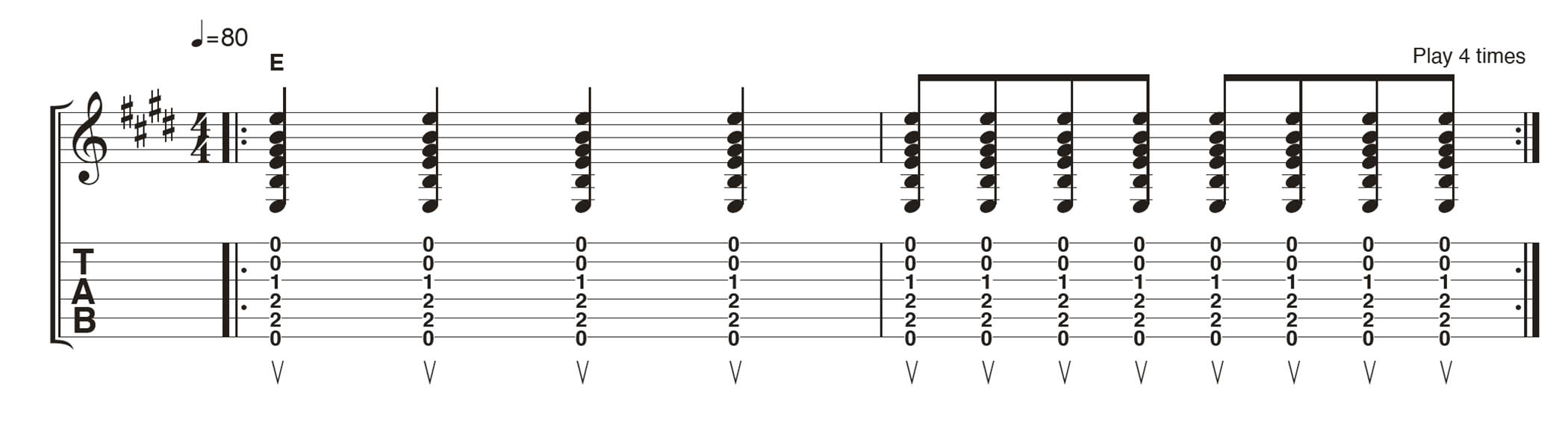
If you’re struggling with timing or evenness, it’s probably your upstrokes. Practise using only upstrokes until they feel and sound as good as your downstrokes. Don’t let too much of the pick cross the strings.
Example 2. Add accents
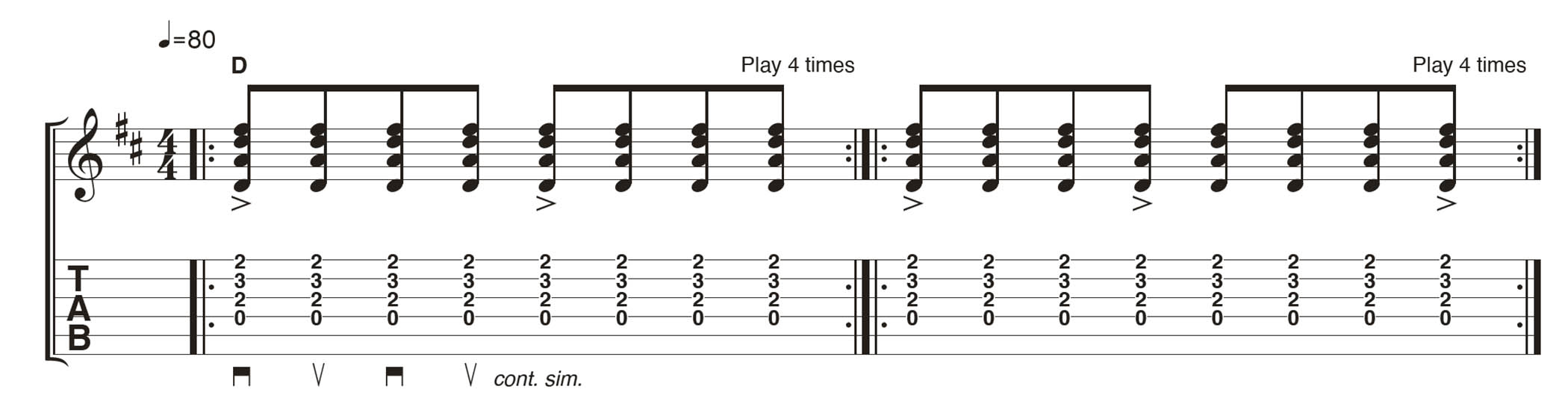
If all your strums are the same volume, it will sound tedious. Practise placing accents on the strong beats at first (shown in bar 1), and then in less obvious places (bar 2).
Example 3. Silence followed by a deafening roar
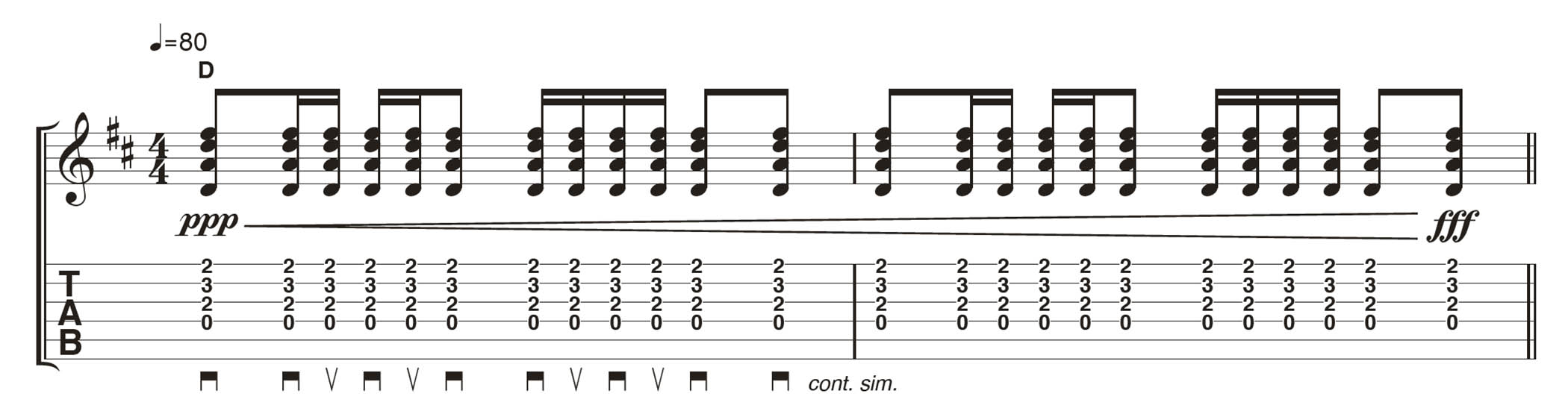
Dynamics are a highly underrated aspect of music – so take control with your strumming arm. See how quietly and loudly you can strum, and practise moving smoothly between those extremes. We’ve demonstrated the effect here in this example.
Example 4. Learn to swing
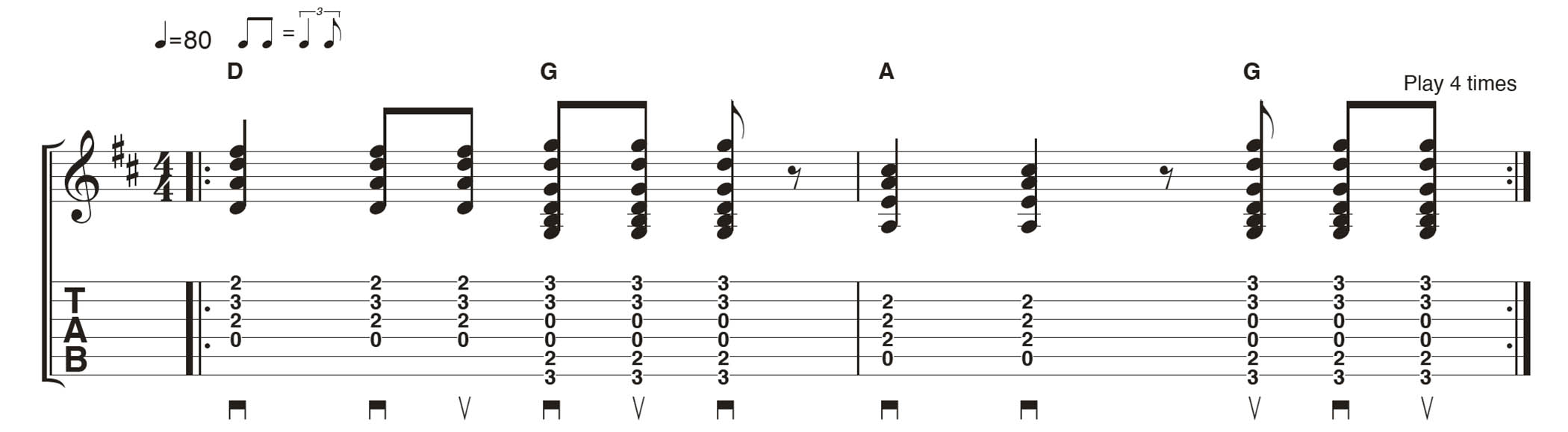
Varying degrees of swing can totally change the feel of a part. There’s no right or wrong here, just different approaches for different musical contexts. We’ve played our example with both swing and straight feel so you can hear the difference.
Example 5. Your ultimate goal!
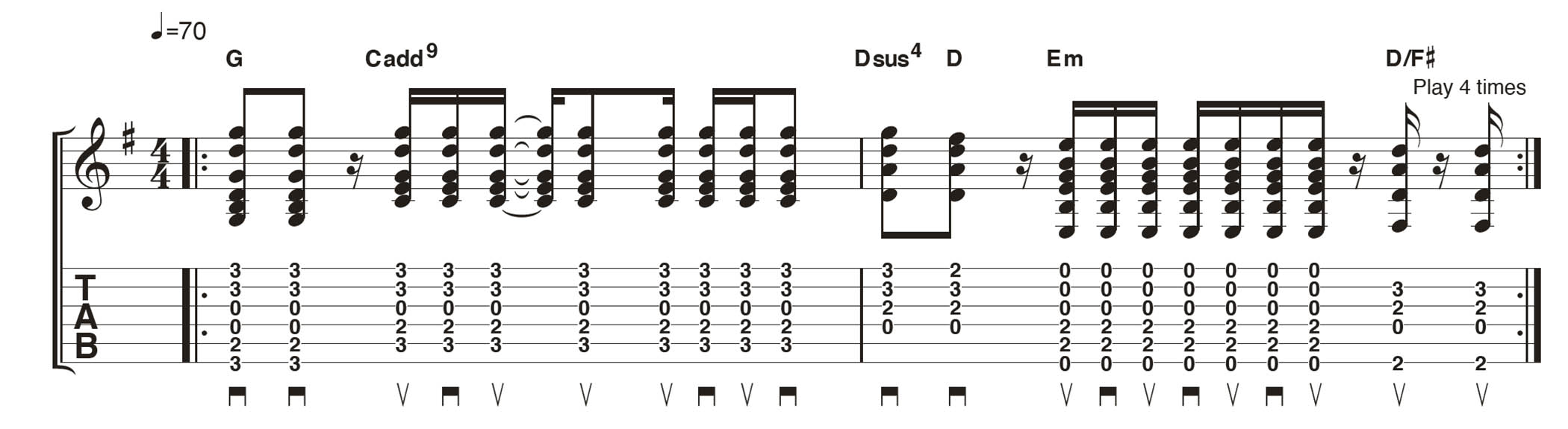
Your aim is for complex rhythms like this to sound smooth and even – though don’t worry if it takes a while to build up to it. Here, your wrist should be moving down-up constantly as you count ‘1 e & a 2 e & a’. A very slight bend in the wrist will help you stay loose.