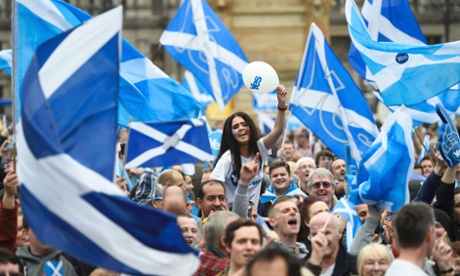
At least three books have come out in the last few weeks about the Scottish independence referendum. Alan Cochrane, the Daily Telegraph columnist and Scottish editor, has published a diary, starting in January 2012, called Alex Salmond: My Part in His Downfall, merrily revealing the contents of conversations he had with protagonists, mostly on the no side, many of which were supposedly “off the record”. David Torrance, the journalist, historian and biographer of Salmond, has also written a diary, 100 Days of Hope and Fear, although this just covers the final phase of the campaign. And Ian Macwhirter, the Herald and Sunday Herald columnist, has published an assessment, Disunited Kingdom: How Westminster Won a Referendum but Lost Scotland.
All three books have their merits, although none stands out as the definitive book on the subject. Of the three, Cochrane’s is the most revelatory, Macwhirter’s is the most cerebral and thought-provoking and Torrance’s is the most fair-minded.
Cochrane’s is also the one that has received the most attention. The Sunday Telegraph serialised some extracts although, peculiarly, the story they lifted for their front-page write-off was about David Cameron shooting pigeons. The Sunday Times ran a big story based on another extract quoting Alistair Darling criticising Ed Balls. Cochrane is something of a hate figure amongst nationalists and some of them have been using the review facility on the Amazon website to take the mickey. His book has been savagely reviewed by STV’s Stephen Daisley, but I have to say I enjoyed it. (Declaration of interest: I used to work with Cochrane years ago at the Telegraph, and like him.) If you judge a diary by quite how rude the author is prepared to be about people within his professional circle, then Cochrane’s is very good indeed.
The three authors have quite different outlooks (Cochrane, fervent unionist; Torrance, professionally unaligned, but clearly federalist, rather than separatist; Macwhirter, a convert from federalism to voting yes) but some common themes emerge from their books. Here are five of them.
1 - Scotland’s last round of devolution almost happened by accident. Several revelations in the Cochrane book have already been reported but, in my view, the most significant may be what he has to say about the Calman Commission - because it illustrates perfectly how political change often happens unintentionally. The commission was the body set up when Labour was in power to examine further devolution to Scotland and its recommendations formed the basis for the 2012 Scotland Act (a significant piece of devolution, but one which generally has not been noticed because its key provisions have yet to come into force.) Cochrane says this became law even though Labour and the Conservatives were never particularly in favour. He explains why as he writes up a private conversation with Alistair Darling, the Labour former chancellor.
[Darling] was also very interesting about the Calman Commission and the Scotland Act. When it was proposed by Wendy Alexander [a former Labour leader in Scotland], the idea in London, in agreeing to it, was that it would be a ‘long grass’ type project and could be kicked there. The Labour cabinet - Broon [Gordon Brown] and him especially - hoped that if the Tories won in 2010 that would be the last we’d hear of it. Unfortunately, the Tories didn’t win outright and the bloody Lib Dems, as well as daft Annabel Goldie [a former Tory leader in Scotland], got the tax proposals inserted into the recommendations and thus into the subsequent Act, along with other devolved nonsense, such as air rifles.
This is basically the opinion I got from Cameron when I talked to him at Bruce Anderson’s 60th birthday party in Victoria in the autumn of 2009. He shrugged his shoulders and made it clear that he was very reluctant to have anything to do with Calman, but with Labour and the Lib Dems insisting they’d implement it, and Goldie pressing him to say the same, he went along with it. Stupid bugger. The whole thing was a farce from start to finish ... but I’ve got to watch myself as MM was a member of the commission.
MM is Murdoch MacLennan, chief executive of the Telegraph Media Group (ie, Cochrane’s boss.)
2 - The Conservatives’ support for more devolution to Scotland after 2015 started life as a tactical ploy. All three main parties are now proposing to give Scotland full power over income tax rates. Labour was initially reluctant to agree this, but it effectively gave in because the Conservatives had already embraced this policy, in a report from a commission chaired by Lord Strathclyde. According to Cochrane, Ruth Davidson, the Conservative leader in Scotland, did not originally believe in this. Here’s an entry from October 2012.
Murdo Fraser [a Scottish MSP] collared me in the lobby to say that Ruth D was about to cave in on more powers for Holyrood at an evidence session with a Commons select committee. Great story? Well, quite good; but what she’s doing is backing the idea of a constitutional convention so that all of the UK will be included in any more devolution. She told me, frankly but off the record, that it is merely a ploy to kick the whole issue into the long grass ... And Cameron is party to all this chicanery.
Cochrane records a conversation with Strathclyde in March 2013 in which Strathclyde reveals that he is reluctant to agree more powers for Holyrood but that party policy is being driven by “some bloke who’s in charge of Tory polling called Andrew Cooper”. When the report comes out in June 2014 Cochrane describes it as a “sell-out” and says “poor old Tom was just following orders”. In his diary Torrance makes a similar point about Strathclyde being bounced into a devolution position he did not fully support. Writing about a conversation with a “well-placed Conservative”, Torrance says:
I asked to what extent Lord Strathclyde had actually engaged with the whole thing and he smiled knowingly before saying that he’d objected to the devolution of capital gains and inheritance tax so they were taken out (as they had to ‘give’ him something).
3 - The referendum result hasn’t resolved the debate about Scotland’s future. Torrance says that, after the result, “it didn’t feel as if the Scottish question had actually been answered one way or the other”. Cochrane’s book is written, as you can tell from the title, on the basis that the no vote did settle Scotland’s future. But even Cochrane does not seem 100% sure and you can detect a trace of doubt in the foreword, which is normally the last bit of a book to be written, where Cochrane concludes: “It’s over. Isn’t it?” Macwhirter robustly argues that the debate is far from over, that the union won “at best a Pyrrhic victory” in the referendum and that “unless there is a very rapid, fully federal transformation of the UK another referendum in the next decade or so will assuredly lead Scotland out of it”. It is an assertion, rather than a fact that can be verified, but Macwhirter makes his argument powerfully and his explanation as to why the union is broken is the most interesting intellectual claim in any of these three books. It is because England said Scotland could not use the pound, Macwhirter argues.
It appeared to many as if the UK was behaving like an old style, pre-Harold Macmillan imperial power, trying to bully and threaten Scotland into sticking with the union rather than offering it as a great common project. The rejection of currency union, out of hand and without possibility of negotiation, sent a disturbing message to many younger Scots: that the rUK [rest of the UK] was prepared, if necessary, to wreck the Scottish economy rather than let Scotland go. History may judge that, as a moral community, the union died on 13 February 2014, and that it was George Osborne who wielded the knife.
4 - The BBC had a poor referendum. Cochrane is scathing about the BBC. “No wonder Mullin [John Mullin, BBC Scotland’s referendum editor] is fed up with BBC Scotland; they are really, really useless,” Cochrane writes in an entry for a day when he spoke to Mullin. “Crap from top to bottom. They wouldn’t know a story if it hit them between the bloody eyes.” Cochrane is scathing about many people, but Macwhirter, in a rather more refined way, also criticises the BBC’s referendum record. He identifies two problems; the fact that they followed an agenda set by the anti-nationalist press; and the impact of journalists from London re-reporting news already well covered in Scotland. “There has been a breakdown of trust in Scotland, and the BBC has to address this somehow,” Macwhirter concludes.
5 - Journalists get things wrong. There’s no surprise there, of course, but it’s a conclusion always worth repeating. Torrance’s diaries include various predictions that turned out to be wrong (his suggestion that Salmond would not resign if he lost, his belief that turnout would be well below 80%), but, in the light of the recent Smith Commission report, this entry from Cochrane in June 2012 is my favourite example.
Times have a splash written by Hamish Macdonell saying that after a no vote all income tax collection will be devolved to Scotland. What a load of tripe, I thought.