
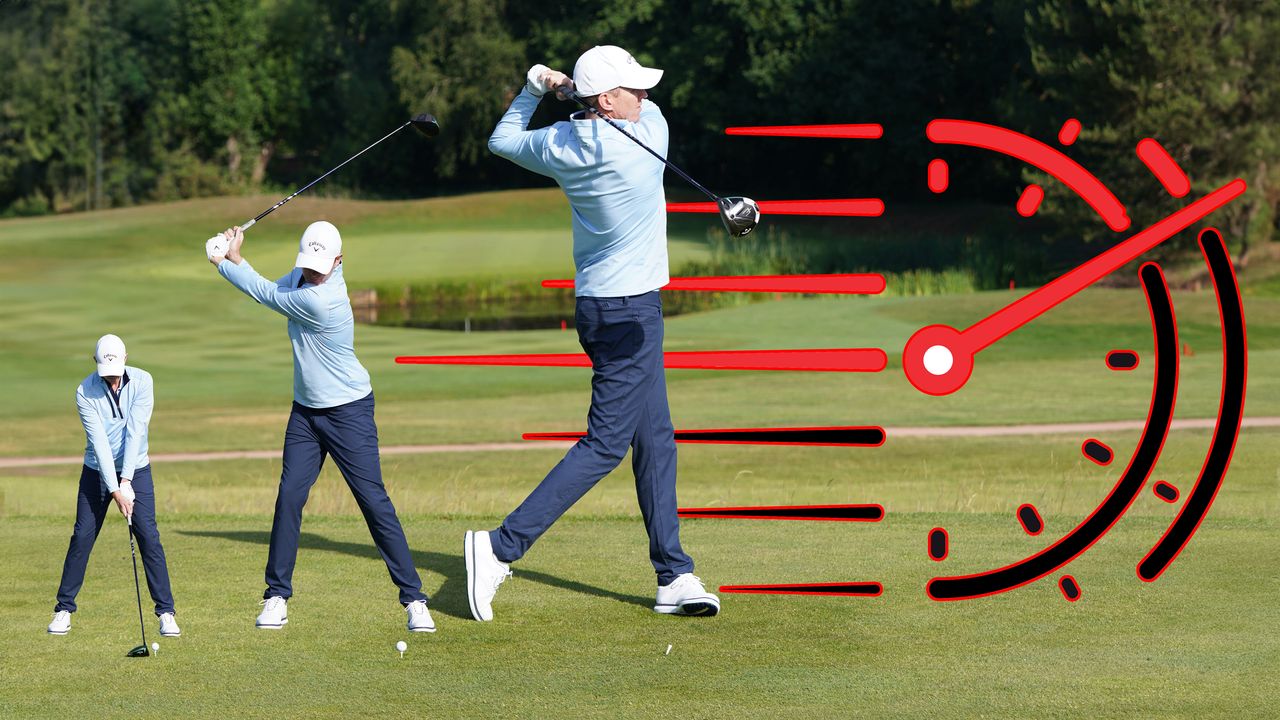
Like many amateur and professional golfers at this time of year, I am keen to improve my clubhead speed in the golf swing.
We all know that achieving a centred strike is the key to achieving maximum distance, but increasing the speed in which you swing the club can also provide a pretty drastic distance boost on the course.
As part of my winter golf rebuild, I am working hard in the gym to build my power and strength using some of the best golf exercises, but how can we also compliment this with some technical elements on the driving range?
In the interest of helping you to improve your clubhead speed this winter, I asked Top 50 Coach and author of ball striking manual 'Strike It Pure' , Ben Emerson, to share his 5 top tips and golf fitness expert Mark Wilson to share a great superset that you can try in the gym to boost your chances of ramping up that clubhead speed...
5 Tips To Generate More Clubhead Speed In The Golf Swing
In more than 20-years of coaching amateur and professional golfers, I can safely say that I have never been asked how to hit the ball shorter.
Distance is king and finding ways to increase your length off the tee and on approach are key to cutting your handicap and shooting lower scores.
Some incorrectly assume that the best way to do that is head out with a bucket of balls and start machine-gunning them as fast - which is actually one of the things you should never do at the driving range.
There is a case for trying to swing the club faster, which we will come onto later, but it's about quality over quantity... so save your money and follow my 5 top tips.
1. Sequencing
Getting the sequencing right gives us the best opportunity to get our strongest muscles into the golf swing. Correct sequencing allows energy to efficiently pass through our body and into the club, but sadly many amateurs get this wrong.
I want to focus predominantly on what happens at the very top of the backswing. We need to try and learn from the best players in the game, as what we typically see in their golf swing is the lower body moving first at this crucial point.
Think of the lower body like the handle of a whip. The last thing you want when cracking a whip is to let the end further from the handle move first, as this is going to be really ineffective.
It's the same in the golf swing, your lower body boasts your strongest muscles, so we want to get them into play early.
As you change direction from backswing to downswing, I want to see your lower body move first and your belt buckle to start moving towards the target. This will be followed by your chest, your lead arm and finally the club.
High-handicappers tend to demonstrate common faults with their sequencing, like the club or the upper body moving first - which promotes casting or an over the top golf swing.
2. Backswing Length
There are two ways that we can hit the ball further, in my opinion.
Firstly, we can apply force to the club more quickly or we can apply more force over a greater length of time.
A good example to highlight this is the contrast between the action of Jon Rahm and Dustin Johnson.
Jon Rahm has not got a very long backswing, but he applies a hell of a lot of force through the golf ball.
Dustin Johnson has a really long swing and applies force over a longer period of time.

So, you can either get into the gym to increase your strength and power, which will allow you to apply an explosive force over a short period of time, or we can extend your backswing and give you more time to build and generate that force.
Increasing your backswing length can cause issues with your timing in the golf swing, at least initially when this change is made, so it's important to practice this on the range before taking it onto the course.
3. Weight Transfer
Correct weight transfer in the golf swing is hugely important to hitting the ball further.
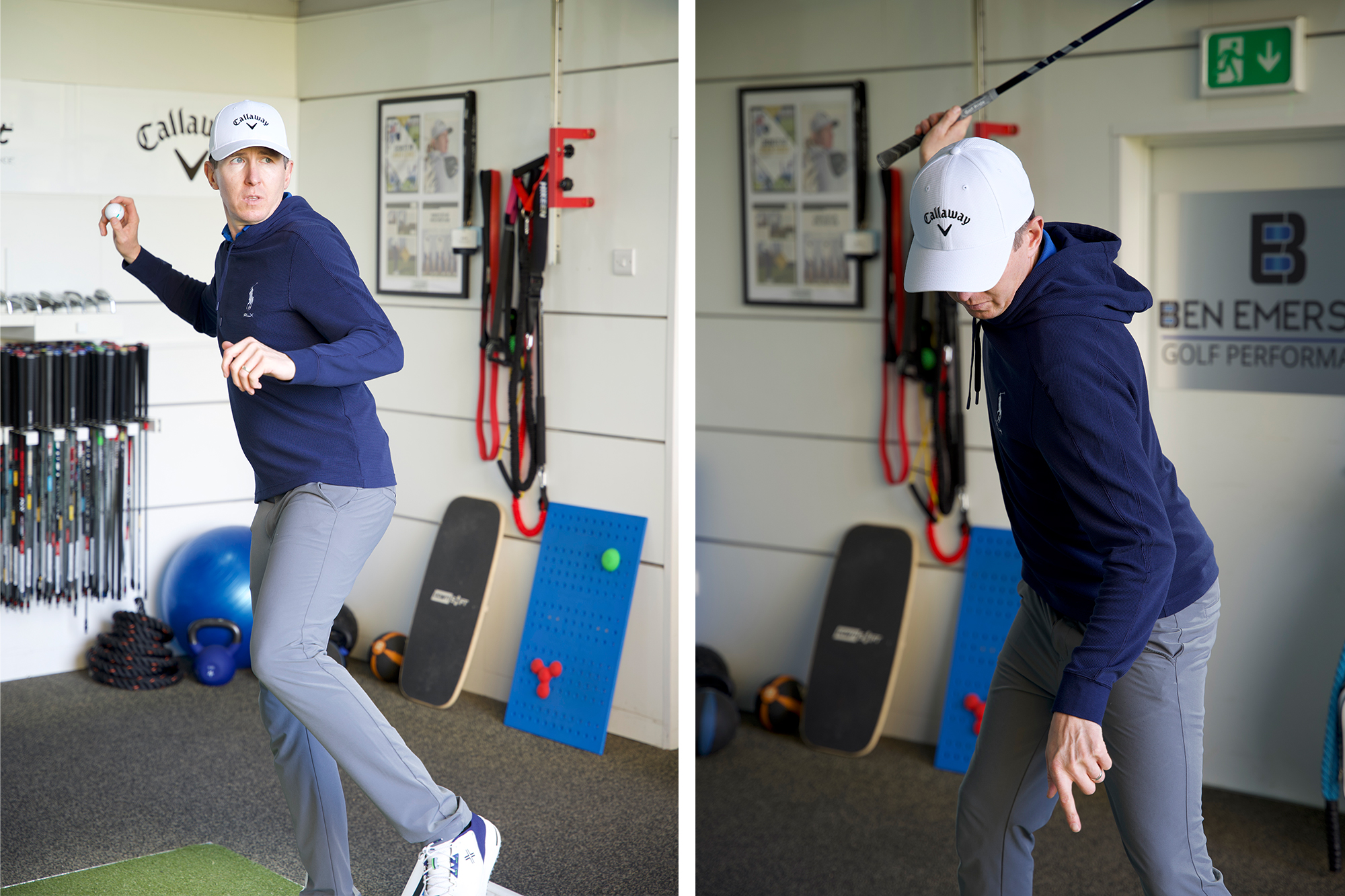
I often use the analogy of throwing a golf ball down the fairway, I would step into the throw and transfer my weight towards the target before I released it.
Try throwing a tennis ball or similar object while moving your weight away from your target... it looks and feels ridiculous.
This happens to many amateur golfers through impact, where their weight is actually moving in the wrong direction, sometimes causing them to lose their balance.
From the top of the backswing, I want you to feel as though you shift your weight towards the lead side and as your chest and arms follow, everything then stays on that lead side.
Timing this transfer is essential. The best players shift into that lead foot at the top of the backswing (or just before) and then unleash everything in a perfect sequence through impact.
This is something I helped Baz with, as part of his tour level golf lesson, using force pedals or a split tennis ball drill to encourage him to push early into that lead foot to initiate the downswing.
4. Backswing Speed
When you look at the biggest hitters in the world, they are not slow on the way back.
More speed in the backswing is great if you are trying to add distance, as you are essentially fuelling the system with more power. If you are working on positioning in the golf swing, however, that's a different story.
When you are at the range, trying to implement necessary swing changes, speed is not always your friend. If you can't do something slowly, you haven't got much of a chance of successfully doing it quickly.
Once you have the fundamentals nailed though, ramping up your backswing speed could be a great way to deliver more power in the downswing and ultimately hit the ball further.
5. Release
Releasing energy at the right time is key to boosting your distance, as letting it go early or late makes it almost pointless.
When amateurs cast at the top of the golf swing, they are actually then slowing down as they reach the ball - which is clearly not ideal for adding extra yards.
Instead, we want to release the energy at the point of impact.
Instead of unhinging the wrists towards the start of the downswing, and the club moving away from you at that point, I want you to feel as though the club actually falls closer to your body in the downswing.
This helps to create lag, which is effectively loading all that power ready to release it through the ball at impact.
This is a great drill to improve this. Place a tee just past the ball, around two feet in front on the target side. Pretend you have hit a shot and look at the position of your body just past impact - the clubhead should point roughly in the direction of the tee.
In the video above, I am extended and my body is facing the ball. As I do a real swing, I am trying to get the feeling over returning to that position.
Don't force or try to manufacture lag, as it makes the swing very wooden and inefficient. Allow your body to flow dynamically, in the correct sequence, with a good weight transfer and you'll give yourself a great chance of hitting the ball further.
How Can I Improve My Clubhead Speed Through Golf Specific Exercises In The Gym?
Using gym work to improve clubhead speed is something many golfers will aim to do over the off season, including Golf Monthly's instruction lead Baz Plummer, who is currently undergoing a total winter golf rebuild.
In the video below, you will see a great three-exercise superset that will help to improve your clubhead speed when partnered with the technical elements listed above.
Exercise 1: Double Leg CMJ (2 x 6 reps on each side)
This explosive exercise looks to develop lower body vertical force production. Higher outputs often lead to improved club head speed and is something often seen in low-handicap golfers.
Exercise 2: Split Stance Rotational Med Ball Slam (2 x 5 reps on each side)
This exercise focuses on upper body (vertical) power development. The split stance adds an additional stability challenge and the rotational component improves the power development of the rotational core muscles closely related to the golf swing.
Exercise 3: Fast Rotational Cable Row (2 x 6 reps on each side)
This exercises develops upper body (horizontal) power by heavily relying on rotation to create force as well as training the rhomboids, traps and lats at speed (muscles which are highly active in the lead side during the downswing).
Like Baz, in the video above, give this challenging superset a try for yourself and let us know how you get on in the comments box below.