“एकं सद्विप्रा बहुधा वदन्ति”
Rigveda 1.164.46
Truth is one, the wise describe it in many ways.
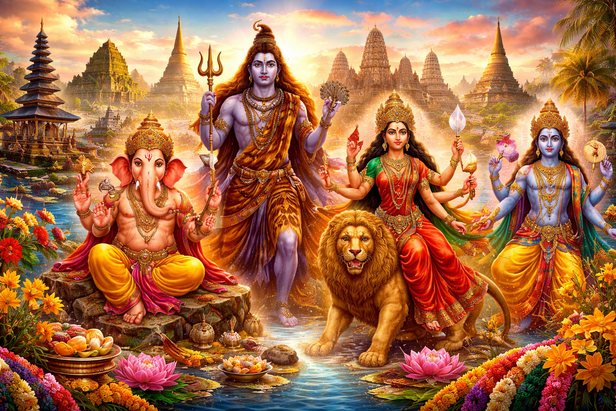
Have you ever wondered what happens to faith when it crosses borders? When people migrate, trade, build kingdoms, or settle on distant islands, they carry their gods with them. But something beautiful happens along the way. The gods remain the same, yet the way they are worshipped slowly changes. Local languages shape their names. Indigenous beliefs influence rituals. Architecture transforms temples. Music and dance reinterpret ancient epics.
Hinduism, perhaps more than most traditions, has shown an extraordinary ability to adapt without losing its core philosophy. From Southeast Asia to island nations in the Indian Ocean, Hindu gods are worshipped with devotion that feels both familiar and surprisingly different.
1. Indonesia: Where Hinduism Blends with Island Spirituality
Indonesia may surprise many people. It is the world’s largest Muslim majority country, yet on the island of Bali, Hinduism flourishes as a living tradition. Hindu influence arrived here through trade and powerful kingdoms like Srivijaya and Majapahit between the 7th and 14th centuries.
The grand Prambanan Temple stands as a reminder of this deep connection. Built in the 9th century, it is dedicated mainly to Shiva, with temples also honoring Vishnu and Brahma.
But Balinese Hinduism feels different from what one might see in Varanasi or Chennai. Here, Shiva is closely connected with local ancestral spirits. Daily offerings called canang sari are carefully prepared and placed outside homes and temples. These small baskets of flowers, rice and incense represent gratitude and balance.
The Ramayana is performed as dramatic dance theatre under the open sky. Ritual calendars follow unique cycles influenced by indigenous cosmology. In Bali, Hinduism feels like a living cultural rhythm woven into everyday life rather than confined only to temple walls.
2. Nepal: Where the Goddess Lives Among the People
Nepal shares an open border and deep spiritual ties with India, yet its worship practices carry distinctive Himalayan flavors. Until 2008, Nepal was officially a Hindu kingdom.
One of the most fascinating traditions is the worship of the Kumari, a young girl chosen to embody the goddess Taleju, a form of Durga. She lives in a palace in Kathmandu and appears during special festivals, where thousands gather for her blessings. The idea of a living goddess walking among people reflects Nepal’s unique fusion of devotion and culture.
The sacred Pashupatinath Temple is one of the holiest temples dedicated to Shiva as Pashupati, the lord of all beings. Rituals here are influenced by both Hindu and Buddhist traditions, showing how seamlessly the two faiths coexist in Nepal.
Tantric practices are more visible in Nepal than in many other regions. Festivals like Dashain involve rituals that preserve ancient forms of worship. In Nepal, gods are not distant figures. They feel present in civic life, festivals and even political symbolism.
3. Thailand: Where Hindu Gods Bless Modern Cities
Thailand is predominantly Buddhist, yet Hindu gods are deeply respected and widely worshipped. Hindu ideas entered the region centuries ago through trade networks and the Khmer Empire.
In the heart of Bangkok stands the famous Erawan Shrine, dedicated to Brahma, known locally as Phra Phrom. Business owners, students and tourists visit daily to pray for success and prosperity.
Ganesha is especially popular among artists and entrepreneurs. His statues appear in universities and creative districts. Vishnu and Shiva are also honored in royal ceremonies that include ancient Brahmanical rituals.
Thailand’s national epic, the Ramakien, is inspired by the Ramayana. Though the storyline echoes the original, characters have Thai names and cultural interpretations.
In Thailand, Hindu gods are not seen as separate from Buddhism. They are viewed as powerful cosmic beings who assist devotees in worldly and spiritual matters alike.
4. Cambodia: Where Temples Tell Epic Stories in Stone
Cambodia’s ancient Khmer Empire embraced Hinduism centuries before gradually shifting toward Buddhism. The architectural legacy remains breathtaking.
The majestic Angkor Wat was originally built in the 12th century as a temple dedicated to Vishnu. It remains one of the largest religious monuments in the world. Earlier temples were often dedicated to Shiva.
Khmer kings followed the concept of devaraja, meaning god king, where rulers were symbolically associated with Shiva or Vishnu. Religion and governance were deeply interconnected.
Temple walls are covered with detailed carvings of scenes from the Mahabharata and Ramayana. These stories were not merely religious texts but political and cultural anchors.
Today, although Cambodia is mainly Buddhist, Hindu symbolism remains woven into its art, architecture and national identity.
5. Mauritius: Where Devotion Preserves Heritage
Mauritius tells a different story. Hinduism arrived here in the 19th century with Indian indentured laborers brought during British colonial rule. For many migrants, faith became a way to preserve identity in a foreign land.
One of the most sacred places is Ganga Talao, a crater lake believed to be spiritually connected to the Ganges. During Maha Shivaratri, thousands of devotees undertake pilgrimage walks to offer prayers to Shiva.
The rituals closely resemble North Indian traditions, yet over time they have blended with Creole culture and island influences. Bhajans are sung in Bhojpuri, Hindi and local languages. Diwali is celebrated as a national holiday.
In Mauritius, Hindu gods symbolize continuity, resilience and community pride.