
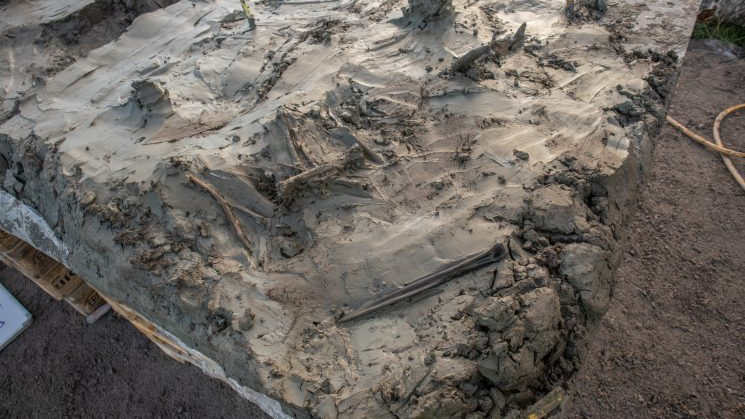
Archaeologists have found the skeleton of a dog alongside a bone dagger at the bottom of a bog in Sweden. The remains are thought to be 5,000 years old and may be from a mysterious Stone Age ritual.
The unique dog burial was identified during construction work for a high-speed railway in the hamlet of Gerstaberg, about 22 miles (35 kilometers) southwest of Stockholm. Experts with the Swedish group Arkeologerna (The Archaeologists) announced the find in a statement and blog post Monday (Dec. 15).
Five millennia ago, this swampy bog was a clear lake that Stone Age people fished in. Wooden pilings and pieces of an ancient pier were discovered on the lake bed, along with a structure made from intertwined willow branches and a woven fishing basket.
But the dog skeleton and nearby dagger surprised the archaeologists.
"Finding an intact dog from this period is very unusual, but the fact that it was also buried together with a bone dagger is almost unique," Linus Hagberg, a project manager at Arkeologerna, said in the translated statement.
While the exact breed of dog is not yet known, it was a large and powerful 3- to 6-year-old male that stood about 20 inches (52 centimeters) tall. The dog had been placed in a leather bag weighted down with stones to sink it to a depth of about 5 feet (1.5 m).
"It is a known phenomenon that dogs were used in ritual acts during this period," Hagberg said.
Directly adjacent to the dog skeleton, the archaeologists found a well-preserved, 10-inch-long (25 cm) dagger made of elk or red deer bone. According to the Arkeologerna blog post, "daggers of this type should be considered a symbolically charged object," and other examples have been discovered in wet and boggy places in Stone Age Sweden.
The dog and dagger appear to have been deposited in the lake at the same time, which suggests that the ancient fishers who lived in this area 5,000 years ago buried them in some sort of ceremonial act, according to the blog post.
Additional work will be done on the remains, Hagberg said, including carbon dating and DNA analysis, to confirm the antiquity of the finds and to learn more about the dog and its owners.
"For example, we can see when the dog lived, its age, and what it has eaten," Hagberg said. "The dog's life history can in turn tell us more about how the people who owned the dog lived and ate."