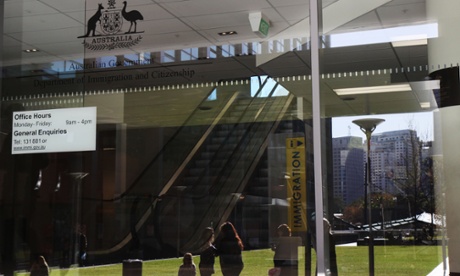
Employers who accept payments from 457 visa holders to stay in Australia will face criminal charges as part of sweeping changes to the temporary visa class to be implemented by the federal government.
The Coalition will adopt or consider all of the recommendations of an independent review into 457s, including criminalising fraudulent behaviour and relaxing the requirements for English language proficiency. But the government said it would examine further the role of labour market testing, which the review recommended scrapping.
The assistant minister for border protection, Michaelia Cash, said the review made “some sensible suggestions … for strengthening existing provisions to ensure Australian workers have priority, while supporting employers with genuine skill shortages to access the skills they need”.
She added: “The Abbott government is firmly committed to ensuring that the subclass 457 program acts as a supplement to, and not a substitute for, Australian workers.
“Through the adopted recommendations, the government has struck the right balance between strengthening necessary integrity measures whilst removing unnecessary red tape.”
Cash told the Senate on Wednesday there are more than 107,000 visa holders in Australia at the moment, which represents a 2.7% drop since the Coalition came to power in September 2013.
She said the review had found no evidence of widespread rorting of the system.
But Angela Chan, the president of the Migration Institute of Australia, said there was anecdotal evidence that 457 visa holders were paying to stay in Australia, particular in regional areas where oversight of the system is not as strenuous.
“It is not unknown for people to pay between $40,000 and $80,000 to do this,” she said.
Other changes include:
- Extending the period in which employers with a good track record can request 457s from three years to five.
- Scrapping the training benchmark for 457 sponsors and replacing it with a mandatory contribution to a government training fund that would fund various training and mentoring schemes for Australian workers.
- Collaboration between the tax office and immigration department to ensure visa holders are being paid market-appropriate wages.
Business groups broadly supported the changes, saying they cut red tape for employers who did the right thing.
The head of the Australian Chamber of Commerce and Industry, Kate Carnell, welcomed “a renewed focus on compliance and monitoring by the government”.
“Ensuring that visa holders and sponsors are meeting their obligations will boost business and community confidence in the 457 visa program,” she said.
But Carnell, and the head of the Australian Industry Group, Innes Willox, were disappointed the government had kept labour market testing.
“The labour market testing regime was always flawed and we urge the government to accept the review’s recommendation that it be scrapped,” Willox said. “The testing amounts to ineffective, time-consuming red tape. Using the scheme is costly for employers and the vast majority don’t recruit 457 workers unless they absolutely have to.”
The secretary of the Australian Council of Trade Unions Dave Oliver said the changes amount to “tinkering at the edges of the 457 visa program” and “will do nothing to stamp out the widespread fraud and rorting of the system”.
The ACTU wanted a Senate inquiry into the temporary visa system, Oliver said.
“With unemployment at 6.4% and youth unemployment at 14.2%, the government should be strengthening the rules for employers to hire local workers and investing in skills and training.”
The Electrical Trades Union criticised the relaxing of English language requirements, saying it might lead to workplace accidents.
Willox wants the English test to be softened further, saying the current requirements are too tough and disadvantage some workers.