A lot of us have felt that awkward pressure moment at a restaurant when the end of a meal often comes with a quiet judgment of how much tip you’re going to leave.
Of course, nobody is saying good service shouldn’t be rewarded. But the line gets blurry fast when tipping feels like a test, and starts popping up in unwarranted situations and places.
Like during a skydiving session, where you’re already paying a pretty serious amount just to jump out of a plane. Or in restaurants where robots are bringing your food to the table — are you supposed to tip the robot, the restaurant, or just pretend you didn’t see the screen?
People have been sharing what they call “reasonable, no-hate rants” on the subreddit r/EndTipping. It’s basically a space for those who feel tipping culture has gone a bit off the rails, and these stories prove exactly why.
#1
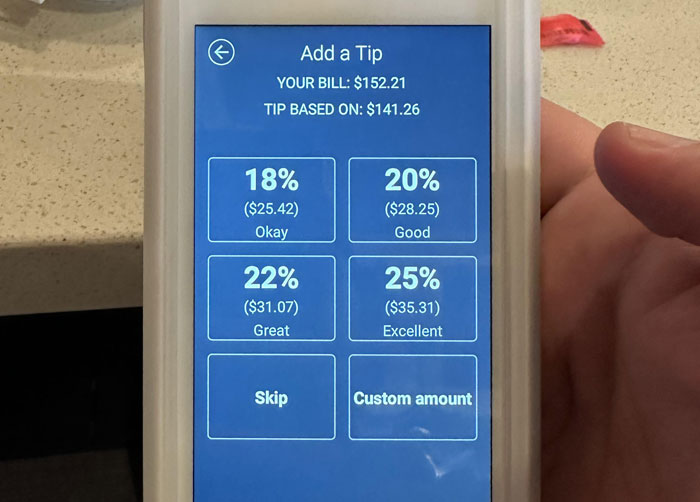
I’m a barista at a small local family-owned coffee shop. We get paid just above minimum wage—not a tipped wage—but we operate with a Square tablet that we have to turn around for tips. I already HATE having to turn it around every single transaction, but the other day my coworker did something awful and I hope they’re fired for it.
We have this regular who comes in every single morning. He’s an elderly man and he usually just gets a small latte and sits and chats with his friends for a couple hours. He’s always incredibly kind to us and makes sure he sees everyone who’s on shift so he can say Good morning to them.
Well, some of my coworkers really don’t like him because he never tips when the tip screen is turned around. Last week, I noticed that he hadn’t been coming in in the morning despite his friends being there. Honestly, I got really concerned because I thought he had run into some medical issues, but then I saw him outside of work and asked him where he’d been. He told me that one of my coworkers rudely told him he was “forgetting something” when he walked away after paying to sit with his friends. Then they yelled at him about how rude it was he never tipped and told him that none of the people who work there actually like him. I was absolutely floored. He told me he planned to never come back because he no longer feels comfortable. Needless to say… I will be talking to my boss about it and I’m mortified that this has happened.
© Photo: SaintTourmaline
#2
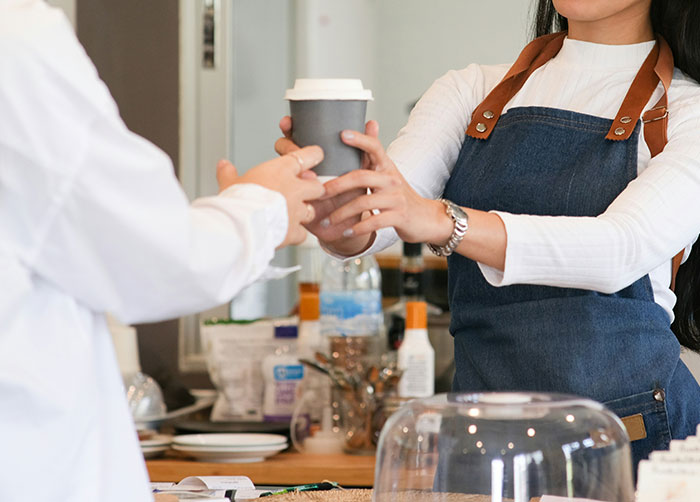
I stopped by this coffee shop I frequent—often enough that they know my name—and ordered a drink. I didn’t tip on the card but left a dollar in the jar. The barista saw it, and I guess noticed the other cash in my purse, and said loudly, “Oh wow! A whole dollar… that’s SO generous! Thank you SO much.”
I have never been that dumbstruck before. The sarcasm was so unreal I was convinced she was going to spit in my drink or something. But really, why should she be entitled to more than a dollar for my $5.00 coffee? Why should she even get an extra cent, for that matter?
She’s performing her job, which is to make a drink. There’s clearly no good service there. If we are going to tip at coffee shops, it should be customary that they receive the tip after we get the drink, not before. Service is so bad right now.
© Photo: moonchildcountrygirl
Tipping culture is often described as more intense in the US and Canada compared to many other countries. In North America, tipping is not just a bonus for good service anymore — it’s often expected in restaurants, cafes, hotels, and even newer settings like digital checkout screens.
The modern tipping culture in the US is often traced back to a pretty uncomfortable history, and several historians point out that it became widespread after the Civil War era.
After slavery was abolished, many formerly enslaved Black workers were pushed into service jobs like waiting tables, rail car services, and hotel work. Employers often didn’t pay them a proper wage, and instead allowed or expected them to rely on tips from customers. In some cases, tipping was even used as a way for businesses to avoid paying wages altogether.
Over time, this system stuck. Even when minimum wage laws started to develop, tipping had already become normal in the hospitality sector.
#3
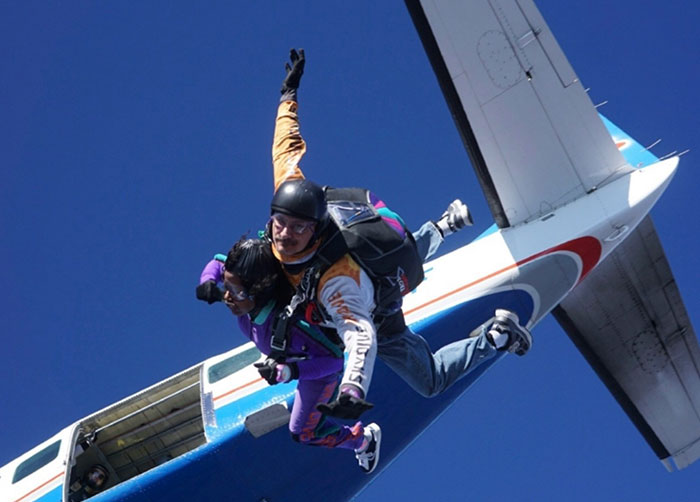
Last year, I went skydiving with some friends in Virginia. We called ahead and were told it was $300 per person. When we got there, they said photos and video were another $100, which we agreed to—so $400 total.
Then, right when we were about to pay, before anything had even happened, they asked if we wanted to leave a tip. That honestly felt weird. I’ve never heard of tipping for skydiving, especially when you’re already paying that much and haven’t even done the jump yet. Nothing about tipping was mentioned on the phone either.
We said no, politely. After that, the vibe completely changed. The instructors and pilot were clearly annoyed, talked to us in a rude, almost scolding way, and the whole experience felt tense. What should’ve been exciting ended up feeling uncomfortable.
This is why tipping culture is getting out of hand. When you’re treated worse for not tipping, it stops being optional and starts feeling like a hidden requirement. I’d much rather just pay a clear, upfront price and be treated the same either way.
© Photo: Kingjoker58
#4
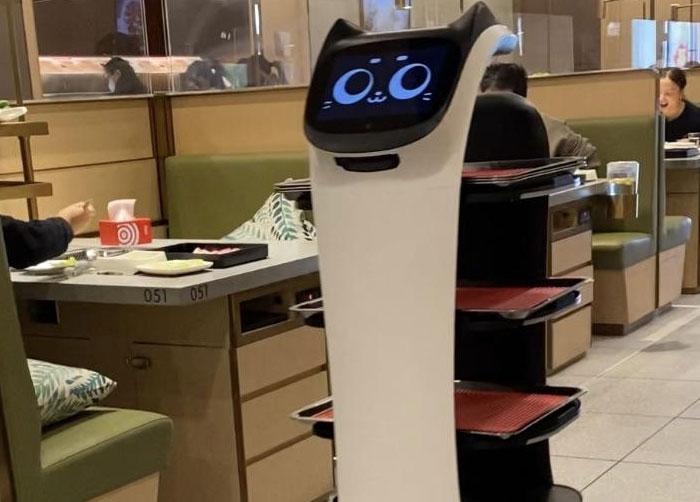
I went out for dinner with a couple of friends last weekend and was pleasantly surprised to see our food being brought out by those funny little robot servers.
At the end of the meal, the robot brought us the plastic tray with the bill and a big laminated sign that said, “Electronic waiters work hard, don’t forget to tip us 😊.” I’m sorry, but what the hell. I was actually a little taken aback at the audacity of the restaurant to pull that.
No, electronic waiters do not deserve a tip. They deserve a tip even less than regular waiters do, which they also do not deserve, to be clear. I was so legitimately angry that I didn’t even take a pic. And no, when I paid my bill at the front, I absolutely did not tip.
© Photo: Whitershadeofforever
In the US especially, tipped workers in some sectors can legally be paid a lower minimum wage than other jobs, under the assumption that tips will make up the difference.
This tipping culture also stuck around because it benefits businesses — menu prices can stay lower than they otherwise would be, since part of the labor cost is pushed onto customers through tipping.
In a way, many workers in hospitality and delivery jobs rely solely on tips as a meaningful part of their income.
#5
© Photo: stonks_hunter
#6
So the wife and I have decided to stop going to sit down restaurants 98% of the time. Sometimes its just unavoidable. Mostly Because of the tipping but also the lack of quality. We have noticed that restaurants in my area raised all their prices and lowered the quality. The last restaurant we went to said it would add an automatic 22% if the tip line was left empty. Like WTF. I think that's theft personally. I never leave tips for any kind of walk up service either but the stuff is getting ridiculous. So we have just decided to not patronize any food service establishment and make everything at home. Guess what, its cheaper and better than any restaurant we've been to in years.
© Photo: tigerbloon71
#7
Years back, I had a sit-down restaurant. When I first started, I tried to pool the tips so everyone in the store—from the dishwashers and cooks to the servers—would get a piece of the tipping pie. I also introduced business profit participation, meaning we would all make the same, including myself. The idea was that we’d all share fairly and keep things balanced. Sounds fair, right? Nope. The “pro servers” were livid. It was a spectacular failure.
So I gave in “for the good of the store.” Imagine making so much in tips that you’re earning more than the owner on any given day, while I was working 60 to 80 hours a week. That was the expectation from most of the professional serving staff. And when it came to helping train younger, less experienced staff? Forget it. The attitude was basically, “Your problem, not mine.” On top of that, you never knew when they’d show up, if they’d show up, or who would show up. Meanwhile, they were making a lot more money than anyone else in the business.
I had a serious dilemma on my hands. My solution? I fired every server and turned the place into “order at the counter.” Honestly, it was probably the best decision I made for my own well-being. The business stayed about the same at first, though I genuinely thought I might go under. But over time, things actually improved.
Why? Because customers didn’t feel obligated to deal with bad service and still tip 20% or more. My reviews got a lot better too. Almost all my one-star reviews before had been about the service, never the food. Removing that element solved a major issue.
I still have a tipping option when people pay, but it’s not percentage-based—just fixed amounts like no tip, $1, $3, $5. If someone places a huge order, they don’t feel pressured to tip $20 or more. And if people do tip, it gets shared among the staff. If they don’t, that’s fine too—no pressure, no attitude—because I already pay my employees well above industry standard.
In the end, tipping culture sucks. I really believe that. But it’s part of the system, and some customers still want to tip, so you can’t make everyone happy. What you can do is minimize the downsides as much as possible.
I don’t know how this take will land, especially coming from an owner, but after being here a while and hearing people’s complaints, I wanted to share that at least one owner agrees. If I get downvoted into oblivion, it is what it is. I just wanted to put it out there. Thanks for reading.
© Photo: DriveNew
But more and more Americans are getting sick of today’s tipping culture.
In a recent survey, about 81% of them said tipping has gotten out of control. More than two in five Americans said they think the US should ban tips.
“Tips have gone far beyond traditional establishments, which had been places like sit-down restaurants, bars and hair salons. Now, it's everywhere you look. That’s part of the frustration, because people are at a point where they don't know who to tip and how much to tip,” says Chip Lupo, an analyst at WalletHub which did the survey.
#8
My wife and I were out with a friend and his wife this past weekend. After a long day out, we decided to grab pizza and found a nearby pizzeria on Google. The listing said they were open until 10 PM, so we called around 8:30 to check, since a lot of places in that neighborhood close early. The lady on the phone said the kitchen was open until 9:30, and after that it would just be counter pizzas, if available, until 10.
We got there around 9 and ordered two pizzas and a side of garlic knots. The pizza was good, the knots were nice and cheesy—so far, so good. We finished up by 9:45, and the check came out to around $51 and change after taxes. We left $60.
As we were leaving, the waitress said something in Italian to the guy at the counter. Once we got to the car, my friend’s wife—who understands a bit of Italian—said the waitress had said something along the lines of, “bastards only tipped 9.”
Safe to say we won’t be going back. Even percentage-wise, we tipped around 16–17%. I get that we were there close to closing, but there were a few other tables occupied too. It’s not like we held the place up after closing.
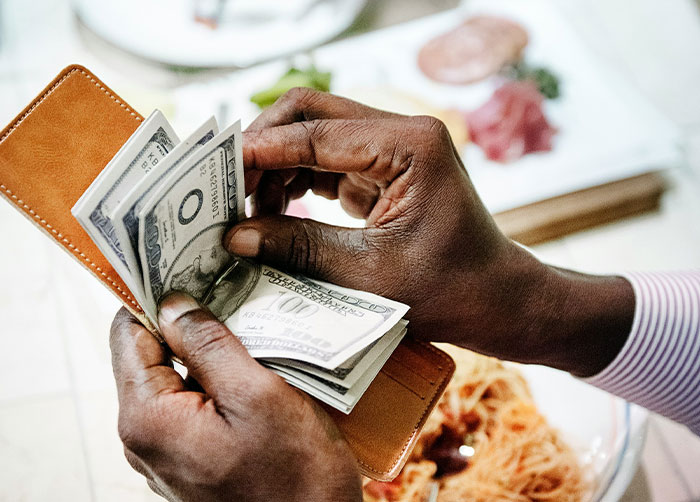
© Photo: Alarmed_Ant9964
#9

© Photo: Bluestatevibes
#10
© Photo: latesummerthrowaway
Tipping is often described as a way to show appreciation for a service. If you regularly go to a café or a restaurant, tipping can build a kind of relationship with staff, and in some cases, it encourages better service over time.
So in that sense, tipping is seen as a way for customers to directly support workers.
But a lot of research has also pointed out why the system can be problematic too, especially in countries like the US, where tipping is deeply built into wages rather than being purely optional.
Studies show it is not a reliable measure of performance, and better service doesn’t always lead to better tips, and vice versa.
#11
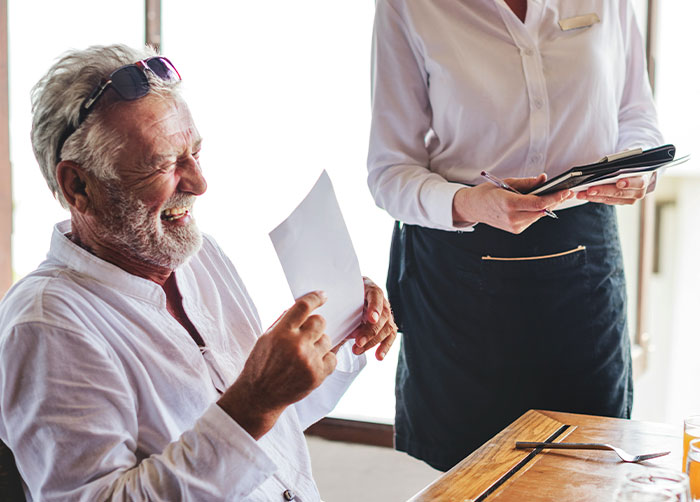
© Photo: michalwalks
#12
© Photo: Salt_Historian_9850
#13
Seattle drive-thru café. I’d been going there for about three years, once or twice a month. Keep in mind, this is Seattle—the land of a $20+ minimum wage. I ordered two drinks, hit “no tip,” and then the barista said out loud, “No tip—okay, that’s nice.” She then handed over the drinks angrily without any acknowledgment. What is that? I won’t be going back.
Edit #1: I removed the business name. I didn’t expect this to lead to multiple negative reviews being posted because of my experience. I left my own review and came here to rant and start a discussion. I don’t agree with the business getting flooded with artificial reviews based on a Reddit post.
Edit #2: The owner, Taylor, reached out to me directly after seeing this post. We talked for about 10 minutes, and she apologized profusely for the experience. She’s even sending us a gift card. So please stop posting fake reviews—the owner addressed it and went above and beyond after the negative experience.
© Photo: tobias_hund
Tips can be influenced by bias, including factors like gender, age, race, and appearance, rather than just service quality. That means two workers doing the same job may not earn the same amount.
Research has found that workers of color often earn less in tips than white workers doing the same job, even when the level of service is similar.
Studies show that even female servers are held to a very high standard. And if this standard is not met, they are treated unfavorably in comparison to male servers who produce the same level of service quality.
“Because of the two-tiered system, because of the racial segregation, the people who are most impacted and impoverished by the current tipping system are people of color, and in particular women of color,” says Saru Jayaraman, director of the Food Labor Research Center at the University of California, Berkeley.
#14
#15
I went to a restaurant in the Chinatown district of a major US city for lunch. The “service” consisted of scanning a QR code to order and then getting up to go to the back of the restaurant to pay. They did bring our food to the table, but didn’t check on us or offer water refills.
After I paid, the receipt had boxes for 15%, 18%, and 20%, along with a custom tip option. Not feeling that the minimal service warranted a tip, I left the boxes blank and signed the receipt. I also took a picture of it, just in case the restaurant tried to add a tip later.
The lady saw the receipt and said, “Excuse me, the tip is not included,” and handed it back to me. I already wasn’t going to tip, but that comment sealed it. It felt like she was trying to pressure me. I wrote “0” and handed it back.
Shame, because the food was good—but I won’t be going back.
#16
Even as criticism of the system grows, we can’t ignore the fact that tips remain a direct source of income for millions of workers. And all the stories here are not reasons to cheap out or avoid tipping altogether.
The broader debate is often about shifting responsibility.
Experts believe that wages should be transparent and included in menu prices, so workers are paid fairly without depending on customer discretion.
Policymakers and labor groups have also pushed for changes like eliminating the lower “tipped minimum wage” and making employers pay full base wages regardless of tips.
Some US states, like California and Washington, already require higher or equal minimum wages for tipped workers, moving away from the traditional two-tier system.
#17
#18
#19
A restaurant I used to frequent had a lunch special—$10.99 for a slider plate, wings, or a Philly cheesesteak with a drink. You get the idea. They weren’t exactly fast, though. So with a 20% tip, that $10.99 meal came out to about $14.37.
A few months later, they dropped the “includes drink” part. Now, after tax and tip, the total was around $18.30. That’s when I stopped going.
The owner asked me why, and I explained all of that. He said, “I’d rather you come in and eat and not tip a dime than not come in at all.” Fair enough. So I started going again and tipping a dollar.
Then I got a nasty Facebook message from a server who was upset she wasn’t getting a 20–30% tip for walking a plate 15 feet. Again, they were slow, and refills were rare. So I stopped going again.
It seems like a lot of other people did too. The cook, the barback, the surly waitress—all out of a job. Not sure what the owner is doing now, but it can’t be going well.
For now, though, nothing about the tipping system is fully fair. That leaves customers in a grey zone.
Experts suggest people should recognize that the system has real flaws, but also know that tips still directly affect someone’s take-home pay.
For example, in restaurants or cafés where tipping is clearly part of the setup, leaving a standard tip is still seen as the safest way to avoid hurting service staff financially.
At the same time, people are encouraged to pay attention to when tipping feels genuinely expected versus when it’s just an optional prompt on a screen — like at self-checkouts or automated kiosks where there is little or no service involved.
“When they turn that device around, it’s this glaring thing, and people feel shamed into tipping, but you don’t have to,” says Elaine Swann, a lifestyle and etiquette expert and founder of the Swann School of Protocol.
#20
I just discovered this sub, and I knew this was the perfect place to say this. If you order food on DoorDash, don’t tip—and I say this as a delivery carrier (or “Dasher,” as they call us).
You might ask why I’d say that. When we accept a delivery order on DoorDash, the information we get is how long it will take and how much DoorDash guarantees we’re going to be paid. That’s where the issue comes in. Their “guarantee system” combines the tip and the delivery fee, but they don’t tell us how much of each makes up the total.
Here in the SF Bay Area, orders usually have a guaranteed pay of around $7. If, after completing the order, the customer tips $5, DoorDash breaks it down like this: delivery fee $2, tip $5. But if the customer doesn’t tip, DoorDash pays it like this: delivery fee $7, tip $0.
So tips are only actually worth it to the driver if you tip more than $7, which usually isn’t the case. If you tip $7 or less, you’re effectively tipping the company, not the driver. People fall for the “100% of your tip goes to the Dasher” line. And yes, technically that’s true—but DoorDash reduces their base payment accordingly.
So please, don’t tip on DoorDash. In California, thanks to Prop 22, we already make enough (and that’s coming from someone in a high cost-of-living area).
TL;DR: If you tip less than about $7 on DoorDash, don’t tip—the company just pays less, and the tip effectively replaces part of the delivery fee.
© Photo: eric39es
#21
My wife called me on Friday afternoon while I was at work and said she and my son wanted to try a new pizza place that opened near us about two months ago. No problem—I like pizza. She mentioned they only had 12-inch pizzas, which was fine, and I told her to get me a pepperoni and a Caesar salad.
I left work a bit later and stopped to pick up the food on my way home. When I walked in, the guy at the counter was as nice as could be. I told him my wife had called in an order and gave her name. He checked the system and said, “Here it is—two pepperoni pizzas and two Caesar salads.” Then he rang it up and said, “That will be $70.50.”
I was in shock, but it’s the neighborhood we live in. I took out my card and tapped it, and the screen showed options for 20%, 25%, 30%, and no tip. I hit “no tip.” The guy’s face dropped instantly, and his whole demeanor changed. I said thank you and told him to have a good evening, but he just walked away without saying a word.
I’m not giving you $15+ for absolutely nothing. I got home and told my wife this is the first and last time we’re ordering from there. I’m done with this nonsense.
© Photo: dcaponegro
At the end of the day (or service), tipping shouldn’t feel like a performance review. It is meant to reflect appreciation, a small extra way of saying thank you when someone has made the experience better than expected.
And if someone provides genuinely poor or rude service, you are not obligated to reward that behavior.
#22
© Photo: Alert_Light_886
#23
#24
© Photo: lynxbby
#25
I took my wife to a 3 Michelin star restaurant to celebrate my birthday last week. The experience was wonderful, and I paid the $30 valet with the check. My wife was driving, and when we got outside the valet driver, while holding onto her car keys, verbally demanded a cash tip. She was pretty intimidated and put off, I had to turn to him from the passenger side and tell him we already paid $30 for his service and are not carrying cash. I reported this to the restaurant and they refunded the parking charge, but it was a bad and harsh end to an incredible evening. Really pissed me off.
#26
© Photo: upset_Dad9
#27
#28
In my city, there’s an all-you-can-eat hot pot restaurant that I genuinely love. The food is amazing, and the service is good too—until it’s time to pay the bill. They use an iPad at the table, then turn it to you “for a question,” but they watch as you enter the tip. The only options are 20%, 22%, and 25%. I’ve dealt with the awkwardness because the food is great, but I always dread that moment.
Then a new place opened in town with the same concept and similar prices. The difference is that it clearly states at the table that tips aren’t expected. A lot of places say that, but here, when you pay and get the check, there isn’t even an option to add a tip.
With similar quality and satisfying the same craving, we haven’t gone back to the first place since trying the new one—purely because it removes that uncomfortable tipping moment at the end of the meal. I hope to see more places like this. They say competition drives change, and in this case, it’s definitely for the better.
#29
© Photo: 13dogfriends
#30
#31
© Photo: Jazzlike_Dig2456
#32
#33
#34
I recently ordered some barbecue in the bustling metropolis of Louisa, Virginia. A little backstory—I used to date a waitress, so I’ve seen how hard they work and have no issue tipping, especially when someone goes above and beyond.
Fast forward to yesterday. I phoned in a pickup order for a work function the next day: four pounds of barbecue at $20 a pound, plus two 12-ounce bottles of sauce at $12 each. After taxes, the total was pushing $120.
I showed up the next day on time, and they had forgotten my order. I ended up waiting 30 minutes while they prepared it, and I was the only person in the restaurant. Then, after all that, I was asked how much gratuity I wanted to add.
Seriously? I’m driving there, picking up the food at the counter—late—and carrying it back to my truck. The only interaction is someone handing me an aluminum pan of barbecue and two small bottles of sauce. I didn’t leave any tip.
#35
#36
I was at WWWY festival in Vegas this past weekend. I was brutally hungover and thought a steak wrap sounded great. I walk over to the stand. Order what turns out to be the saddest,coldest, smallest, most pathetic steak wrap in existence for $23.00! The guy hands me a premade wrap (I thought they would be made fresh. I would not have bought if I knew it was premade) and I tap my card against the payment machine. He then sheepishly says here and I asked did the transaction go through? He then says yes but I need to do this and clicks 20% for me and goes to click done. I said absolutely not and clicked no tip. The lion, the witch, the audacity of this jerk! His face when I clicked no tip was like I ended a newborn and he called me a jerk as I walked away.