LOS ANGELES _ A six-month investigation into the poaching of marine life from fragile tidal pools at White Point Beach in San Pedro has culminated with charges against 45 people, the Los Angeles city attorney announced Thursday.
The extensive harvesting of edible marine life _ including hundreds of pounds of mussels, turban snails and purple sea urchins _ "has decimated the fragile ecosystem along the coast, and it is uncertain if it can recover," L.A. City Attorney Mike Feuer said.
"We allege these defendants have jeopardized that future by threatening this sensitive ecosystem," he added. "You can't just take as many of these creatures as you want. That's why we're prosecuting."
The cases were brought to city prosecutors by California Department of Fish and Wildlife officers.
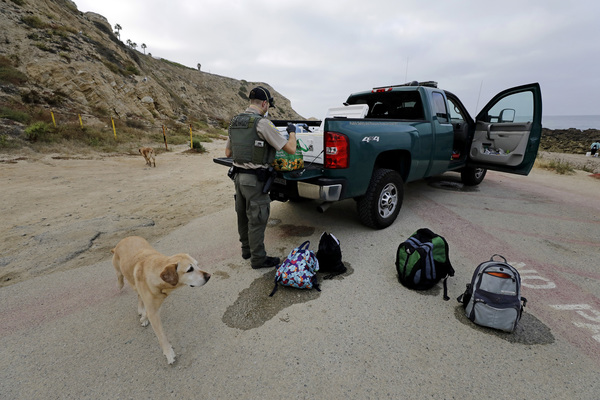
State game wardens were notified in May of crowds _ some using garden tools, screwdrivers, crowbars and, in at least one case, kitchen tongs strapped to a man's foot _ who were digging and dislodging enormous amounts of sea creatures from the tide pools and surrounding areas.
The activity, which triggered numerous edgy encounters between area residents and harvesters, appeared to be motivated by social media posts encouraging the practice to enjoy life outdoors during a time of coronavirus restrictions and high unemployment.
"It's a fun way to spend the day and grab a free dinner," Lisa Yan, 55, an unemployed casino card dealer, told the Los Angeles Times in July. "Especially for those of us who lost jobs because of the coronavirus pandemic. ... All you need is a fishing license."
"I understand how desperate people are in the midst of the coronavirus pandemic _ I get it," Feuer said. "People have lost their jobs. Peoples' rent is at stake. But to respond to that crisis by going to White Point and prying sea creatures off the tide pools in the quantities we've been seeing cannot continue."
In response to a barrage of local complaints, state game warden Douglas Wall issued roughly 50 citations at the White Point tide pools, most for harvesting sea creatures over the daily legal limits.
"Personally, I've seized well over 500 pounds of illegally taken mussels since May," he said Thursday.
Each of the charges against the 45 defendants carries a maximum punishment of six months in jail and a $1,000 fine. Some of the accused face multiple charges, which are detailed in 23 separate cases.
Under California law, it is legal to take invertebrate animals from tide pools with a sport-fishing license unless the pools are located in a marine reserve or other special enclosure.
Also, specific bag limits, seasonal restrictions, size requirements and outright bans apply to different species in different regions. For example, up to 35 purple sea urchins and up to 10 pounds of mussels can be taken in a single day, throughout the year. Lobsters, however, can be taken only from October through mid-March.
Once common starfish, now rarely seen in local coastal waters, cannot be taken at all, officials said.
In one case announced Thursday, Chunyan Gu, 55; Yanhua Ge, 56; Zhongmei Cui, 50; and Jihua Li, 48, were each charged with one count of harvesting more than 10 pounds of mussels and one count of taking marine life without a fishing license.
In a separate case, Yuming Jiang, 60, was charged with taking more than 35 black turban snails and hermit crabs.
White Point isn't the only coastal area that has seen an increase in harvesting, according to Mike Quill, marine programs director for the nonprofit Los Angeles Waterkeeper.
As part of an effort to curb illegal harvesting in the tide pools, his organization is developing public outreach programs that include distributing handouts in English, Chinese, Korean and Spanish at popular fishing areas along the Southern California coast.
"We've definitely stepped up our patrols in the area," Department of Fish and Wildlife Lt. Michelle Budish said.
In the meantime, the number of people showing up to harvest sea life at White Point has dropped significantly in recent weeks.
"But it is still going on in a limited sense at low tide after dark," Wall said. "It's people doing the same thing with flashlights."