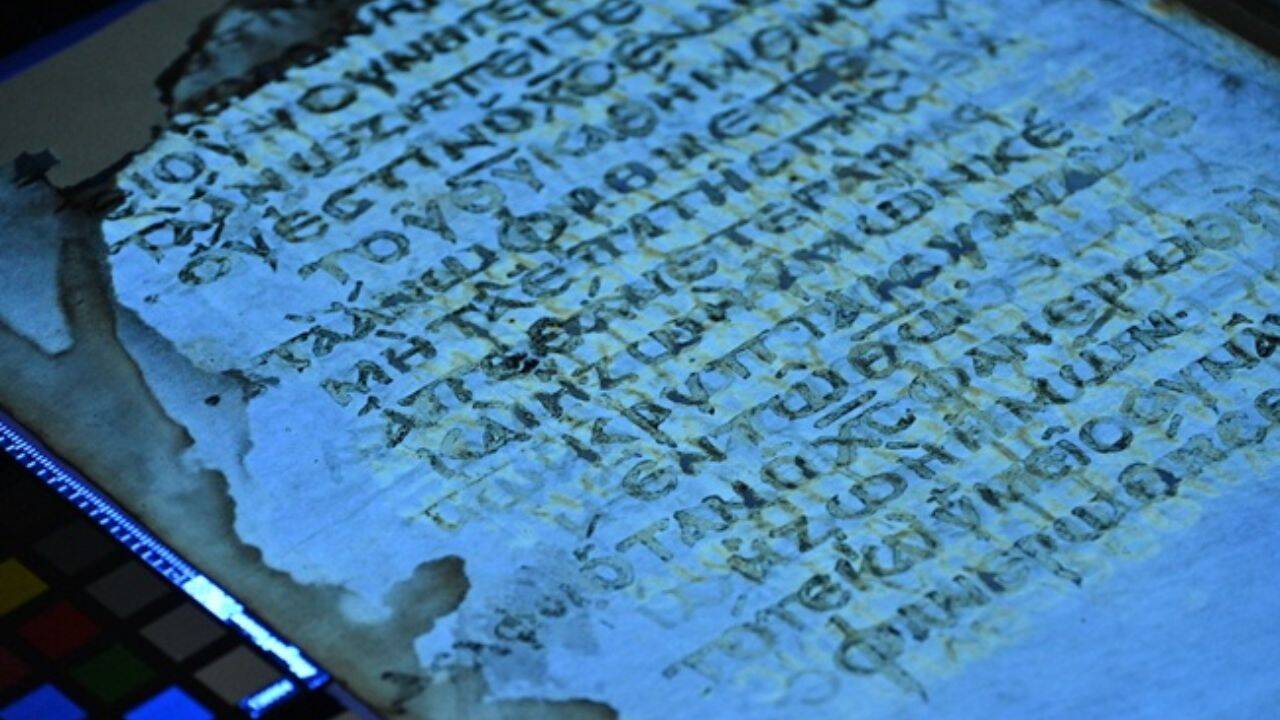
For centuries, fragments of an ancient biblical manuscript existed only as scattered pieces hidden inside the bindings of later books. What appeared to be ordinary reused parchment gradually revealed traces of a much older text, belonging to one of the earliest surviving copies of the Letters of St Paul. A team of scholars has now reconstructed dozens of missing pages from Codex H, a 6th-century manuscript whose original form had been lost after it was taken apart during the Middle Ages. Using advanced imaging methods alongside scientific testing, researchers have been able to recover writing that was no longer physically present, offering a rare glimpse into early Christian manuscript culture, medieval book recycling and the ways ancient readers organised and interpreted biblical texts.
Get breaking news anytime, anywhere. Download the TOI app now!
The forgotten manuscript that survived by becoming part of other books
Codex H was created in the 6th century as a copy of the Pauline Epistles, the collection of letters attributed to St Paul that became a central part of the Christian New Testament. For centuries, it was preserved as part of the manuscript tradition on Mount Athos, a region in northern Greece known for its monasteries and long history of safeguarding religious texts.
At some point during the 13th century, the manuscript was dismantled at the Great Lavra Monastery. Instead of remaining as a complete biblical volume, its parchment sheets were cut apart and given a new purpose. Pages from Codex H were reused as binding material and protective leaves for other manuscripts.
This was not unusual in the medieval period. Parchment was expensive and durable, and older books that were damaged, outdated or no longer needed in their original form were often recycled. In many cases, this process erased works that had survived for hundreds of years.
The remains of Codex H eventually ended up spread across several collections in Europe. Fragments were identified in libraries and archives in countries including Italy, Greece, Russia, Ukraine and France, but the original manuscript remained incomplete and difficult to reconstruct.
The invisible marks that revealed a lost Biblical manuscript
The recovery of the lost pages began with a clue hidden in the way the parchment had been reused. When medieval scribes wrote new text over the old manuscript material, the fresh ink left traces on the opposite side of the parchment. Over time, this created faint mirrored impressions known as offset damage.
These marks were almost impossible to read with the naked eye. In some cases, however, the traces preserved information from pages that no longer survived. The lost writing had effectively left behind a shadow of itself.
Working with the Early Manuscripts Electronic Library, the research team led by Professor Garrick Allen from the University of Glasgow used multispectral imaging to examine the surviving fragments. The technology captures images at different wavelengths of light, allowing researchers to separate layers of writing and reveal details hidden beneath later damage, ink and surface changes.
The process did more than improve visibility. It allowed scholars to recover information from pages that had physically disappeared centuries earlier. Each surviving fragment could contain evidence from the original manuscript as well as later reuse.
Confirming the age of the recovered fragments
Because ancient manuscripts can sometimes be difficult to date accurately from handwriting alone, the team also used scientific analysis to confirm the origin of the parchment.
Experts in Paris carried out radiocarbon dating, which supported the identification of the material as belonging to the 6th century. The results matched the historical understanding of Codex H and helped verify that the recovered material came from the early manuscript rather than from a later copy.
Combining imaging technology with scientific dating allowed scholars to rebuild parts of the manuscript with greater confidence. It also demonstrated how modern methods can uncover information hidden within objects that have already passed through many stages of use and reuse.
The manuscript that preserved more than just Biblical words
Among the recovered material were chapter lists connected to Paul’s Letters. These lists provide evidence of how early readers organised biblical texts before the chapter systems familiar to modern readers existed.
The divisions used in the manuscript do not match the chapter arrangements found in contemporary Bibles. Instead, they reflect an earlier approach to navigating and understanding the letters.
Such details may appear small, but they provide clues about how communities read scripture more than 1,400 years ago. Manuscripts were not simply containers for religious words; they also reflected the habits, choices and interpretations of the people who copied and studied them.
The recovered pages therefore add information not only about the text itself, but about the people who handled it.
The human traces hidden within a 1,500-year-old manuscript
Moreover, there is also information about the work of scribes who worked with Codex H. Corrections and notes are proof of the fact that this manuscript was a living object. As other manuscripts from ancient times, it could be changed through the process of interaction of its readers with it.
Readers made changes to the text, left corrections and notes. All these things give an idea of what happened between the reader and the manuscript, proving that biblical manuscripts were carefully preserved and used by people instead of being just kept in libraries.
This kind of information is very useful for scholars of the history of early Christianity.
The medieval life of an ancient book
The story of Codex H does not end with its creation in late antiquity. Its later history is equally significant.
The manuscript’s transformation into binding material reveals a different chapter in the life of old books. Medieval communities often had practical reasons for reusing parchment, and the physical remains of Codex H show how attitudes towards manuscripts changed over time.
A work that had once been a carefully produced copy of Paul’s Letters eventually became part of other volumes, hidden from view for centuries. The same material that caused its apparent disappearance also helped preserve fragments of its existence.
The recovered pages now offer evidence from both periods: the world of 6th-century Christian scribes and the medieval communities that repurposed older books.
Reconstructing a lost piece of biblical history
The recovery of 42 missing pages has expanded knowledge of one of the most important early witnesses to the New Testament. While the recovered passages largely contain sections already known from Paul’s Letters, their value lies in the additional information surrounding the text.
They reveal how the manuscript was structured, how scribes worked and how readers interacted with scripture long before modern printing and standardised editions existed.
The Codex H project was supported by the Templeton Religion Trust and the Arts and Humanities Research Council in the UK, with cooperation from the Great Lavra Monastery.
The manuscript that once seemed permanently fragmented can now be studied in a fuller form, not because the lost parchment was physically returned, but because technology has made it possible to recover the traces it left behind.