Confirmed cases involving variants of the novel coronavirus, thought to be more contagious, has increased particularly in Osaka and Hyogo prefectures, causing a new surge in infections.
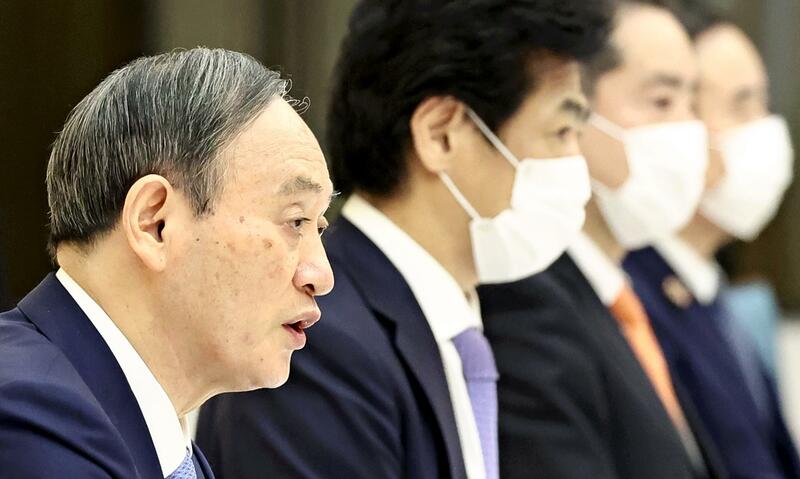
On Thursday, Prime Minister Yoshihide Suga expressed concerns that variants were detected in 50% of those who tested positive for the coronavirus in Osaka Prefecture and 70% in Hyogo Prefecture. "We will further strengthen monitoring [of the coronavirus]," Suga said at a meeting of the government's task force on COVID-19 measures.
Takaji Wakita, director general of the National Institute of Infectious Diseases who chairs an advisory body to the Health, Labor and Welfare Ministry, said, "The increase in infections in the Kansai region is linked to the variant strains."
According to data presented to the advisory body on Wednesday, tests for variants were conducted on 181 of 431 people confirmed to have contracted the coronavirus in Hyogo Prefecture during the period of March 15-21, of which 128 tested positive. In Osaka Prefecture, where 852 infection cases were confirmed during that period, 52 of 187 tested for variants came up positive.
Conversely, of 124 people who tested for variants in Miyagi Prefecture, one came up positive, while six of 87 did so during testing in Tokyo.
As of Tuesday, the combined number of confirmed cases involving variants was 801 nationwide, with Hyogo and Osaka prefectures accounting for about 40% of the total. More than 90% of the variants were of the strain first observed in Britain and are said to be highly infectious.
The higher number of variant infections in the Kansai region is said to be attributed to increased activities of young people following the lifting ahead of schedule of the state of emergency at the end of February.
"There is a possibility that a similar situation will occur in the Tokyo metropolitan area and other places," said Kazunori Tomono, head of the Osaka Institute of Public Health who chairs an expert panel of the Osaka prefectural government.
The implementation of testing for coronavirus variants varies among local governments. The Kobe city government claims that the higher detection rate is linked to an enhanced monitoring structure, such as actively testing those who have come into contact with people infected with variants. The central government has accelerated efforts to establish a nationwide system, with the aim of raising the rate of variant testing to about 40% of all infected with the coronavirus.
Coronavirus variants are spreading rapidly around the world. In Britain, the variant detected there accounted for only a slim percentage of total infection cases in October last year, but became the dominant strain by year's end.
In France, where a lockdown will be expanded to cover the entire country from Saturday, about 80% of new infections have been from the British variant. That strain has spread to 130 countries as of Sunday, according to the World Health Organization. The South African strain has been confirmed in 80 countries.
Read more from The Japan News at https://japannews.yomiuri.co.jp/