A relic from the beginning of the galaxy has finally come out of the sun's shadow. It gives us a rare look at a cosmic history that goes back before our own world. In November 2025, the interstellar comet 3I/ATLAS began its long-awaited journey back towards the outer Solar System. This caused a lot of excitement among astronomers and space agencies.
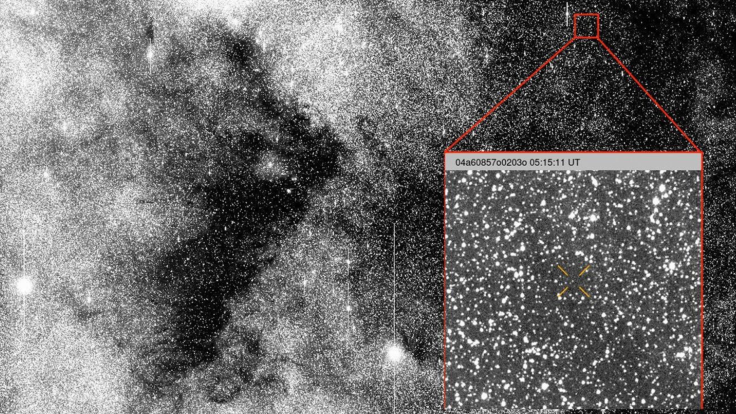
The Asteroid Terrestrial-impact Last Alert System (ATLAS) in Chile first saw this celestial wanderer on July 1, 2025. It is only the third interstellar object ever seen passing through our neighbourhood. Like the mysterious 'Oumuamua in 2017 and the comet 2I/Borisov in 2019, 3I/ATLAS is turning out to be the most exciting visitor so far.
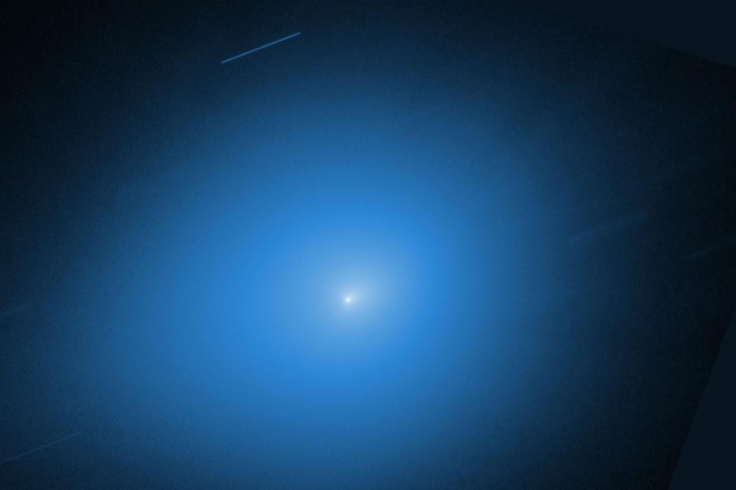
The European Space Agency (ESA) is in charge of the Jupiter Icy Moon Explorer mission, which is better known as JUICE. While the probe's primary mission involves the gas giant Jupiter, its current trajectory allowed it to capture a stunning 'teaser' image of 3I/ATLAS on Nov. 2, 2025. The encounter was a masterclass in opportunistic science; as the craft hurtled through deep space at millions of miles from its primary target, mission controllers in Darmstadt pivoted its sensors to catch a fleeting look at the visitor.
At the time, the craft was approximately 66 million kilometres (41 million miles) away from the comet — roughly two days before its closest approach. Although other missions like Mars Express and the Trace Gas Orbiter took earlier photos in October, the new JUICE data shows the comet in a far more active and dramatic state.

A Surprise Close-Up of 3I/ATLAS From Deep Space
Despite the Navigation Camera (NavCam) not being designed for high-resolution deep-space photography, the results have left the science team genuinely surprised. The image clearly displays a brilliant coma and two distinct tails — a 'plasma tail' of electrically charged gas reaching upwards and a 'dust tail' of solid particles streaming below.
This level of 'hyperactivity' — which has seen the comet spewing water and gas like a 'cosmic fire hydrant' — is the result of the object's high-velocity dash past the sun. At its peak, 3I/ATLAS reached a blistering speed of 153,000 miles per hour (68 kilometres per second) on a hyperbolic trajectory that ensures it will eventually leave our Solar System forever.
The discovery has provided a much-needed boost for the team, as they are currently working with only a quarter of the total NavCam data. The rest of the information, including high-resolution shots from the JANUS optical camera and complex spectrometry from the MAJIS and UVS instruments, is currently 'stuck' in space.
This digital bottleneck is a result of the extreme conditions the probe must endure near the sun. The delay is not due to a malfunction, but rather a clever piece of engineering; the JUICE probe is currently using its main high-gain antenna as a literal heat shield to protect its delicate internal instruments from intense solar radiation.
Consequently, the probe must rely on its smaller, medium-gain antenna to beam its findings back to Earth. This backup system operates at a fraction of the usual speed, meaning the data arrives in tiny, painstaking increments across the void. This process is significantly slower, meaning the full scientific treasure trove won't be in the hands of researchers until between Feb. 18 and 20, 2026.
Chasing the Seven-Billion-Year Secrets of 3I/ATLAS
The wait is expected to be well worth it, as 3I/ATLAS is no ordinary space rock. Scientists believe the comet could be at least 7 billion years old, with some estimates suggesting it could be as ancient as 11 billion years.
This would mean the traveller was drifting through the void of the galaxy for aeons before our sun even began to shine. By studying its composition through data from the Sub-millimetre Wave Instrument (SWI) and the Particle Environment Package (PEP), experts hope to understand the conditions of other solar systems in our galaxy's distant past.
Because 3I/ATLAS likely originated from the Milky Way's 'thick disk' — a region populated by the galaxy's oldest stars — its chemical signature acts as a biological and geological fingerprint for a completely different part of the universe. Every piece of data captured by JUICE acts as a window into an era of cosmic history that has remained hidden until now.
For now, the global scientific community remains on the edge of its seat, waiting for the remaining data to trickle across the vastness of space following the comet's recent closest approach to Earth on Dec. 19, 2025.
As scientists wait for the full data set to arrive in February 2026, 3I/ATLAS continues to redefine our understanding of the ancient cosmos. This interstellar visitor serves as a rare bridge to a time before our own world existed, offering a glimpse into the conditions of a distant part of the Milky Way.