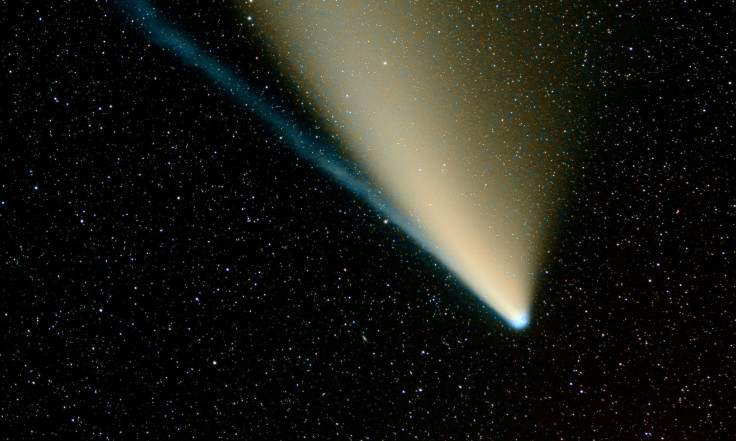
An interstellar visitor, comet 3I/ATLAS, is presenting scientists with a series of puzzles that challenge our understanding of these celestial travellers. The comet is 'surprising us', according to experts, as it exhibits a strange new blue colour and an unexpected acceleration not caused by gravity.
As new images and data from multiple space agencies emerge, researchers are racing to understand what is driving the comet's peculiar behaviour.
An Interstellar Visitor's Puzzling Colour Shift
One of the most significant mysteries surrounding 3I/ATLAS is its rapidly changing colour. The comet, which previously appeared red and green, has now taken on a distinct bluish tint. This colour change likely indicates shifting gases in its coma, the nebulous envelope around its nucleus.
Gases like cyanides and dicarbon can glow green, while carbon monoxide or ammonia could contribute to its current blue hue. However, the temporary nature of these colours, especially around its closest approach to the Sun (perihelion), continues to baffle scientists.
A Nudge From An Unseen Force?
Adding to the mystery, 3I/ATLAS is showing signs of non-gravitational acceleration. While this is not unheard of for comets, as jets of outgassing material can act like small thrusters and nudge the nucleus, the effect on this particular visitor warrants a closer look.
Given the comet's interstellar origins and a recent spike in activity, research teams are conducting a close investigation into the anomaly. This detailed analysis is needed before any conclusions can be drawn about the comet's fundamental nature.
Eyes On The Comet From Mars And Earth
Multiple space agencies now have their eyes on the interstellar object, providing scientists with data from several vantage points. China's Tianwen-1 Mars orbiter captured rare images of the comet from its position in Martian orbit, adding a new perspective to observations made by the European Space Agency's Mars Express and ExoMars probes. This combined report helps build a three-dimensional picture of its activity.
Meanwhile, with the comet now emerging from behind the Sun, Earth-based observation has resumed. The Virtual Telescope Project captured a new image on 5 November, kicking off a season that will allow astronomers to track its brightness and behaviour nightly.
BREAKING🚨: 3I/ATLAS, Interstellar comet leads NASA and Harvard to take unprecedented action in space
— All day Astronomy (@forallcurious) November 6, 2025
3I/ATLAS races through our solar system with unprecedented and bizarre anti-tail and erratic motion. pic.twitter.com/gD2IJvMBXh
What Makes 3I/ATLAS So Special?
3I/ATLAS is only the third interstellar object ever detected, following the discoveries of 1I/'Oumuamua and 2I/Borisov. It travels on a hyperbolic trajectory, meaning it will swing past our Sun once before continuing its journey into deep space.
It brightened more than predicted during its perihelion around 30 October, suggesting unusual outgassing or dust-to-gas behaviour. Furthermore, analysis from the JWST revealed its surface seems to have a radiation-altered crust up to 20 metres deep, suggesting it has weathered billions of years in interstellar space.