
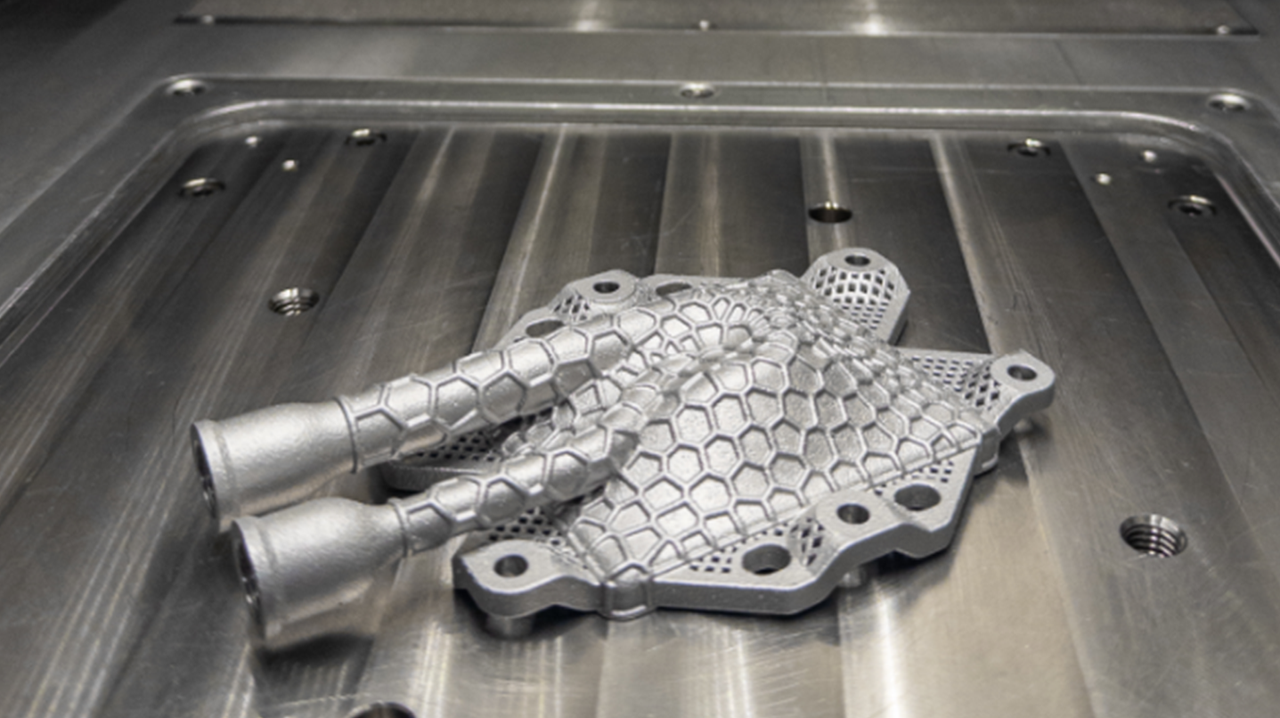
Move over, Frore, there's a new player in town. A research team comprising boffins from the Danish Technological Institute and the Heatflow company have come up with a 3D-printed cooler that can draw a whopping 600 W off a chip fully passively, without any pumps or fans, 3D Printing Industry reports. The design is naturally aimed at datacenters first and foremost, though one can imagine a world where variations on the design could work on desktop PCs and workstations.
Should the presented figures pan out, to say this cooler is impressive is quite the understatement. The original specification set an already-ambitious target of 400 W, a figure that was exceeded by a nice, round 50%.
Other than a presumably exquisite internal layout, this heatsink doesn't seem to have any special tricks. It's a standard two-phase thermosiphon, where coolant heats up and evaporates at the bottom, and condenses into vapor at the top, coming back down via gravity alone. The part shown in the picture is the heatsink that will connect to a radiator somewhere without any moving parts needed for the heat transfer.
The cooler's dissipation ability is impressive enough, but the liquid that goes out of it is claimed to be at 60 to 80°C, making it easy to recover and use in other heating networks for a double-whammy. The report claims these figures are superior to standard datacenter cooling that whisks away heat at lower temperatures, making it harder to reuse.
Seeing as the cooler is 3D printed, it has very little material wastage for production and only employs one material, making for efficient production and easy recycling. The underlying chip temperatures should also be lower than with conventional designs, helping with their longevity — a boon for AI accelerators that tend to live fast and die young, with exceedingly high failure rates.
The project's budget is arguably even more surprising than the end results. All it seemingly took was 10 million Danish Crowns (DKK), a figure that translates to $1.56 million, or 1.34 million euros. We do hope this technology makes its way to our gaming PCs... whenever we can afford RAM again.

Follow Tom's Hardware on Google News, or add us as a preferred source, to get our latest news, analysis, & reviews in your feeds.