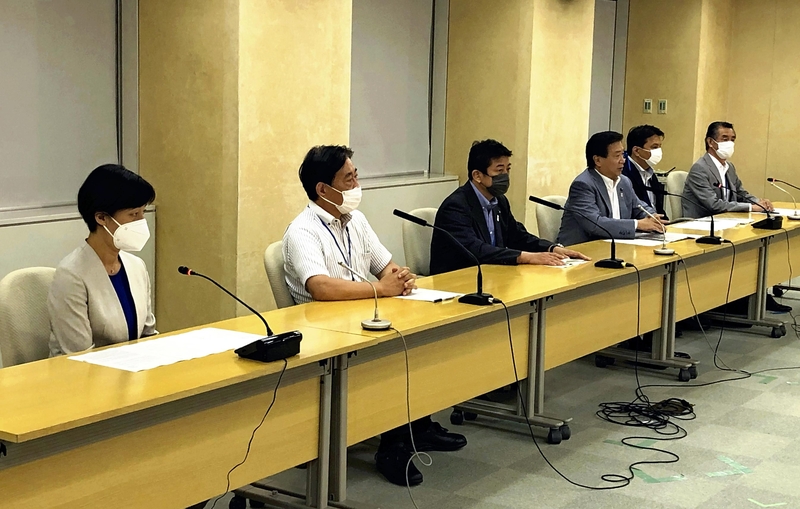
Thirty-four prefectural governments in Japan have not provided personal information on COVID-19 patients recuperating at home, such as their names, to municipalities under their jurisdiction, according to a survey conducted by The Yomiuri Shimbun.
Many prefectural governments cite the protection of personal information as a reason. Municipalities that do not operate public health centers are struggling to confirm the whereabouts of patients and support their daily life needs.
As the number of homebound patients has continued to rise in the fifth wave of the pandemic, there were more than 100,000 people under treatment at home nationwide as of Aug. 25.
There have been a number of cases in which patients have died due to a sudden worsening of their symptoms while they were recuperating at home, and it is getting more difficult for public health centers, which manage information on infected patients, to provide daily support for home patients, such as health monitoring and food delivery.
Therefore, the revised Infectious Diseases Control Law, which took effect in February, states that prefectural governments should make efforts to cooperate with municipalities as necessary. In August, the Health, Labor and Welfare Ministry issued a notice to prefectural and municipal governments asking them to cooperate in providing daily life support to COVID-19 patients staying at home, expecting them to share patients' personal information for that purpose.
However, when The Yomiuri Shimbun asked all 47 prefectures nationwide from Monday to Wednesday about whether they provided local municipalities with personal information on COVID-19 patients held by prefectural public health centers, such as their names, addresses and contact details, 34 prefectures said they had not provided such information.
Of them, 19 prefectures, including Tokyo and Fukuoka, said it would violate or might violate their own ordinances on protecting personal information to provide such information.
Five prefectures, including Nagano and Okayama, said they have not offered such information because they have received no such requests from municipalities.
Another five prefectures, including Iwate, Akita and Wakayama, said they have not provided such information because there are no COVID-19 patients recuperating at home in their prefectures.
Some prefectures replied that care for patients at home has been sufficiently handled by health centers.
Meanwhile, 13 prefectural governments that do provide information on COVID-19 patients at home have taken cautious measures, with many of them obtaining consent from the patients on information sharing.
Kanagawa and Gunma prefectures have concluded agreements or memorandums with local governments that clearly state the purpose of using information, and where responsibility lies, to enable sharing of information quickly without a patient's consent.
Of the 1,741 municipalities in Japan, about 1,600 are under the jurisdiction of prefectural public health centers. Meanwhile, 110 municipalities have their own health centers.
"Without the provision of personal information, prefectural governments cannot cooperate with municipalities. While medical care is in short supply and it is difficult for patients to be admitted to hospitals, prefectural governments should provide active support in collaboration with municipalities, to help patients who are recuperating at home and are in a distressed condition," said Takeshi Hitomi, a professor of administrative law at Waseda University.
Read more from The Japan News at https://japannews.yomiuri.co.jp/