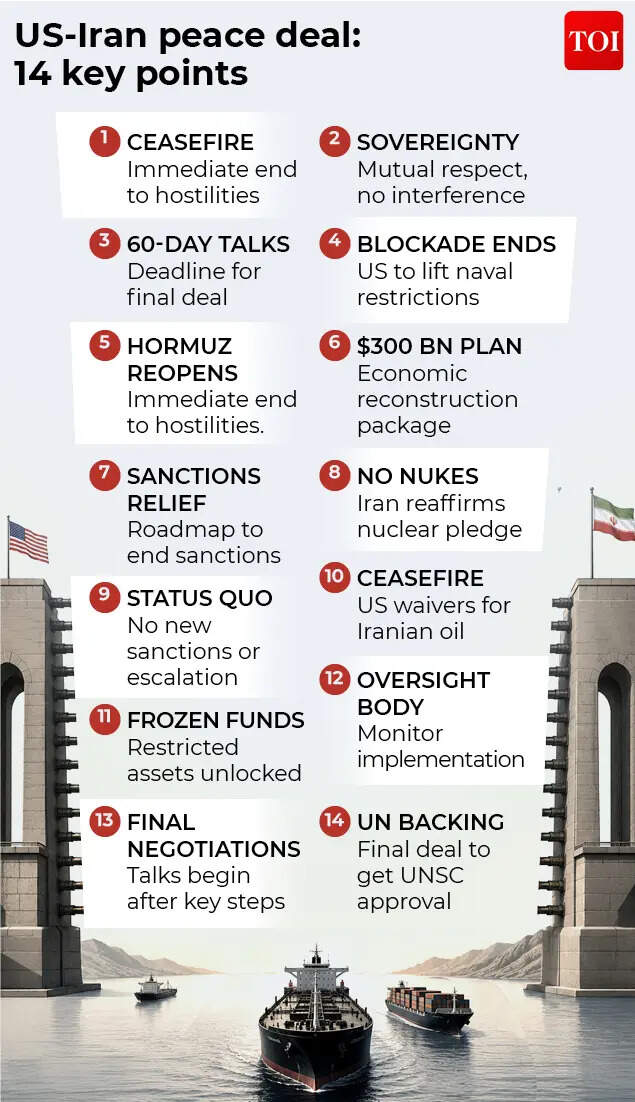
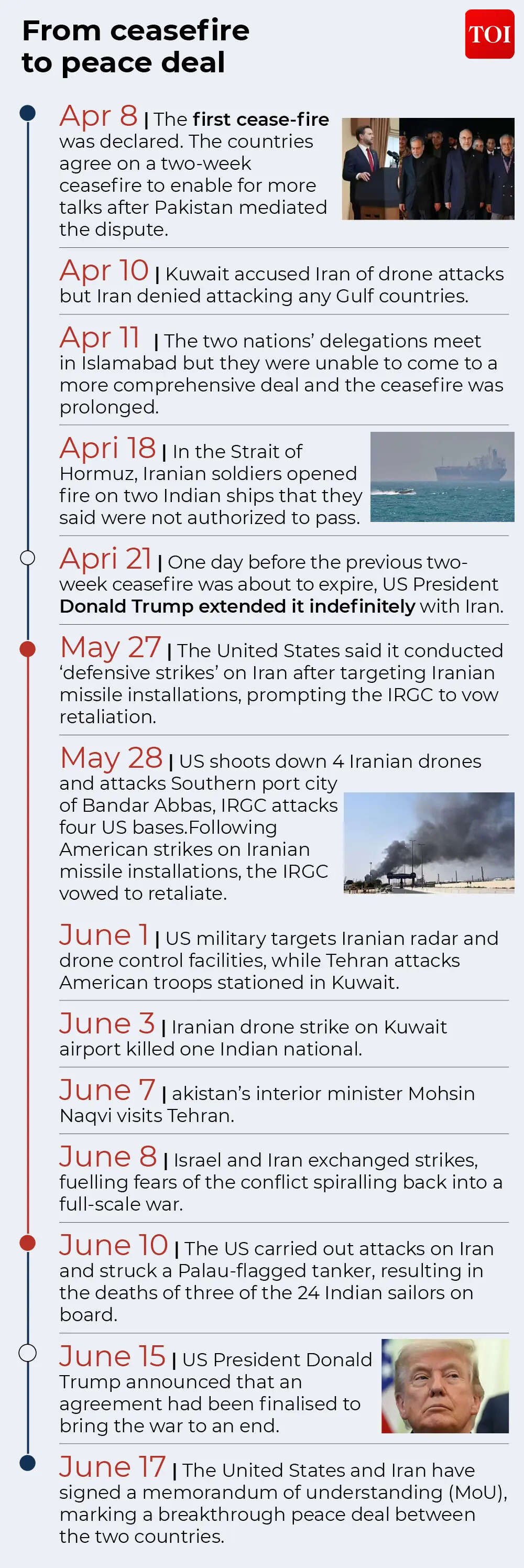
The US-Iran peace memorandum of understanding (MoU) outlines a sweeping framework aimed at ending military confrontation, opening the Strait of Hormuz, releasing Iran's frozen assets and providing $ 300 billion for reconstrction and opening the door for long-term negotiations.
Get breaking news anytime, anywhere. Download the TOI app now!
While the agreement still requires a final deal within 60 days, both sides stand to gain significant strategic, economic and diplomatic benefits.
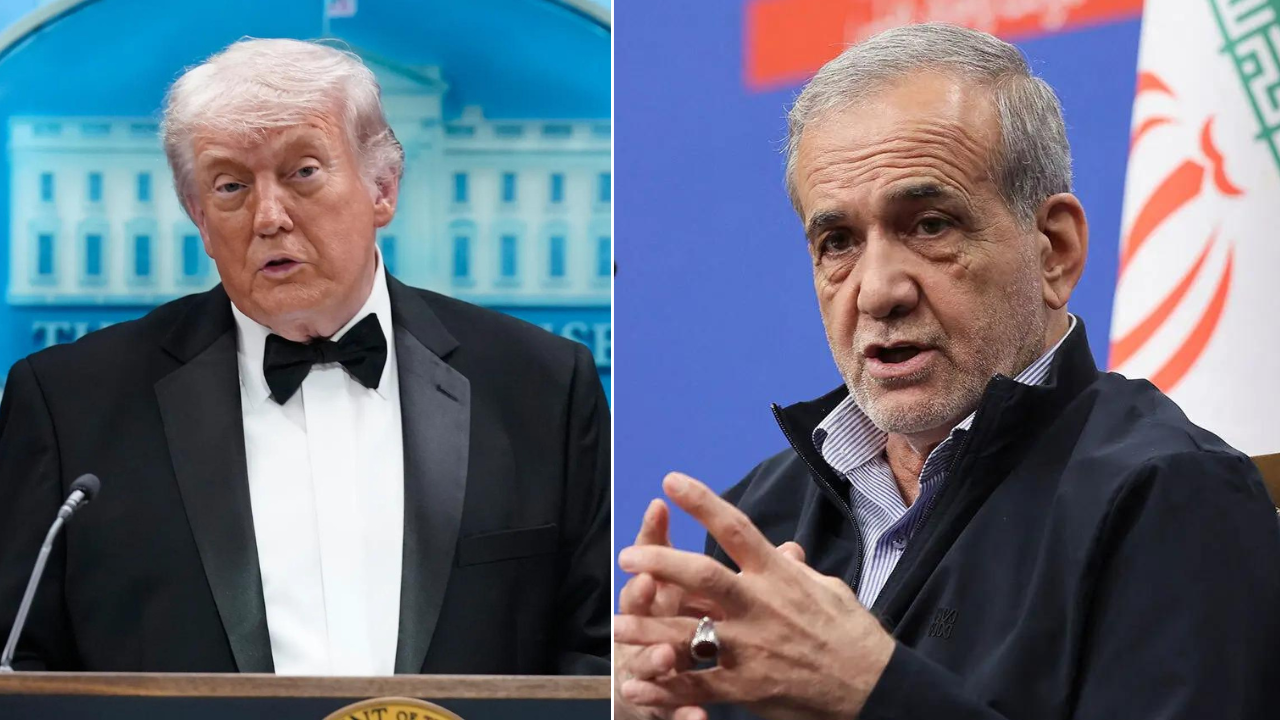
The 14-point memorandum of understanding (MoU) signed virtually by US President Donald Trump and Iranian President Masoud Pezeshkian on Thursday sets out a roadmap for ending military hostilities, restoring commercial movement through the Strait of Hormuz and beginning a 60-day negotiation process towards a final agreement on sanctions relief, economic cooperation and Iran’s nuclear programme.
However, the parties can still walk away from the memorandum of understanding they are set to sign on Friday, and upcoming talks are likely to focus on the precise sequencing of the steps previewed in the preliminary accord, Reuters reported citing a US official.
"I think the meeting in Switzerland will be quite critical in order to really see how we get to the next phase," they said.
"It has to be a situation where both parties... agree on the full magnitude of what both parties are going to do, and then come up with a sequencing agreement on who's going to do what when, and that's really where the crux of the negotiations will go," they added.
What Iran stands to gain
Relief from sanctions, economic recovery
A major gain for Tehran would be the removal of extensive US and international sanctions. The MoU states that Washington would work towards ending all sanctions, including unilateral US measures and restrictions linked to the United Nations Security Council and the International Atomic Energy Agency (IAEA).
The agreement also provides for the issuance of waivers allowing Iranian crude oil exports, petroleum products and related banking, insurance and transportation services to resume.
"The United States of America undertakes to terminate all types of sanctions against the Islamic Republic of Iran, including the United Nations Security Council resolutions, IAEA Board of Governors resolutions, and all unilateral US sanctions, primary and secondary, in an agreed upon schedule as part of the final deal," the MoU said.
For Iran, sanctions relief could unlock access to frozen funds, revive trade and attract foreign investment after years of economic isolation.
Access to frozen assets
Under the agreement, the US would make Iran’s frozen or restricted funds and assets available for use once the MoU is implemented. The two sides would negotiate procedures for releasing these funds, which could then be used for payments designated by Iran’s central bank.
The move could provide Tehran with much-needed financial resources to stabilise its economy.
"The United States of America undertakes to make fully available for use the frozen or restricted funds and assets of the Islamic Republic of Iran upon the implementation of this MOU. The United States of America and the Islamic Republic of Iran will mutually agree on the procedures related to the release of these funds during negotiations," it said.
$300 bn for reconstruction
The MoU includes a commitment by the US and regional partners to develop a plan worth at least $300 billion for Iran’s reconstruction and economic development.
The framework says the mechanism for implementing the investment plan would be finalised as part of the final deal within 60 days.
"The United States of America undertakes with regional partners to develop a definitive, mutually agreed plan with at least $ 300 billion for the reconstruction and economic development of the Islamic Republic of Iran. The mechanism for the implementation of this plan will be finalized as part of a final deal within 60 days," the MoU said.
Removal of US naval blockade
The US committed to remove naval blockade against Iran. It also said that it would remove its forces from the proximity of Iran within 30 days after the final deal.
"Immediately upon the signing of this MoU, the United States of America will begin the removal of its naval blockade and any disturbances or impediments against the Islamic Republic of Iran, and will fully end the naval blockade within 30 days. During this period, the traffic of vessels will be in proportion to the numbers of pre-war traffic being restored by the Islamic Republic of Iran. The United States of America further undertakes to remove its forces from the proximity of the Islamic Republic of Iran within 30 days after the final deal," the MoU said.
Security assurances, reduced military pressure
Iran would benefit from a commitment by both sides to end military operations and avoid future use or threats of force against each other.
The agreement also includes a US pledge to remove its naval blockade and end the deployment of forces near Iran after the final deal is reached.
Nuclear negotiations without immediate escalation
The MoU acknowledges Iran’s commitment not to develop nuclear weapons while allowing discussions on its nuclear programme, including enrichment and the handling of enriched material.
Until a final agreement is reached, both sides would maintain the status quo — Iran would freeze its nuclear activities at their current level, while the US would avoid imposing new sanctions or deploying additional forces in the region.
What US stands to gain
Limits on Iran’s nuclear programme
A key US objective is ensuring that Iran does not develop nuclear weapons. Under the MoU, Tehran reaffirms that it will not pursue nuclear weapons and agrees to negotiate mechanisms for dealing with its stockpiled enriched material under IAEA supervision.
A final agreement would also establish a framework for addressing Iran’s enrichment activities and broader nuclear needs.
"The Islamic Republic of Iran reaffirms that it shall not procure or develop nuclear weapons. The United States of America and the Islamic Republic of Iran have agreed to resolve the disposition of stockpiled enriched material pursuant to a mechanism that will be mutually agreed upon in accordance with the schedule mentioned in paragraph seven, with the minimum methodology to be down blended on site under the supervision of the IAEA," the MoU said.
Hormuz opens
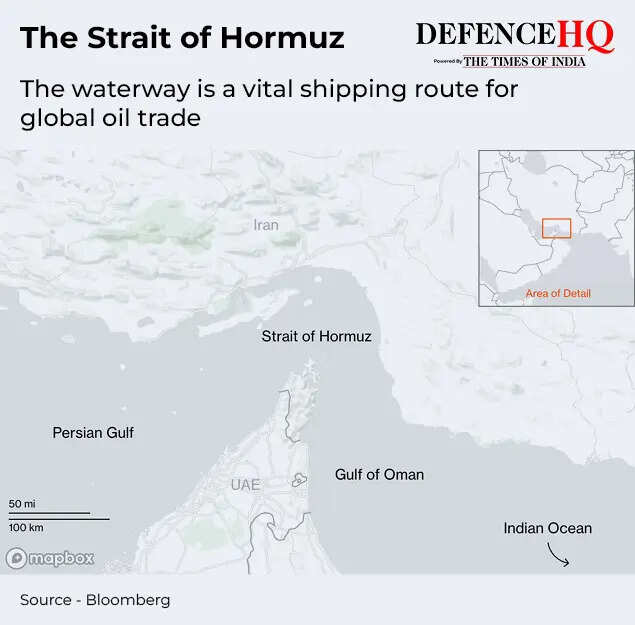
The deal includes arrangements for restoring commercial shipping through the Strait of Hormuz, one of the world’s most important energy routes.
Iran has committed to facilitating safe passage for commercial vessels for an initial 60-day period while discussions continue on future maritime arrangements involving Oman and other Gulf states.
"Upon the signing of this MOU, the Islamic Republic of Iran will make arrangements using its best efforts for the safe passage of commercial vessels with no charge, for 60 days only, from the Persian Gulf to the Sea of Oman and vice versa. The traffic of commercial vessels will immediately start, and considering the need for removing the technical and military obstacles, and demining by the Islamic Republic of Iran will be instated within 30 days," the MoU said.
"The Islamic Republic of Iran will conduct dialog with the Sultanate of Oman to define the future administration and maritime services in the Strait of Hormuz in discussion with other Persian Gulf littoral states in line with the applicable international law and the sovereign rights of coastal states of the Strait of Hormuz," it added.
Diplomatic alternative to prolonged conflict
For Washington, the agreement creates a diplomatic channel with Tehran rather than relying solely on military pressure and sanctions.
The MoU also proposes an executive mechanism to monitor implementation and ensure compliance with the final deal.
"The United States of America and the Islamic Republic of Iran agree that an executive mechanism will be established to monitor the successful implementation of this MOU and the future compliance of the final deal," it said.
131820420
Despite the broad commitments, the agreement leaves many details to be negotiated. The two sides have agreed to work towards a final deal within 60 days, covering issues including sanctions removal, nuclear restrictions, economic cooperation and security guarantees.
The success of the agreement will depend on whether Washington and Tehran can move from commitments on paper to verifiable actions on the ground.