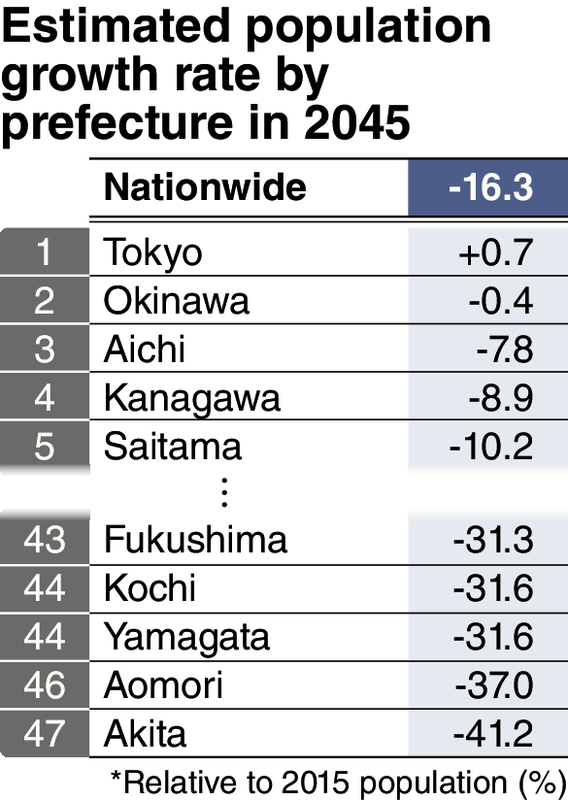
The populations of all prefectures but Tokyo are likely to decline from 2015 to 2045, according to the latest estimate announced by the National Institute of Population and Social Security Research.
According to the Regional Population Projections for Japan released on Friday, the total population of the country will be 106.42 million in 2045, a decrease of 20 million from the 2015 figure. The projection shows declining populations in the 46 prefectures besides Tokyo, and continued concentration of the population in the capital.
The ratio of elderly people aged 65 or older is expected to account for more than 30 percent in every prefecture in 2045, according to the same report.
With the 2015 national census as a baseline, the institute estimated population changes in each prefecture and municipality in five-year increments for the 30 years until 2045.
The nation's population is expected to begin shrinking in all prefectures sometime between 2030 and 2035 or after, according to the report. The previous projection released five years ago predicted it would begin declining sometime between 2020 and 2025.
The latest projection thus pushes the starting year for a decline across all prefectures back by 10 years, reflecting the improving birthrate in recent years.
Compared to the previous estimate, the pace of population decline is expected to slow. However, the overall trend of population decline remains unchanged because the number of births was below 1 million in 2016 and 2017, according to the report.
Tokyo's population will reach its peak in 2030, and the figure for 2045 will surpass the 2015 figure by only 0.7 percent.
By prefecture, Akita will see the largest drop at 41.2 percent from the 2015 figure, followed by Aomori's 37.0 percent and Yamagata's and Kochi's 31.6 percent.
By municipality, the population of Kawakami, Nara Prefecture, is expected to drop by 79.4 percent; that of Utashinai, Hokkaido, by 77.3 percent; and that of Nanmoku, Gunma Prefecture, by 77.0 percent.
The population of people aged 65 and older is estimated to significantly increase in the large metropolitan areas and Okinawa Prefecture.
In Tokyo, Kanagawa and Okinawa prefectures, the number of people in this age category is expected to increase by 30 percent or more compared to the 2015 figure.
However, in Akita, Toyama, Wakayama, Shimane, Yamaguchi, Kochi and Tokushima prefectures, the number of people in this age category will peak in 2020 and begin declining as their entire populations decline.
In 2045, 36.8 percent of people nationwide are expected to be 65 or older, with the figure likely reaching 40 percent or more in 19 prefectures.
In Akita Prefecture, the percentage of elderly people is estimated to reach 50.1 percent in 2045. For the first time, at least one in every two people in a prefecture in Japan will be elderly, according to the estimate.
The percentage of people aged 75 or older will also surpass 20 percent in 43 prefectures.
The number of municipalities where the percentage of people aged 65 and older will account for 50 percent or more will surge to 456, or 27.6 percent, in 2045 from 15, or 0.9 percent, in 2015.
In 2045, the number of municipalities where the population of people aged younger than 15 will drop by more than 40 percent from the previous estimate will be 1,060, or 63 percent.
Read more from The Japan News at https://japannews.yomiuri.co.jp/