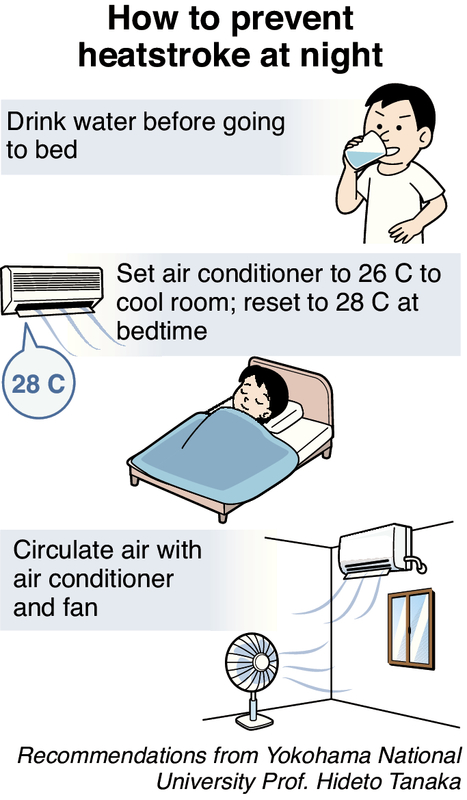
About 30% of the deaths from heatstroke in Tokyo over the past 10 years occurred at night, according to the Medical Examiner's Office in the metropolitan government.
This summer alone, 32 people have died of heatstroke at night. The number of "tropical nights," which are defined as nights with a minimum temperature of at least 25 C, has been increasing in recent years, and the heat has continued through the evenings this month. Experts are urging people to be aware of the health risks.
-- 300 deaths in 10 years
According to the Medical Examiner's Office, 996 people died of heatstroke in Tokyo's 23 wards from 2010 to 2019, with 301 people -- including those whose time of death was estimated from the condition of their body -- dying between 5 p.m. and 5 a.m.
In the summer of 2018, when the mercury hit a record high of 41.1 C in Kumagaya, Saitama Prefecture, 56 people died in the 23 wards at night. Forty people died during that time period in 2019.
The office has monitored since 2011 whether victims were using air conditioning, and 75% of all the people who died were not using it.
This summer has seen a record heat wave, with 11 tropical nights seen in Tokyo from Aug. 1 through Monday. The rainy season was said to have ended in the Kanto-Koshin region on Aug. 1.
Of the 79 people who died this month, about 40% -- or 32 people -- died at night, exceeding the 25 who died during the daytime, or between 5 a.m. and 5 p.m. The office could not determine when the remaining 22 people died.
Of the 32 who died at night, 30 people were aged 65 or older, and 28 of them either did not have an air conditioner or did not have it turned on.
In the case of a woman in her 80s who was found dead on the morning of Aug. 11 in an apartment in Kita Ward, Tokyo, the temperature was nearly 30 C from the night of Aug. 10 until dawn on Aug. 11. The air conditioner in her apartment was out of order.
-- More tropical nights
The number of tropical nights has been increasing in recent years. The Japan Meteorological Agency checked the number of tropical nights at 13 locations nationwide, including Hokkaido, Chiba and Kagoshima prefectures, and found the nighttime temperature was 25 C or higher for 7.51 days a year on average from 1910 to 1919.
Since then, however, the number of tropical nights has increased year by year. It was 14.39 days a year between 1950 and 1959, exceeded 20 days for the first time from 1990 to 1999, and then increased to 27.17 days between 2010 and 2019.
This is believed to have been caused by factors including the heat-island phenomenon, in which heat is trapped in the Tokyo metropolitan area due to a growing number of concrete buildings, and global warming, in which an increase in greenhouse gases raises air temperatures.
Hot nights have continued throughout the country this month. Many regions across Japan saw a tropical night on Monday, with temperatures of 25 C or higher in Nagoya, Osaka and Fukuoka.
According to the Japan Meteorological Agency, the Japanese archipelago tends to be covered by a high-pressure system until the end of this month, causing uncomfortable nights.
"It's dangerous because you may get dehydrated without noticing it at night and end up in serious condition," said Chukyo University Prof. Takaaki Matsumoto, who is an expert on heatstroke.
Read more from The Japan News at https://japannews.yomiuri.co.jp/