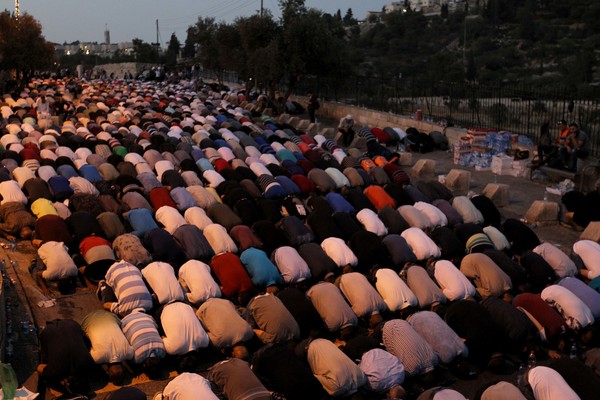
TEL AVIV, Israel _ Violent clashes with Israeli security forces across East Jerusalem and the West Bank left three Palestinians dead and hundreds injured Friday after thousands of Muslim worshippers held midday prayers in the streets around Jerusalem's Old City, in one of the worst days of unrest in years.
Palestinians called the mass prayer gatherings to protest new Israeli metal detectors at the entrance to a plaza holy to Jews and Muslims outside of the Al-Aqsa Mosque _ a move that escalated tensions in recent days because it is viewed as an effort by Israel to tighten control over the religious site.
In a rare sight, worshippers filled Salah el Din street, an East Jerusalem commercial thoroughfare just outside Herod's Gate, as demonstrators chanted, "Oh armies, destroy their thrones" and "Rattle the knife."
Despite fiery sermons and chants opposite hundreds of Israeli riot police around the Old City, the noontime prayers ended with only isolated incidents of violence. But in the hour or so after the crowds dispersed in the vicinity of the Old City, the clashes began to spread throughout East Jerusalem and to the West Bank.
Rioters hurled rocks, Molotov cocktails and firecrackers, and security forces responded with tear gas and stun grenades. An Israeli police spokesman said five officers were slightly injured and they arrested about a dozen rioters. Palestinian medics said they treated people who had been injured with rubber and live bullets.
The dead included Mohammed Sharaf, 18, and Hassan Abu Ghannam, 20, who were killed amid clashes in the Jerusalem neighborhoods of Ras el Amud and A Tur, respectively. Mohammed Lafi was killed in the West Bank town of Abu Dis, just outside the Jerusalem border. According to the Palestinian Red Crescent, nearly 400 demonstrators were injured during the Friday clashes.
Mourners carried bodies of the dead through the streets and chanted, "We will continue the fight." Meanwhile, scuffles broke out at Al Makassed hospital in East Jerusalem when Israeli police arrived to search for suspects in the rioting.
In the West Bank, clashes and casualties were reported in the Qalandiya refugee camp, in Bethlehem and Hebron. In Gaza, Palestinians held demonstrations near Israeli military positions along the border.
The casualty count and the widening chaos seemed to confirm warnings through the week about the risk of a dangerous escalation from the standoff over the metal detectors and the esplanade. The site, known to Muslims as the Noble Sanctuary and to Jews as the Temple Mount, is a tinderbox of religious tensions, and has touched off waves of Palestinian-Israeli violence in the past.
The Muslim Waqf authority responsible for the Al-Aqsa Mosque has encouraged believers to demonstrate opposite the metal detectors, but not to go through them. Amid pressure to diffuse the tension, Israel in recent days had been holding quiet talks with Jordan, which is the official custodian of the Muslim holy sites in Jerusalem.
Israeli media reported that security leaders were divided over what to do about the metal detectors, with the Israeli army and the Shin Bet supporting removing the equipment and the police recommending that they remain in place.
But following an emergency session hours before the prayers, Prime Minister Benjamin Netanyahu's Cabinet decided to keep the metal detectors in place.
"The metal detectors are a critical tool for ensuring the security of all visitors to the mount," said Israeli Public Security Minister Gilad Erdan before the Cabinet meeting, according to the Israeli news outlet Maariv-NRG.
The police imposed an age restriction for the first time in years, banning male worshippers under the age of 50 from participating _ further inflaming accusations.
As the casualty count rose, Palestinian Authority President Mahmoud Abbas convened an emergency meeting Friday evening at his headquarters in Ramallah.
The escalating crisis was touched off a week ago, after three Palestinian citizens of Israel ambushed two Israeli policemen with machine guns outside the Temple Mount and then were killed by police on the plaza. Israel closed the esplanade for two days, and canceled Friday prayers for the first time in decades. When the holy site was reopened, police installed metal detectors outside two entrances to the plaza to check worshippers.
The violence on Friday didn't result in the worst-case scenarios that Israeli security officials feared. Israel's army on Friday afternoon released two of five batallions put on alert a day before.
But the deaths, the high number of casualties and the breadth of the unrest increased the likelihood that the unrest will continue into the coming days.