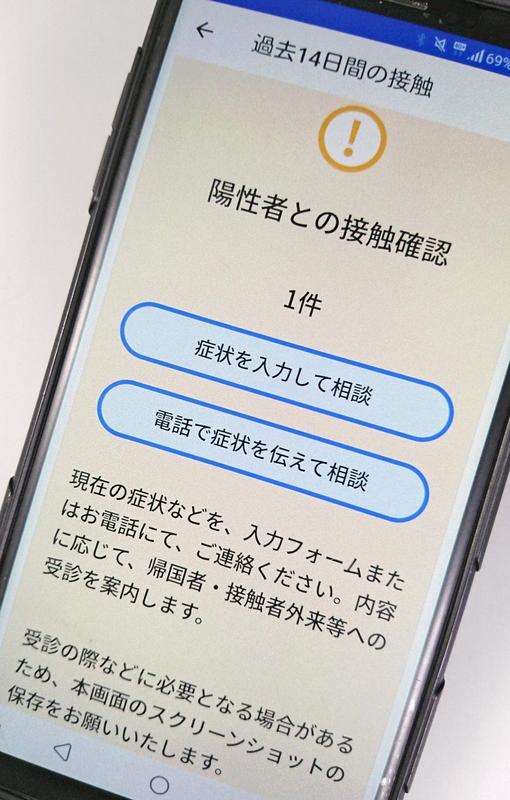
Three months have passed since the health ministry introduced a smartphone app that alerts users they may have been in contact with people infected with the novel coronavirus. However, the app, called COCOA, has been downloaded by slightly over a tenth of the population, far below the 40% yardstick needed to show the app's effectiveness.
Widespread acceptance of the government-initiated app has faced many hurdles, such as some users not being able to get virus tests quickly enough after being notified about possible exposure to infection.
-- Tests not widely available
Shortly after 2 p.m. on Aug. 25, a 47-year-old woman who teaches English in Yokohama received a notification on her smartphone through the app, saying, "Contact with a positive tester confirmed."
The woman had no COVID-19 symptoms, but was notified that she had possible contact with a person who tested positive for the coronavirus 10 days earlier on Aug. 15. She had visited Tokyo by train on that day.
The woman wanted to take a PCR (polymerase chain reaction) test, but could not get through to a call center linked to the app. The following morning, she called her nearest consultation center, set up for those who returned from overseas and had possible contact with infected people. However, she was told by a person in charge: "You can take a PCR test, but hundreds of people are waiting now. So your turn will probably come in September or later."
A test kit to take a saliva sample was delivered to her home on Sept. 1, and she received a negative test result on Sept. 8. From the possible contact with an infected person on Aug. 15, it took more than three weeks until her negative test result arrived.
"While waiting to take the test, I was very worried that I might have infected people around me," she said. "Unless the testing system isn't improved, the app is meaningless."
-- Downloads far below yardstick
According to the Health, Labor and Welfare Ministry, as of Thursday, downloads of the app totaled about 17.04 million, or 13% of the population. There are estimates that the app needs to be used by 40% or 60% of the population to make it effective.
If users of the app are infected with the virus, they register a number issued by a public health center. As of Thursday, only 796 infected people had made such a registration.
When the app was launched, the ministry initially did not actively recommend giving tests to users who had no symptoms or had no idea about contact with positive testers, even though they were notified about possible contact by the app. Given that, some public health centers declined to conduct tests on such people.
A number of the app's users complained about a possible situation in which they could not take tests despite receiving notifications. On Aug. 21, the ministry called for relevant bodies to establish a system that will enable all notified people to take tests at public health centers and other places if they want to.
The ministry does not bring together all the basic information, such as the number of infected people who have been issued a registration number by a public health center and the number of app users who have taken tests after receiving notifications.
"We don't know the real situation," a ministry official said.
-- Accuracy questionable
There is also a problem with the app's accuracy.
In Tsuruga, Fukui Prefecture, employees of the city government received notifications of possible contact with infected people on their smartphones one after another on Aug. 23. According to a probe by the city government, 59 people received the notifications as of Aug. 25. But they all tested negative for the virus.
Meanwhile, the city government was understaffed at its main building and forced to post a notice at the counter on the first floor, saying, "We have been short on staff."
According to the city government, there had been no events in which all of its employees participated together, and some officials had been away from the city hall on days they were believed to "have contact" with infected people.
Mayor Takanobu Fuchikami has urged the central government to look into this incident.
"It's hard to believe that employees had contact with infected people at the city hall," Fuchikami said. "I want [the central government] to investigate the cause thoroughly."
According to the ministry, there have been reports that users received contact notifications, but when they opened them, they were led to a message saying, "No contact was confirmed." Urged to improved the accuracy of the app, the ministry has released three updates so far.
"Problems with the system should be corrected immediately," said Takayuki Mizuno, an associate professor at the National Institute of Informatics. "The central government needs to examine the current state of the use of the app and increase user satisfaction."
Read more from The Japan News at https://japannews.yomiuri.co.jp/