Three major convenience store chains are considering jointly delivering their products to stores by sharing trucks. They are joining hands to resolve driver shortages, as well as to help government efforts to reduce traffic congestion. Since the three have been rivals competing fiercely to open new stores, many issues need to be resolved in order to build a cooperative structure.
On Aug. 1-7, the first field experiment involving 40 stores from the three chains -- 13 operated by Seven-Eleven Japan Co. and FamilyMart Co. each and 14 by Lawson Inc. -- were conducted around Odaiba, Tokyo.
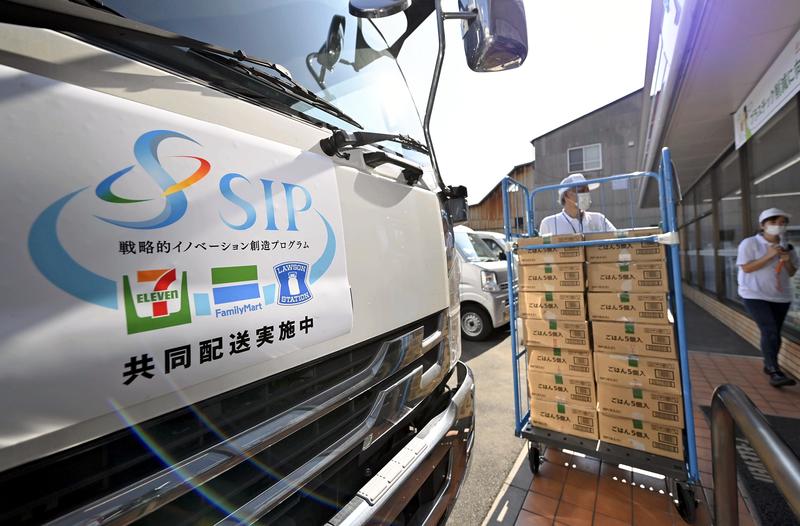
First, the three companies transported their products to a distribution center in Tokyo from their facilities using their own trucks. Then, products were reloaded to a common delivery truck and delivered to stores located close to each other. The corporate logos of the three chains were placed at the front of the delivery trucks during the experiment.
The biggest advantage of a joint delivery is that trucks can load more products and more efficiently visit stores quickly. For example, when products are delivered to five stores, the mileage is shorter if the nearby stores of other chains are included.
Based on results of the experiment, the loading ratio, which indicates how much cargo is loaded on a platform, will increase by about 10 percentage points to about 60% compared to the conventional way in which each chain only delivers its own products. To deliver to 40 stores 13 trucks per day were needed by three chains in the past, but this is estimated to be reduced to 10 trucks per day. At the same time, fewer drivers will be needed.
The largest chain, Seven-Eleven, which has about 21,000 stores across the nation, uses over 6,000 trucks. If joint delivery could be implemented nationwide, trucks and drivers could possibly be reduced by 30%.
In June, the ratio of job offers to job seekers for truck and other vehicle drivers was 1.92, far exceeding the ratio of 0.97 for all other occupations. The spread of the coronavirus has boosted the popularity of mail and web order services. As demands for deliveries are expected to increase, "a severe shortage of drivers is likely to continue for the time being," an industry source said.
The Economy, Trade and Industry Ministry took the initiative in approaching the three companies to carry out the experiment. In addition to reducing labor shortages and traffic jams, the system is expected to also reduce carbon dioxide emissions. The three companies are set to examine the results of the experiment, and they plan to consider expanding the areas and ranges of products subject to joint delivery.
However, the complicated delivery system could become a bottleneck. In the convenience store industry, delivery are separated by temperature range such as frozen food, prepared food and sundries. Truck delivery to each store could become as frequent as about 10 times a day.
The products handled by the experiment, such as instant noodles and sundries, were relatively easy to control temperature. From now on, however, the joint delivery project aims to include bento boxed lunches and rice balls, which will require strict temperature control. They are hot-selling products, so stores hope to place the products on the shelves as soon as they arrive. The order of the joint delivery trucks going to each store would be difficult to coordinate among companies and stores.
A review of convenience stores' 24-hour operation that started in earnest last year, is also expected to backfire. Even stores that close late at night may need to make staff members wait for a delivery truck as delivery times would become less flexible.
"Concerns remain over possible mistakes caused by the introduction of joint delivery," said an owner of a Seven-Eleven store in Tokyo.
Read more from The Japan News at https://japannews.yomiuri.co.jp/