
It was the French historian Pierre Nora who coined the term lieux de mémoire – “sites of memory”. He meant to suggest that places and objects can embody or contain personal and collective memories, and that such memories can also obtain in the intangible – in a scent or a colour, for instance. “Even an apparently purely material site, like an archive,” Nora wrote,
becomes a lieu de mémoire only if the imagination invests it with a symbolic aura […] Lieux de mémoire are created by a play of memory and history […] To begin with, there must be a will to remember.
This seems a reasonable starting point with the collections under review, for it seems to me that poems might arise from sites of memory, and can also be them. Each of these collections brings imagination to bear on material objects and places, on works of art, documents and archives. Each invokes a degree of play, and even contestation, between memory and history.
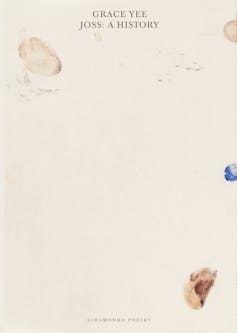
Review: Joss: A History – Grace Yee (Giramondo); Essence – Thuy On (UWA Publishing); Kangaroo Unbound – Luke Johnson (Puncher & Wattmann)
Joss: A History
Of the three, Grace Yee’s Joss: A History concerns itself most explicitly with writing back to history and the historical record, acknowledging those who have been left out, misrepresented and maligned, or excised from official accounts. The history in question is that of early Chinese settlers in Australia and New Zealand.
Yee’s method might be described as documentary or archival poetics, a method also employed by other contemporary Australian poets, Natalie Harkin most obviously.
The majority of the poems in Joss: A History incorporate verbatim or adapt lines and sentences from a range of sources (poems, newspapers, novels, etc.). As explained in the book’s notes, of which there are eight pages, three of the poems – The March, The Work, and History of Botany Bay – “are composed from extracts from The Bulletin: Anti-Chinaman Special Number. 14 Apr 1888”.
These poems emerge from a process of erasure and the results are striking. I cannot replicate the layout – the visual appearance of each erasure poem is part of its effect – but isolated words connect to become evocative phrases, such as this, from The Work:
foreigners
surrender to
everlasting
white planet history.
And this, from History of Botany Bay:
little verses
dangled from the gallows
the plaintiff’s labour
wide illustrious
free.
As well as drawing on a range of sources, Joss: A History also presents a variety of poetic forms, including many prose poems, or poems that, while lineated, may as well be prose.
There is a six-page list poem, Non-European Ancestry, which consists of the honour roll of Chinese Australians born in Victoria who enlisted in World War II. I confess to finding this work difficult to categorise as a poem, though I have returned to it on several occasions. Most recently, I found myself counting the number of Goons (11) and Hoes (5) and Kees (17), and noting their places of residence (Ballarat, Castlemaine, Daylesford, East Melbourne, etc.).
How many of these men and women were of the same family? How many were acquainted with each other? How many returned from the war – which is also to ask, how many did not?
Perhaps a more conventional poem would focus on an exemplary individual. Perhaps the book’s more conventional poems, then, such as the fabulous Greener, require these contrasting forms to provide the historical backdrop against which they might stand in sharper relief.
That has been my reading of the book – that is how I have learned to read it – and I am grateful for the lesson.
Essence
Thuy On’s Essence is also concerned with memory. The second part of the collection is titled Heart. Ostensibly, it is about the rise and fall of a relationship, and from within its ashes the setting alight of a new love. The poems are seemingly personal, but at the same time metaphysical.
Here is Saturday, quoted in full:
There will be nothing
outside this room
beyond this bedthe moat around us
can be ringed with fire
let the world burnthere is only skin
osmotic in feeling
rippling in tuneso tell me of the labyrinth
coiled inside you
in the shrouded lightyour eyelashes alone
their rapid beckoning
will turn tides in mewe can wax and wane
cortex flooded with
moonshine and wine.

I find this poem quite beautiful, the second half especially. It feels good in the mouth and in the ear. The stanza about the labyrinth is striking and lovely to read, to subvocalise. On’s best poems exhibit these qualities. Tulip, originally published in Meanjin, is a case in point. It is worth the effort to track down, and to read more than once.
Saturday is beautiful in another sense too. It suggests that romantic love needs only its protagonists – “let the world burn” the speaker says – and such an avowal represents a rejection of busyness and interference. It is all about the lovers and their feelings, their bodies, their skin. They are at the centre of the universe.
On’s Saturday remembers John Donne’s poem The Sun Rising and maintains a conversation with it. As Donne would have it, addressing his “unruly sun”:
This bed thy centre is, these walls, thy sphere.
On, I think, wishes to remind us that we are deluded by love, made delusional by it; delusion is constitutive, necessary. Isn’t that the point? To hope – actually, to believe – that love’s incipience may last forever. Each time is the first, irrespective of the last. Is this a suppression of memory, of wisdom, or a momentary overcoming? Answers on a postcard please.
On’s allusion to Donne – “there will be nothing / outside this room” – is the admittance of poetry and art into “this room”, this stanza, this poem. Poems, too, are “osmotic of feeling”. They are permeable. They ravel and unravel us, and each other, as we unravel them.
On is not interested only in poetry. The first part of Essence is all about art and artists, from Miss Saigon to Paul Verlaine’s poem Clair de Lune, from Kylie Minogue to Jeffrey Smart. The poems in this section are inventive and sometimes even fun.
Here are Jane Austen’s Pride and Prejudice and Mary Shelley’s Frankenstein as they appear in Twelve Classic Texts in Haiku:
Single white female
seeks witty bachie with cash
soz, no vicars please!
[…]
Quilt of living parts
goes monstering the village
just looking for love.
These are both haikus – three lines of five, seven, five syllables – but the second is more original and therefore more interesting.
Perhaps this points to the difficulty of humour in poetry, and the challenge of mimicking for artistic purposes the informal speech we find online, particularly on social media. Several of On’s other poems, such as Coding and CasE SenSITivE, invoke more successfully the weft and warp of the digital sphere.
Kangaroo Unbound
Luke Johnson’s debut collection, Kangaroo Unbound, opens with a funny poem about a poetry reading.
Funny poems about poetry readings are something of a subgenre (perhaps someone is working on an anthology?). Johnson’s poem, The Arrival, features a poet who arrives late to his own reading and proceeds to read a series of poems
such as the one
about the obscure thing
no one’s ever heard of
and the one
about the thing
everyone’s heard of
but cannot make sense of
within the context
of the poem
and at long last
the one that finishes
with a rhyming couplet
that makes everyone laugh
and clap
with relief…
Johnson incriminates himself in a rhyming couplet, when he asks, referring to the poet’s parents,
through how much more of this shit
was he expecting them to, er, sit.
It’s funny, but also quite familiar – we know these readings, and some of us (sorry mum, sorry dad) have given them.

Kangaroo Unbound includes other funny poems, none better than The Visitors. Encountering it makes me hope that Johnson will soon give a poetry reading in Sydney, though he needn’t bring his relatives. Among 33 other crimes mentioned in the poem, which together render them unrelatable, the visitors “leave tea-bags on the sink for reuse at a time that never arrives”.
Self-deprecation only goes so far. It’s important to stress that Johnson has other modes. Kangaroo Unbound takes its inspiration from Garry Shead’s D.H. Lawrence series of paintings. Shead, in turn, was inspired by Lawrence’s time in Australia, a large portion of which was spent on the south coast of NSW. Lawrence’s 1923 novel, Kangaroo, was drafted during his stay.
Johnson is, by turns, tightly bound to the paintings, narrativising or critiquing them, and then much looser, taking a title of Shead’s for a spin, or traversing and traducing modern day Thirroul. In Railway Station, for instance, the speaker tells us that,
I was not there
to greet the Lawrences
when they disembarked
the 2pm train
from Central Station
at Thirroul on
the 29th of May 1922
though I’d like
to think the mood
was much the same
that day as it was
today when waiting
on the same platform.
The notion here is that mood and place are concomitant, and that poets and writers and artists (Johnson, Lawrence, Shead) might observe or sense this connection and interrogate it in their work.
This raises a broader and more important matter, addressed also by Yee and On, as to the mood of this place, Australia. How and by whom might it variously be defined and divined? In Railway Station, when the speaker witnesses
a schoolboy
pretend to throw himself
in front of a screaming
southbound freight train
the mood is
reckless albeit not
totally incomprehensible.
Something degenerate is being foregrounded, freighted, as in Lawrence’s Kangaroo. Degeneracy is not the place’s fault, but perhaps it issues from the conditions of one’s relation to it – which returns us to Nora’s lieux de mémoire and a “play of memory and history”.
As with Yee and On, Johnson is unafraid to employ a variety of forms. Again there are prose poems, but also visual poems, and even a poem written in the form of a film review. His line-breaks can seem arbitrary, as in the example quoted above, but perhaps I just need to spend more time with them, which is another thing poems are for.

I am the Reviews Editor for Southerly. Luke Johnson is the incoming Fiction Editor.
This article was originally published on The Conversation. Read the original article.