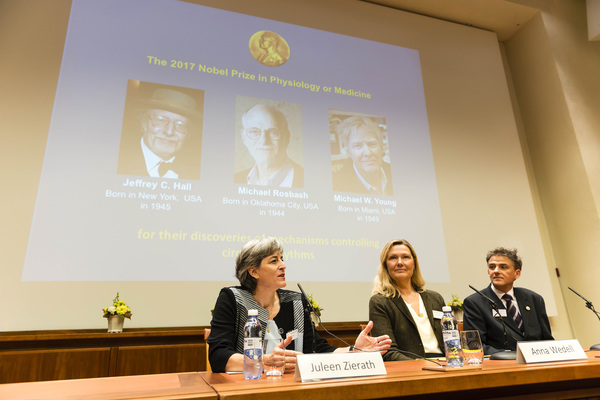
The Nobel Prize in Physiology or Medicine has been awarded to a trio of American scientists whose work revealed the mechanisms of a cellular clock regulating biological changes in complex organisms across a 24-hour span.
Working at Brandeis University in the 1980s, Jeffrey C. Hall and Michael Rosbash conducted work that uncovered the genetic basis of circadian rhythms in fruit flies. Michael W. Young collaborated with Hall and Rosbash from Rockefeller University in New York to isolate the gene, named "period" by scientists who had earlier surmised its existence.
Hall, Rosbash and Young would go on to discover a variety of genetic and cellular mechanisms that keep circadian clocks ticking in sync with the Earth's daily rotation.
Rosbash remains on the faculty at Brandeis University, and Young at Rockefeller University. Hall is at the University of Maine.
The work honored by the Nobel Committee sheds light on how all multicellular creatures undergo regular changes in body temperature, hormones, metabolism and behavior that keep time with different phases of the day.
While the scientists honored by the Nobel committee conducted much of their pioneering work on fruit flies, the circadian clock whose workings they elucidated is a powerful factor in human health as well. It helps explain how jet lag and other disruptions to our evolved cycles of sleeping and waking can wear us down and contribute to disease.
Their research has laid the foundation for research into how the time of day influences everything from the way we think to how our bodies store calories or respond to medications. In a world that's open for business 24/7, research has shown that people who try to defy their circadian rhythms will eventually come up against the biological limits of their cells' internal clocks.
"Since the seminal discoveries by the three laureates, circadian biology has developed into a vast and highly dynamic research field, with implications for our health and well being," the Nobel committee said in its announcement Monday.
In its citation for the $1.1 million prize, the Nobel Assembly at Sweden's Karolinska Institute said the researchers "were able to peek inside our biological clock and elucidate its inner workings."
That process unfolded in many steps.
In 1984, Hall, Rosbash and Young isolated the period gene. It would take several more years of research for Hall and Rosbash to detect that the protein encoded by that gene _ called PER _ went through a daily cycle of accumulating during the night and was being depleted in the course of the day.
But how was that rhythm sustained? Hall and Rosbash surmised that some feedback loop was at work, whereby the buildup of PER protein inside the cell might dial down the period gene's activity. But they puzzled over how that shutoff signal was sent from the cytoplasm, where PER protein was produced, to the cell nucleus, where the genetic machinery is located.
That mystery was solved in 1994, with Michael Young's discovery of a second clock gene, which he called timeless. That gene also appeared to be required for organisms to maintain normal circadian rhythm, by encoding the production of a protein called TIM.
Young's "elegant work," the Nobel Committee wrote, showed that when the TIM and PER proteins were bound together, they were able to enter the cell nucleus. There, they blocked the activity of the period gene and closed the feedback loop.
Over time, Young would go on to discover a third timekeeper gene, which he called doubletime, that would allow a more precise alignment of protein levels with a 24-hour cycle. Hall, Rosbash and Young have identified additional proteins required for the activation of the period gene, as well as for the mechanism by which light can synchronize the clock.