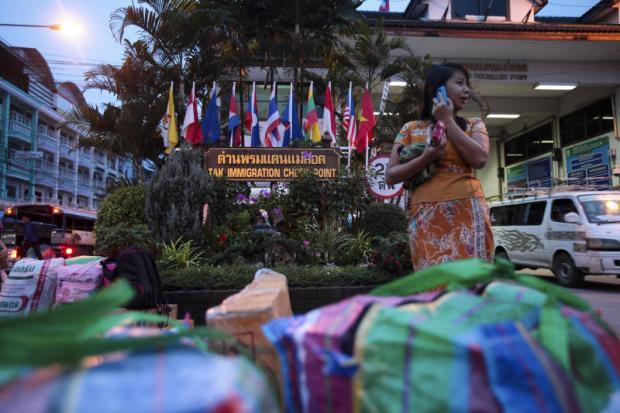
The Treasury Department has opened the second round of auctions for leasing state land to develop the special economic zone (SEZ) in Tak province after the first auction failed to attract bidder.
The conditions of the first round of the auction will be applied to the second bidding, said director-general Amnuay Preemonwong.
Under the 50-year rental agreement, the tenant is required to pay annual rent of 36,000 baht per rai or 38.4 million baht in total, with a 15% increase every five years.
Moreover, the tenant is subject to a 266.8-million-baht surcharge.
The Treasury Department will put 1,067 rai of state land in Sai Luat subdistrict of Tak's Mae Sot district up for bid.
Interested participants must be juristic entities with Thai nationality and have registered capital of at least 50 million baht. In the case of joint venture firms, they must have minimum registered capital of 50 million baht and land development experience in at least one project.
The auction documents will be sold from March 5 to 30. Details of development plans must be submitted on July 1.
The government earlier dedicated 10 provinces for development with SEZs. They are Tak, Sa Kaeo, Songkhla, Trat, Mukdahan, Chiang Rai, Kanchanaburi, Narathiwat, Nakhon Phanom and Nong Khai.
Activities at the SEZs will include agriculture, industry, logistics and tourism. They are meant to improve the local economy in border provinces.
So far, five lease contracts for land in four provinces -- Sa Kaeo, Trat, Songkhla and Kanchanaburi -- have been signed.
The Treasury Department in 2017 decided to relax conditions for bidding to develop SEZs in order to spur interest after receiving a lukewarm response from putting 2,693 rai -- 718 rai in Nong Khai, 1,080 rai in Mukdahan and 895 rai in Trat -- up for auction in 2016.
For the 2016 auction, Property Perfect Plc was the only company to bid on developing land in Trat province, and it won the bid.
The relaxed conditions include land development experience in wider fields, an extension of development proposal submissions, change in construction cost presentation models and permission to let winners sublease the developed land.
The previous conditions limited bid winners' experience to just industrial estates.