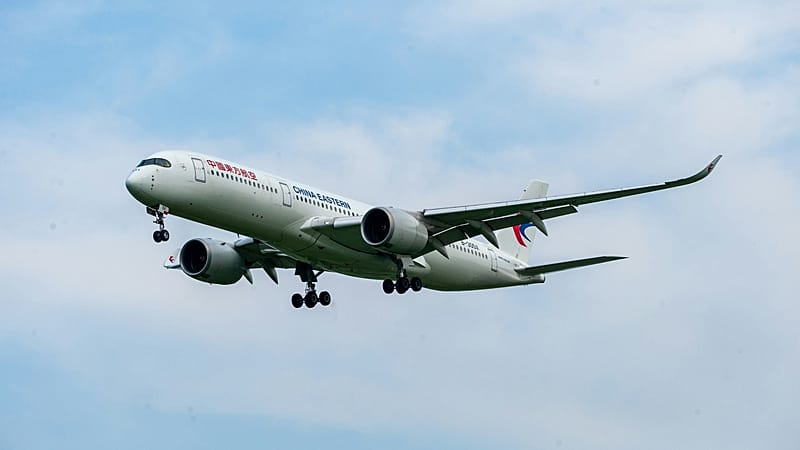
Taking an astonishing 29 hours, the world’s longest flight made its record-breaking debut this month.
China Eastern Airlines operates the marathon link between Shanghai and Buenos Aires, with a short stopover in Auckland.
The inaugural service departed Shanghai Pudong International Airport on 4 December. The southbound journey takes just over 25 hours, while the return to China stretches to roughly 29 hours in the prevailing winds.
Operated by a 316-seat Boeing 777-300ER, the twice-weekly service covers around 20,700 kilometres and lands at Ezeiza International Airport outside the Argentine capital.
A new ‘southbound corridor’ between three continents
China Eastern has described its new flight as a step toward creating an “Air Silk Road” connecting Asia with Oceania and South America.
Around 55,000 Chinese nationals live in Argentina, making it a key market for the airline.
Prices range from €1,320 to €1,950 in economy to about €4,200 for business class.
The carrier says the new “southbound corridor” links opposite ends of the Pacific and strengthens travel options between three continents.
What are the world’s longest flights?
The flight also reflects how rapidly ultra-long-haul travel is expanding. Powered by lighter aircraft and better fuel efficiency, airlines are seeking direct links between far-flung regions – even, as China Eastern puts it, “antipodal” destinations.
The new journey joins a small but growing group of ultra-long-haul routes already in the skies.
Singapore Airlines currently operates the longest non-stop service, connecting Singapore and New York’s JFK Airport.
The eastbound and return flight last about 18 hours and are flown in an ultra-long-range Airbus A350, a type of plane that can remain airborne for nearly 18,000 kilometres. The airline also offers a slightly shorter Singapore-Newark service.
Other airlines maintain routes that regularly exceed 15 hours. Qatar Airways links Doha and Auckland, while Qantas operates two major long-hauls: Perth to London Heathrow and Melbourne to Dallas Fort Worth.
All fall within the ultra-long-haul category, defined as flights lasting 16 hours or more.
Ultra-long-haul flights: What’s next for air travel?
Soon, travellers unbothered by extremes can take even lengthier journeys.
Qantas plans to introduce its ‘Project Sunrise’ routes either in late 2026 or 2027. Using specially configured Airbus A350-1000s fitted with additional fuel tanks, Qantas will offer non-stop flights from Sydney to London and Sydney to New York, with journey times expected to range between 19 and 22 hours.
The aircraft are due for delivery in October 2026, with Sydney-London expected to be the first departure.
Other long-haul additions are also planned for 2026, although China Eastern’s eye-reddening journey is likely to be the only one long enough to watch an entire season of your favourite show.
Etihad will introduce a new Abu Dhabi-Charlotte service in May, expanding its US network with near-15-hour flights. Delta is set to launch its first nonstop route between Atlanta and Riyadh in late 2026.
Meanwhile, Ireland’s Aer Lingus will expand its transatlantic network with a new Dublin-Raleigh Durham route and British Airways is adding extra flights to Miami and Bangkok and reopening seasonal links to Jamaica.
What do ultra-long-haul flights mean for the climate?
This upward trend may tickle travellers fascinated by the experience of flying, but it’s bad news for the climate.
Taking one long-haul flight generates more carbon emissions than many people around the world produce in a whole year – and more than an average European emits with heating their home and eating – according to campaign group Stay Grounded.
"This shows exactly why the industry cannot be trusted when it comes to reducing emissions and protecting our future," Stay Grounded spokesperson Hannah Lawrence tells Euronews Travel.
"It is not even possible to make flying sustainable with the current number of flights that take off each day and yet they're adding more and longer routes. This is why we need effective policies to reduce flying fairly - through things like a Frequent Flying Levy which could raise €64 billion and reduce emissions by a fifth in Europe."