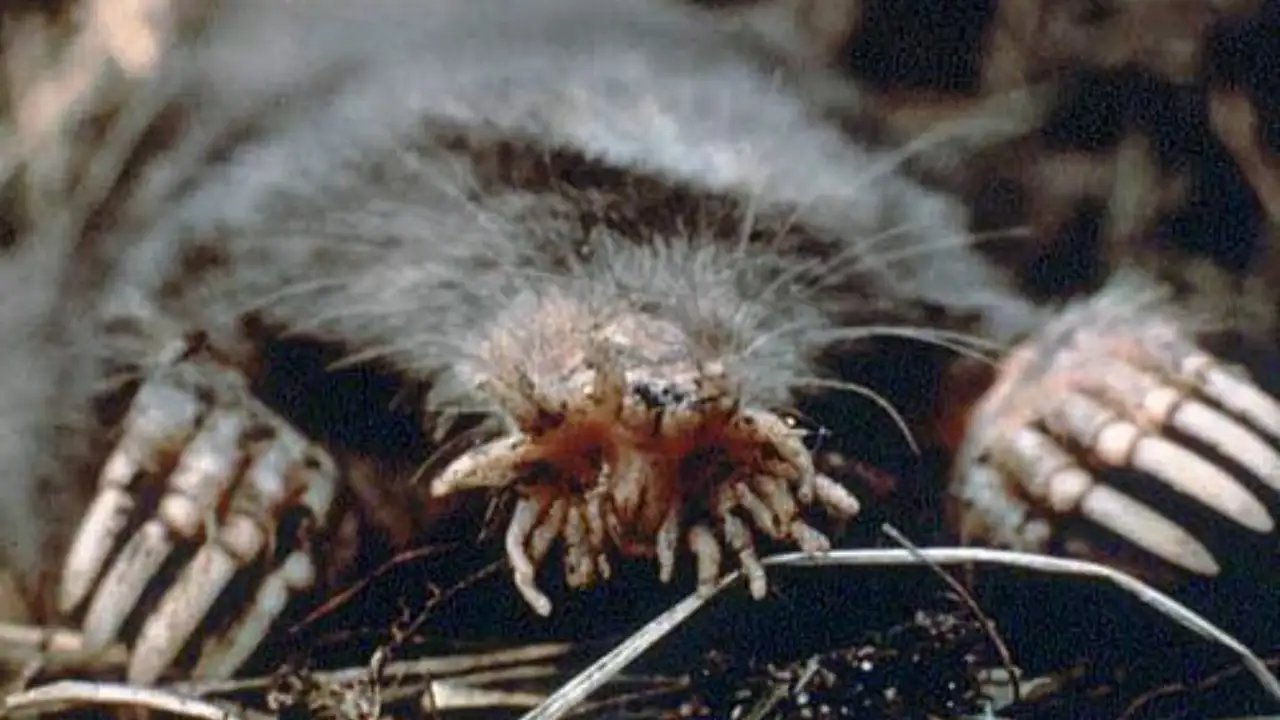
Deep beneath the wetlands of eastern North America lives one of the strangest hunters on Earth. The star-nosed mole is tiny, nearly blind and rarely seen above ground, yet scientists say it may possess the fastest hunting system ever recorded in nature. What makes the animal remarkable is not strength or speed in the traditional sense. It is the astonishing way its brain and sensory system work together in complete darkness.
The star-nosed mole, scientifically known as Condylura cristata, does not resemble the kind of predator that usually captures public imagination. It is small, lives underground and spends most of its life moving through muddy tunnels in wetlands and river edges across eastern North America.
At first glance, the animal appears almost alien. Surrounding its nostrils are 22 fleshy pink appendages arranged in the shape of a star. But those unusual structures are far more than decoration. They are one of the most advanced sensory tools found anywhere in the animal kingdom, as per a report by Forbes.
Why is the star-nosed mole so fast?
In 2005, neuroscientist Kenneth Catania of Vanderbilt University and colleague Fiona Remple published groundbreaking research in Nature examining how quickly the star-nosed mole hunts.
Using high-speed video analysis, the researchers discovered the mole could identify and consume prey in as little as 120 milliseconds. On average, the process took about 227 milliseconds. Even more astonishing was the finding that the mole only needed roughly 8 milliseconds to decide whether something it touched was edible.
That reaction time pushes close to the biological limit of how quickly nerve signals can travel through the body.
Unlike a cheetah, whose speed comes from muscular movement and pursuit, the star-nosed mole’s advantage comes from sensory processing. The animal has evolved a system that allows it to make near-instant decisions in complete darkness, as per a report by Forbes.
Researchers described the mole’s hunting ability as operating at the “asymptotic speed limit” of prey profitability. In simple terms, evolution appears to have pushed the animal as close as possible to the maximum speed its nervous system can physically achieve.
What makes its strange nose so powerful?
The mole’s famous “star” measures only about 15 millimeters across, yet it contains an extraordinary concentration of sensory equipment.
Each of the 22 appendages is packed with tiny mechanoreceptors known as Eimer’s organs. These microscopic structures are highly sensitive to texture, pressure and shape. Across the entire star, scientists counted more than 25,000 receptors connected to over 100,000 myelinated nerve fibers.
That is roughly five times more touch-sensitive fibers than the entire human hand, compressed into an area smaller than a fingertip.
Research published in the Journal of Comparative Neurology in 1995 revealed something even more fascinating. The mole’s brain is effectively built around its nose.
Each appendage on the star corresponds to a distinct section of the brain’s somatosensory cortex. Under laboratory staining, scientists could literally see patterns in the brain matching the geometry of the star itself.
One appendage stands out above all the others. Known as ray 11, this small central structure acts like a tactile version of the human eye’s fovea — the part responsible for sharp central vision, as per a report by Forbes.
When the mole detects something using one of the outer rays, it immediately redirects the object toward ray 11 for closer inspection. Scientists described this behavior as remarkably similar to the way primates move their eyes to focus on objects of interest.
The numbers behind this are striking. Ray 11 contains around 11 percent of the star’s sensory fibers but occupies nearly 25 percent of the brain area devoted to processing touch from the nose. That imbalance reveals how heavily the mole depends on ultra-fast tactile analysis for survival.
ALSO READ: China wouldn't let Marco Rubio in, so he did something nobody in US politics has ever done
How did evolution create such a hunter?
The wetlands inhabited by the star-nosed mole are filled with tiny prey such as earthworms, insect larvae and leeches. While abundant, these creatures provide very little energy individually.
That forced the mole to evolve incredible efficiency. To survive, it must locate, identify and eat enormous numbers of prey items every day.
According to Kenneth Catania and Fiona Remple’s research, the mole’s extraordinary 8-millisecond decision-making speed is the evolutionary solution to that challenge.
The animal’s success is not based on overpowering prey. Instead, it depends on processing information faster than almost any other creature alive.
This is what separates the star-nosed mole from more famous predators. A cheetah evolved for pursuit. A mantis shrimp evolved for explosive strikes. The mole evolved for recognition — the ability to rapidly determine what should and should not be eaten in total darkness.
What does the mole teach scientists about the brain?
The star-nosed mole has become one of neuroscience’s most valuable model animals because its sensory system is so specialized.
In a 2011 review published in Philosophical Transactions of the Royal Society B, Kenneth Catania explained how the animal demonstrates broader principles shared across mammalian brains.
The mole shows how the brain dedicates more processing power to the sensory systems most important for survival. It also demonstrates how tactile systems can function similarly to visual systems, even in species that are nearly blind.
Scientists believe the animal offers rare insight into how brains make incredibly fast decisions before conscious thought even occurs.
Despite its bizarre appearance, the star-nosed mole represents an extraordinary example of evolutionary precision. Millions of years in dark, wet environments shaped a nervous system capable of functioning near the physical boundaries of neural performance.
The creature may spend its life hidden underground, but its unusual face and lightning-fast reflexes have made it one of the most scientifically important hunters on the planet.
FAQs
Why is the star-nosed mole called the fastest hunter?This is because it can identify and consume prey in as little as 120 milliseconds.
What makes its nose so special?
Its star-shaped nose contains thousands of highly sensitive touch receptors connected to over 100,000 nerve fibers.