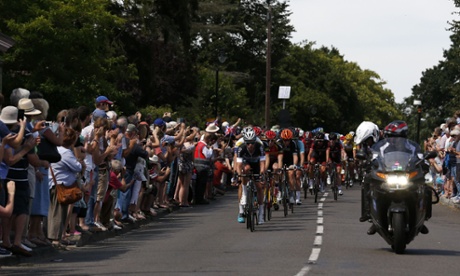
After last year’s downpours from the tail end of hurricane Bertha, the third incarnation of what is already one of the world’s biggest mass cycling events was bathed in sunshine on Sunday, as 25,000 riders tackled a 100-mile course through London and Surrey before a professional race featuring Sir Bradley Wiggins and Mark Cavendish.
Ride London, a weekend of cycling events for families, enthusiasts and professionals, was launched amid the euphoria of London 2012, first running a year later.
It has expanded since, and this year brings together almost 100,000 riders over the two days. On Saturday, almost 70,000 people, many of them children, pedalled around traffic-free streets in central London for a gentle, family-oriented ride known as the FreeCycle. Later the same day, Italy’s Barbara Guarischi grabbed victory in a women’s circuit race from rivals including Britain’s Laura Trott.
Sunday brought out riding enthusiasts en masse, as 26,000 people squeezed into Lycra for the RideLondon-Surrey 100, a 100-mile event beginning at the Olympic stadium in Stratford, taking riders out of London into the greenbelt countryside and back for a gala finish on the Mall.
Lauren Griffin, a 35-year-old regular participant in such mass bike events, as well as triathlons, said she saw Ride London as the best organised of them all. “It’s my third year doing it, and I almost had tears in my eyes when I finished, it was so amazing – the ride, and all the crowds cheering us on. And to ride 100 miles on closed roads is so special.
Sonja Strutt was equally exultant, albeit a joy mingled with pain as she stretched her aching legs just after the finish. “That really hurt,” said the 46-year-old from Clacton-on-sea. “But it was brilliant, so well run. It’s my first time. He’s done it three times and persuaded me to join him,” she said, indicating husband Alastair.
The 2014 event was pounded almost throughout by tropical-style downpours, prompting the organisers to trim the course at the last minute to 86 miles, avoiding some precipitous descents. Such was the severity of the weather that the event’s director, Hugh Brasher, at one point considered calling it off.
This year was considerably less stressful, said Brasher, whose team has spent 35 years organising the London Marathon: “It’s not pouring with rain this year – the weather conditions could hardly be better. The London and the Surrey countryside looks amazing.”
Brasher has high ambitions for the Ride London weekend, hoping it will not just prompt a sales surge for high-end road bikes, but inspire more commonplace cycling. “It’s absolutely about everyday cycling – this is about trying to inspire people to take up cycling,” he said. “A huge part of it is trying to get people to start commuting to work by bicycle.
“It ticks so many different boxes – sport and exercise, health, pollution and transport. All those strands have equal importance. There were so many kids in the FreeCycle yesterday. It’s inspiring the next generation to take up cycling, whether they’re a Laura Trott or Mark Cavendish, or just the next generation who appreciate cycling.”
Cavendish was among those competing in the final event of the weekend, a men’s race featuring not just Wiggins’ new eponymous cycling team but one from Team Sky, albeit featuring none of the riders who propelled Chris Froome to his second Tour de France win last month.
In the end neither Cavendish or Wiggins were competing for the top places, although one Sky rider, Briton Ben Swift, was narrowly outsprinted by the winner, Jean-Pierre Drucker from Luxembourg, racing for another Tour de France team, BMC.
Ride London is seen as one of the relatively few legacy success stories from the London Olympics, amid general gloominess about figures showing that most sports have not, as promised by the bid, seen an upsurge in participation. In fact, the weekend faces another problem altogether, especially the 100-mile event: too many people want to take part. The first 100-mile ride, which follows much of the 2012 Olympic road race route, went from 16,000 starters in 2013 to 21,000 the next year, and more than 25,000 this time. Even with the added capacity it was hugely oversubscribed, with precisely 86,001 candidates joining the 2015 ballot for places.
Brasher and his team will spend a long time crunching data from the timing chips mounted on every bike, calculating how many riders per hour used roads of varying widths, and thus whether more could be safely accommodated. He said: “A huge amount of work goes on in the next two to three months, with the feedback we get, and the debrief, and then we decide where we can take it.”
Another goal for organisers is to ensure that more women take part – a sometimes difficult issue with regard to cycling in Britain, which tends predominantly to involve men, whether in terms of commuting or more sporty rides.
“The first London marathon had less than 5% women – this year it was 42%,” said Brasher. “Last year 20% of the finishers here were women. We’ve got a target of 35% by 2019, and there’s no reason why we can’t do it.”