
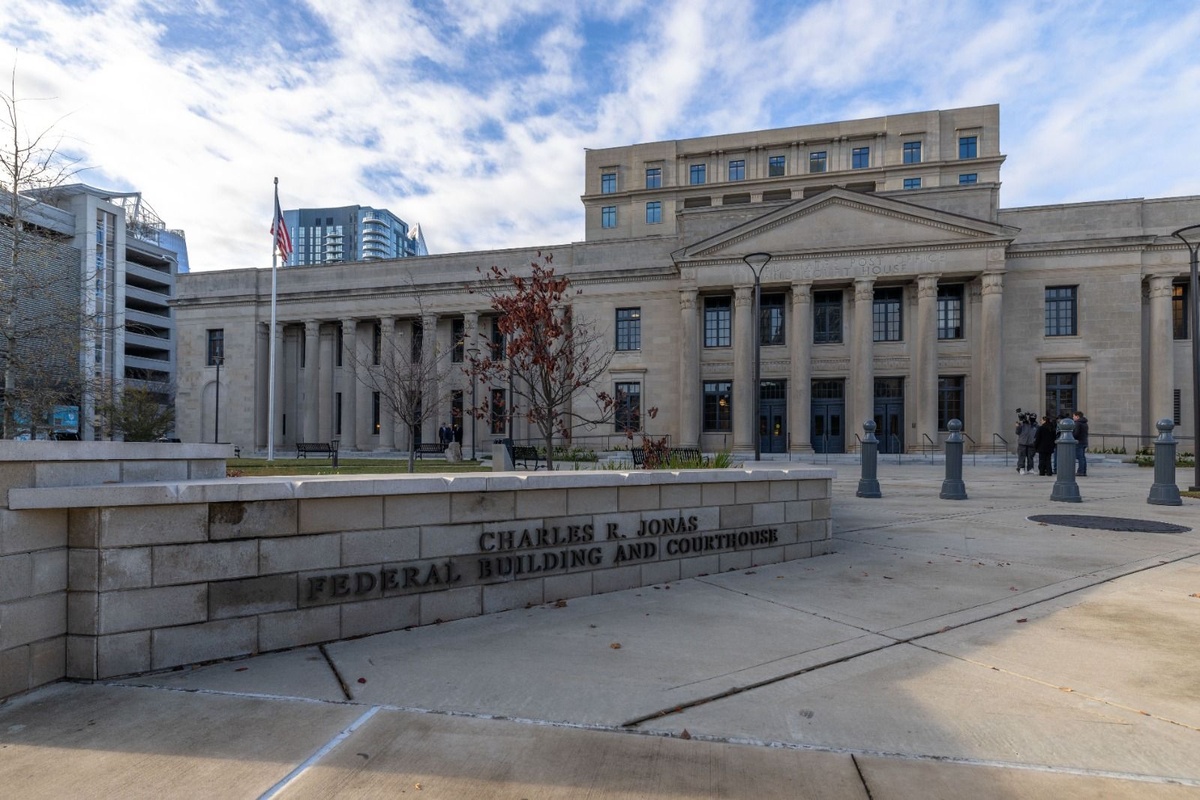
In a timeline where the parties involved in the 23XI Racing and Front Row Motorsports v NASCAR trial couldn’t agree on anything to the point they have ended up in court, it is no surprise that they could look at the same financial records and end up with two different interpretations.
That is the key takeaway from much of Wednesday, which is officially Day 8, of the trial that will determine if NASCAR used its monopsony status to financially disadvantage teams that compete in the Cup Series and harm competition on the whole.
As a reminder, this case isn't about whether or not NASCAR is a monopoly, which by itself is not illegal. Instead, the Western District of North Carolina has already determined that NASCAR is a monopsony, the only purchaser of the product that is premier Stock Car racing teams.
The jury must determine if NASCAR used that market power to harm competition and the earnings of teams through the charter system.
NASCAR Chief Financial Officer Greg Motto was on the witness stand for just short of two hours where he spent most of the time discussing the $400 million in distribution to the France family trust.
First, understand that for tax purposes, NASCAR is structured as a private S Corporation meaning that its income, losses, deductions and credits are passed to the shareholders. The shareholders, in this case, are all France-Kennedy family members.
Jeffrey Kessler, the lead attorney for 23XI and FRM, made the argument that NASCAR could have afforded $720 million a year in charter payments to the teams instead of the $431 million distributed in 2025. Motto, in addition to a financial expert (Mark Zmijewski) said that would have bankrupted NASCAR, in contrast to arguments made by team financial expert Dr. Edward Snyder.
Kessler has made a similar argument from the start of the trial that all the testimony from NASCAR executives and their experts' math include everyone retaining the same salary and the business being run exactly as it was last year.
Instead, Kessler has repeatedly pointed to what happened in 2020 when COVID-19 forced NASCAR to issue salary cuts for everyone from the top to the bottom until the pandemic subsided.
Kessler said in a world in which the teams were paid what they felt they were entitled to if not for anticompetitive behavior, Jim France down to track maintenance would have also experienced similar shifts in their compensation.
Kessler said that NASCAR selling a majority of the land that once housed Auto Club Speedway for $544 million could have gone to paying the teams instead of paying down debt from the International Speedway Corporation merger in 2019. He also said that, as an S-Corp, NASCAR isn’t required to send dividend payments to the France family.
Motto says NASCAR has to pay its taxes, and that means the France family, since the company is an S-Corp. Kessler says selling a NASCAR owned track meant that its overall equity was improved since it now has less debt.
Kessler said NASCAR and the France family trust is just moving money from one palm of the family hand to another.
“You do whatever you can to minimize the taxes to the France family,” Kessler said to Motto under cross-examination.
Motto says NASCAR’s year over year revenue loss in 2025 was $10 million, which Kessler says was simply a ‘rounding error’ for an entity that size.
Kessler also cross-examined Zmijewski, who prefers to go by Professor Z, and said that the NASCAR financial expert did not properly account for the Sanctioning Body’s financial records in the ‘but for world’ in which teams were healthier because they weren’t subject to anticompetitive harm.
Again, both sides used the same financial records to reach two different conclusions throughout the day.
NASCAR begins defense
The first seven and a half days of the trial featured 23XI and Front Row’s lawyers calling their witnesses, with NASCAR cross-examining them, and then passing the witness back for a re-examination.
Starting on Wednesday afternoon, the reverse process occurred with NASCAR building its case through its selected witnesses, which get passes back-and-forth through the same process.
The first witness called was John Probst, senior vice president of innovation and racing development for NASCAR, who spoke mostly to the development of the NextGen car and the argument that teams having a ‘reckless’ spending problem as previously articulated.
Probst started working for Ford Motor Company out of college in the Mid-90s, which led him to competing in the CART Indy Car Series, and then NASCAR with Red Bull Racing and Chip Ganassi Racing, before moving to the Sanctioning Body in 2016.
NASCAR wanted to use Probst to illustrate what happened with the American Open Wheel Split, as a reason to not have a competing series, but those questions were objected to by Judge Kenneth D. Bell and sustained.
In other words, the questions were not allowed to be answered.
"We're getting a little bit out in left field," Bell told the defense.
Probst was allowed to offer a brief summation of what happened between CART and the Indy Racing League over the 90s.
"(IRL) started racing at the Indianapolis 500, created their own racing series, started their own teams to fill the grid, worked with the OEMs to start more teams and split the series apart."
Probst was used as a conduit to explain to the jury what a wind tunnel is, discussing the Laurel Hill Tunnel under a mountain owned by Ganassi, to illustrate just how much money teams spend to use such facilities.
Thousands of dollars an hour
Kessler objected to Probst going on for nearly 10 minutes about the history of wind tunnel testing and Judge Bell asked to move the conversation along.
"This is all very interesting and we understand your point but let’s move on," Bell told the NASCAR side of the room.
Probst explained to the jury that the development of the NextGen car, a single-source parts supplied spec car, was created around the philosophical idea that fans only care about manufacturer specific engines and bodies.
Everything else, Probst argued, could not be seen by fans and largely were not important to them. This would allow teams to spend considerably less money spending time in wind tunnels and engineering their own parts and pieces.
Probst said the concept of the car was endorsed by 30 of the 36 charter holders before development formally began on its development. It’s a development, that Probst points out, has cost NASCAR $14 million and the teams nothing since they no longer R&D the car.
'I thought that was a pretty compelling endorsement by the team owner council,' Probst said.
Probst testified that NASCAR knows how often teams purchase parts from the approved vendors and they ask for that data once or twice a year. They are allowed to under the charter agreement. They ask for this data because they want to turn around and show teams that buying more parts doesn't correlate to wins.
He cited that Team Penske routinely wins the most races on the fewest re-purchasing of single source supplied parts. 23XI Racing has spent the most over the past two years.
Probst explained to the jury that while some teams (like Front Row Motorsports according to the testimony of owner Bob Jenkins last week) resent not being allowed to repair parts because purchasing new ones repeatedly cost more, NASCAR doesn't allow it because 'repair' to teams means 'modify' and 'improve.'
Allowing teams to repair parts, Probst testified, would open up a spending war between teams and up-end the parity that was the entire point of the seventh-generation platform.
Under cross-examination by Kessler, Probst was told 'you are aware that my clients aren't challenging the NextGen, right' but instead sued NASCAR based on the non-compete restrictions placed in the charter agreement.
Kessler asked Probst if he knows of any studies that would support preventing teams from using Cup Series cars in other leagues as ‘pro-competitive’ and they argued back-and-forth over legalese and the clarity of the question.
Before developing the NextGen car, Probst wrote in discovered emails that NASCAR had explored taking the previous car, the Gen6 and selecting parts and pieces of that platform and making that spec instead.
Why choose developing a new car over that?
Probst wrote in an email that the Gen6*, which is what the modified version of the old car would have been called, would 'increase the risk to NASCAR of a copycat series.'
Kessler asked what NASCAR was afraid of.
"We don't fear competition," Probst responded.
Kessler then pointed out that NASCAR adding exclusivity clauses came in immediate aftermath to the RTA developing a mid-week summer dirt series and the arrival of the SRX series.
NASCAR’s legal team objected to the assertion but Judge Bell allowed it.
Probst said track sanctioning agreements were not his department and couldn’t speak to the exclusivity agreements. In addition, he said that NASCAR’s position of protecting its brand is common business and compared the Sanctioning Body to Coca-Cola.
He said Coke wouldn’t develop a new recipe and then immediately allow Pepsi to copy it. Probst also said that no team ever asked NASCAR to use the Gen6 car in a non-NASCAR division nor the NextGen.
"All they have to do is ask," Probst said.
Kessler responded by saying there is no way that NASCAR would allow teams to use the NextGen in a non NASCAR series.
"We would discuss it," Probst said back.
Kessler then asked why NASCAR Commissioner Steve Phelps suggested that ‘someone needs to put a knife’ in the ‘trash’ SRX series.
"I'd assume Steve would answer that question," Probst said.
Kessler presented Probst an internal document in which NASCAR executives including Probst, Phelps, Steve O’Donnell and Scott Prime were tasked with discovering how much it would cost to start a Cup Series team from scratch.
Probst said teams mislead or do not answer cost questions accurately or evenly so NASCAR simply wanted to have a better idea of what the actual costs associated with competition were.
Kessler suggests it was an exercise to better inform ‘Project Gold Codes,’ NASCAR’s option to take the Cup Series ‘vertical’ and run a series in-house if every team refused to sign the 2025 charter extension.
Probst says their reasons to conduct the exercise were altruistic and at face-value.
Probst, when asked about, says he did not solely author the Gold Codes document but contributed to it. He also conceded that he used data from the aforementioned study in his contributions to the Gold Codes slide presentation.
Lastly, Kessler asked Probst about a text message conversation between he and his chief of staff, Tom Swindell the morning after NASCAR’s charter extension deadline on September 6, 2024.
Swindell said 'RIP Project Gold Codes,' in a message to Probst, who replied ‘YES.’ Swindell said this was 'great news' and asked 'what is the leverage for (23XI, FRM in) holding out?' Probst said 'I can't see any.'
Kessler was trying to illustrate that Project Gold Codes was more than just a contingency plan but a very real consideration. Probst said he and Swindell are personal friends and they text about their friends, hobbies, families and work.
"No further questions, your honor," Kessler said upon ending cross-examination.
France finishes up
After a Tuesday session where he was largely evasive, offering over a dozen 'I do not know' or 'I do not remembers,' France did answer a direct question over why he was not in favor of permanent charters for Cup Series team owners.
“I don’t have a sightline to the future, and I don’t feel comfortable making a promise I don’t know if I can keep,” France said.
On Tuesday, France was shown letters sent to him by friends Roger Penske, Rick Hendrick, Joe Gibbs and Jack Roush urging the NASCAR CEO to make their ownership statuses 'evergreen,' which would grow the equity of what would then be a franchise, while costing the Sanctioning Body nothing.
“I don’t know how you can set anything in this changing world we’re in as permanent,” France said. “I’m just not comfortable making agreements that go on forever.”
France said NASCAR budged on numerous points, something an internal (Amanda Chart) graph disagrees with as it showed 21 wins or neutrals for NASCAR and one win for team, but France was not going to make charters permanent.
What sort of certainty would he need?
“Don’t know ’til we get there,” France said.
Loose ends
Before dismissing the jury, Judge Bell told them that they will be needed next week but that NASCAR has expressed to the court its intent to conclude its case by 5:30 on Friday. The original schedule was a 10-day trial over two weeks.
A sluggish start forced Bell to extend each day to an extra hour this week, and closing arguments will come no sooner than Monday morning now.
There was also the matter of where NASCAR’s attorney received the information that Richard Childress explored selling a portion of his Cup Series team to a group spearheaded by former driver Bobby Hillin Jr.
This was protected by a non-disclosure agreement and Childress was visibly agitated when NASCAR’s attorney used it on him during cross-examination on Tuesday.
Also after the jury was dismissed on Wednesday, teams attorney Danielle Williams says she had six questions on the matter. Judge didn't want to hear them. Williams says NASCAR hasn’t even given their side the documents yet.
They want to know who NASCAR’s source was who broke an NDA.
Bell said both parties needed to work together to get a solution before Thursday morning or he was going to issue an order 'and I have an idea of what that is going to be.'













Read and post comments