Twenty-three passengers were released from the Diamond Princess cruise ship without undergoing the mandatory tests for the new coronavirus before disembarking, according to the health ministry.
They were among the passengers who disembarked on Wednesday and Thursday after receiving approval to do so, Health, Labor and Welfare Minister Katsunobu Kato said at a press conference Saturday. The ministry said it is continuing to conduct tests on these 23 passengers.
After being quarantined in their cabins aboard the Diamond Princess for about two weeks from Feb. 5, passengers who tested negative were allowed to disembark.
Though all passengers were expected to be tested during the quarantine period, the 23 passengers, 19 of whom are Japanese, underwent an examination only before Feb. 5 and did not get tested after, Kato said.
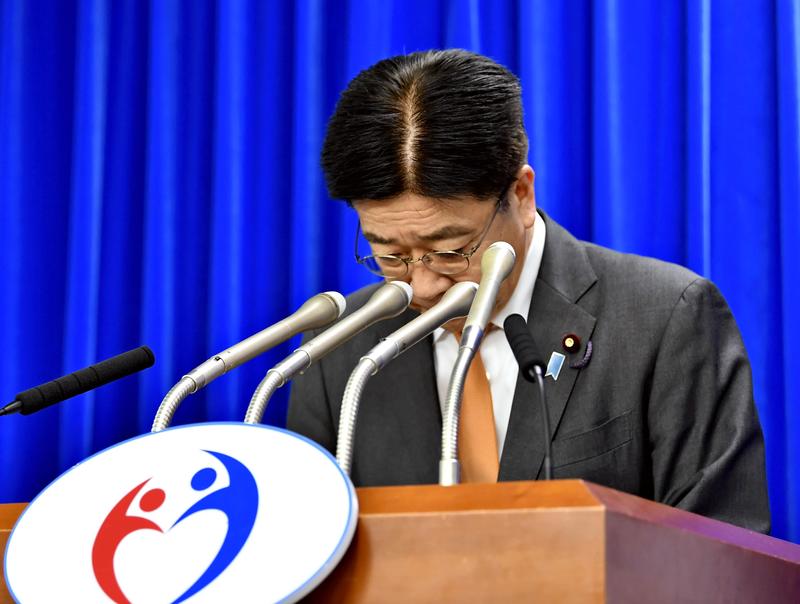
Kato apologized during the press conference, saying, "I deeply regret that procedural mistakes brought about such serious problems."
Given that ministry officials who were sent aboard the ship for quarantine operations have begun to come down with a viral infection, the ministry plans to conduct tests on 41 officials. Gaku Hashimoto, the vice health minister, and Hanako Jimi, parliamentary vice minister of the ministry, are also to get tested, he said.
Meanwhile, 89 passengers, 70 of whom are Japanese, who had stayed in the same cabin as people infected, left the ship on Saturday. They were moved to National Tax College's Wako building in Wako, Saitama Prefecture. Following a health monitoring period, they are expected to go home if they are confirmed negative after undergoing tests again.
Kato said some people infected with the new coronavirus are being given the anti-influenza drug favipiravir on a trial basis. The ministry plans to analyze the effectiveness of the medicine.
A research group in which the National Center for Global Health and Medicine is playing a central role has prepared two domestic medical institutions for the trial, with one of these giving patients favipiravir on Saturday.
"[Favipiravir] inhibits an enzyme that viruses use to replicate," Kato said. "It's possible it can be effective on the new coronavirus."
He also said the government plans to soon start using remdesivir, an antiviral drug developed as a treatment for Ebola, for people infected with the new coronavirus.
Read more from The Japan News at https://japannews.yomiuri.co.jp/