A cache of handwritten manuscripts and correspondence from such Japanese literary giants as Ogai Mori (1862-1922) and Soseki Natsume (1867-1916) has been discovered at the offices of publishing house Shinchosha in Shinjuku Ward, Tokyo.
The collection was found pasted into the pages of a scrapbook uncovered by the company during an extensive cleanup of the president's office at the end of last year.
In total, the collection comprises 21 items penned by 18 literati including Futabatei Shimei, Toson Shimazaki, and Takeo Arishima. Three of the papers were written by Shimazaki, while the other 17 contributed one item each. The identity of the author of one of the items remains unknown.
The scrapbook is believed to have been compiled by Shinchosha's founder, Giryo Sato (1878-1951).
Measuring about 30 centimeters tall and about 40 centimeters wide, the album was likely meant as a personal memento of the writers Sato had brushed shoulders with as director of one of the nation's preeminent publishers.
Organized in no discernible order -- the documents were not filed by date of publication or the authors' date of birth -- the scrapbook does not appear to have been created with the express purpose of preserving source material.
However, the scarcity of such primary documents could provide researchers precious firsthand insights into the literary milieu of the time.
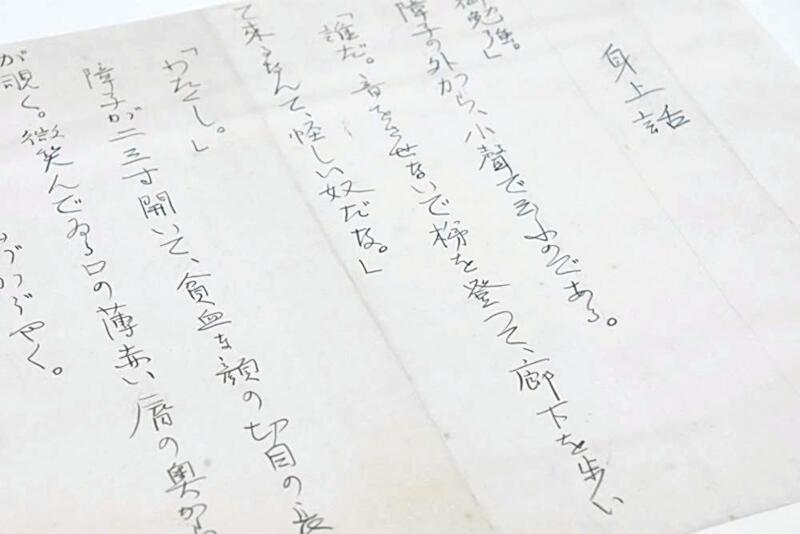
Of particular interest are an original manuscript by Natsume offering readers writing advice in response to a literary magazine questionnaire, and a manuscript page from a comical vignette by Mori titled "Minouebanashi" (A personal story).
First published in the literary magazine Shincho in 1910, "Minouebanashi" tells the story of a young man staying at a seaside inn and a woman who works there, inspired by a real-life anecdote Mori heard from a friend.
The manuscript is a prime example of the well-regimented handwriting of the author-cum-army surgeon, written in ink pen on unlined foreign-made paper.
"The use of foreign paper and a pen [instead of a calligraphy brush] is characteristic of Ogai at the time," said Waseda University Professor Emeritus Kunihiko Nakajima, who conducted research on the manuscripts.
"The absence of any additions or corrections to the manuscript page suggest that he quickly copied the text down from another draft in hand. 'Minouebanashi' is a minor work, but its discovery is very valuable, as most of his manuscripts from the period have not been found."
Read more from The Japan News at https://japannews.yomiuri.co.jp/