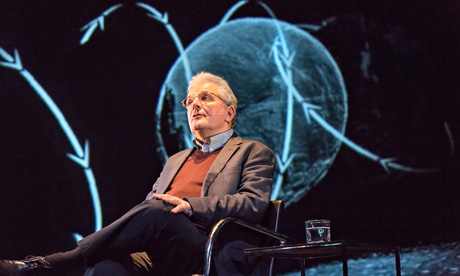
2071 is not a play, it’s a lecture, read from an autocue in a nervous but poised performance by Chris Rapley, professor of climate science at University College, London.
What’s frustrating about it is the limits it sets itself. The prof, almost by way of apology, reminds us towards the end of just over an hour, that science’s job is to inform not arbitrate. But theatre’s job is to do more than inform. It has, potentially, a moral momentum, a power to move, shake and stir. This lecture was weirdly balanced between the alarming and the soporific. Its elegantly swirling black, white and scarlet computer graphics (designer Chloe Lamford) mesmerically illustrated melting glaciers, collapsing ice shelves – in “unprecedented retreat” – and rising sea levels. The professor never stirred from his chair. I watched several people drop off to sleep in the stalls, becalmed just when they should been galvanised.
And this was a pity because Rapley’s endeavour, under Katie Mitchell’s dedicated direction (a successor to Stephen Emmott’s Ten Billion, an exploration of population explosion), is a brave new departure about the brave new world we hope will never arrive. It was an evening to make the craziest of climate change deniers blush. Yet its only engaging moment was when Rapley described holding in his hand an offcut of ice (he made many visits to Antarctica when he was director of the British Antarctic Survey) and watching it melt, in awe that it was releasing air from the beginning of time. Even as a scientist, he explained, he was moved. It was also made clear that 2071 is personally significant to him as the year in which his eldest grandchild will arrive at his present age. His resolve, otherwise maintained throughout, to detach science from feeling did the subject no favours.
The conclusion was clear: we need to make sure the global temperature rise does not exceed 2C, and this will “require the greatest collective action in history”, but he was perfunctorily non-crusading about detail – I’d have liked a bolder prescription. Still, what is heartening is that Rapley emerged not as a prophet of doom but as a professor of cautious hope.
More Stage reviews
Wildefire review – an unexpectedly sympathetic look at the Met
Queen Coal review – ruptured relationships in a former mining community
Royal Ballet triple bill – a purely surface rendering of Auden’s Age of Anxiety
The Shape of the Table review – David Edgar’s power play proves prophetic
Stewart Lee review – tricksy gags about liberals, rightwingers and ‘the Islams’