
The Breakdown
- The EX60 is Volvo's longest-range EV: 400 miles on a charge.
- Single- and dual-motor versions available.
- The dual-motor-only Cross Country gets a raised suspension.
- Three battery sizes: 80 kWh, 91 kWh, and 112 kWh.
With more than 2.7 million units sold since its launch in 2008, the XC60 is already Volvo’s best-selling model ever. The arrival of an electric counterpart comes at a time when the company’s EV sales have suffered a major setback. In 2025, demand for vehicles without combustion engines fell by 13 percent. The Geely-owned brand is pinning its hopes on the EX60 to turn things around.
Although the familiar name might suggest the EX60 is related to the hugely successful gas-fueled XC60, the two models sit on completely different platforms. The newcomer rides on Volvo’s electric-only SPA3 architecture, meaning engineers didn’t have to make compromises to accommodate combustion engines.
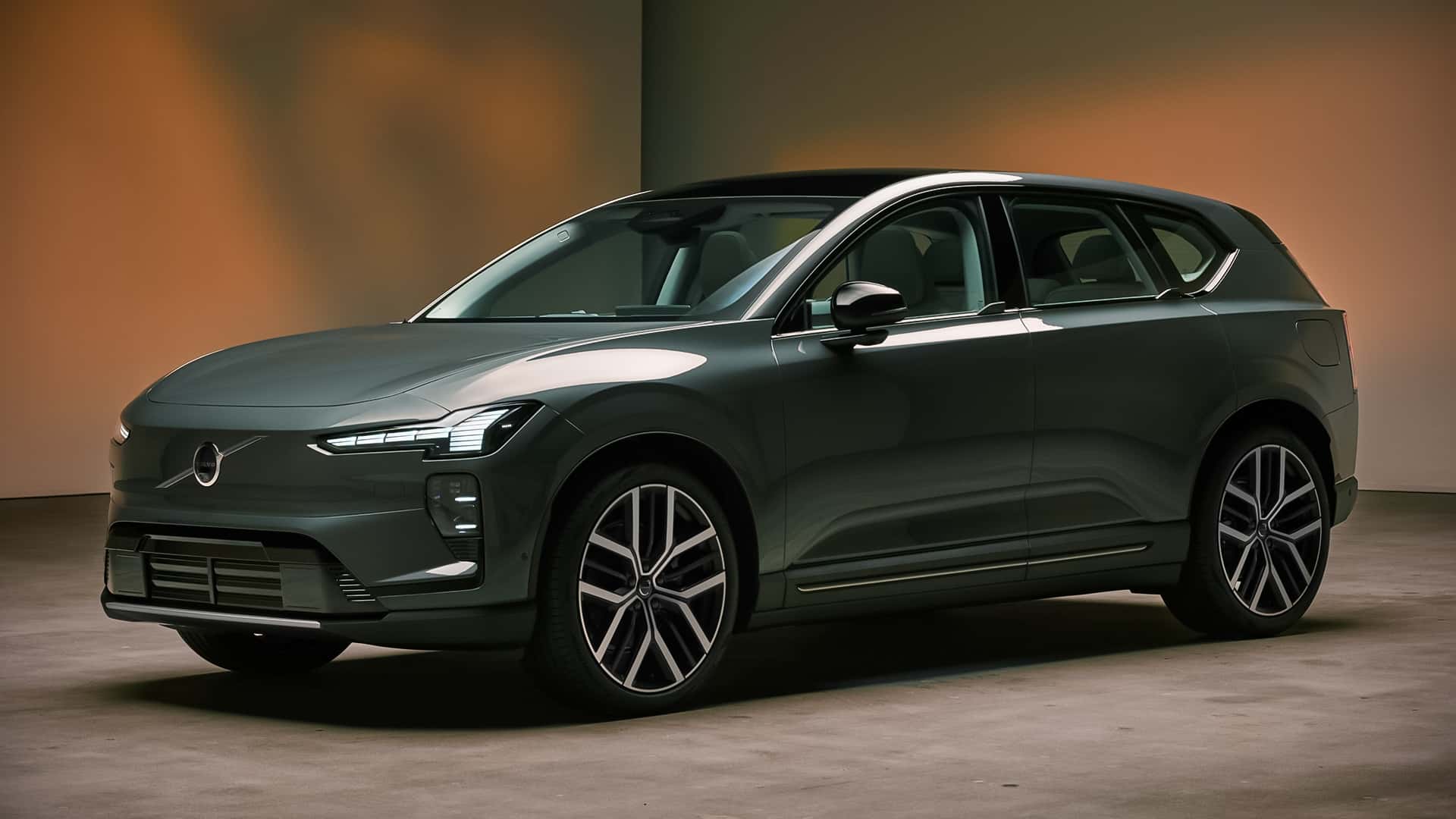
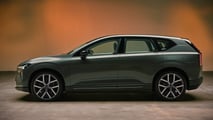
The styling is in keeping with the larger EX90, but you’ll notice the electrically operated door handles aren’t where you’d normally expect them. In fact, they're not even handles in the traditional sense. Instead, Volvo integrates winglets into the beltline to clean up the profile, similar to the Ford Mustang Mach-E. In Volvo’s case, the discreet setup contributes to a relatively low drag coefficient of 0.26, helping to boost range.
Volvo EX60 Exterior: Streamlined Design

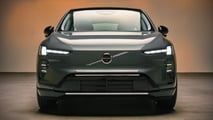
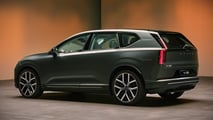
A glance at the EX60’s front shows that split headlights are still trending in 2026. The closed-off grille is a dead giveaway that there's no combustion engine in need of cooling. At the rear, the vertical upper taillights flanking the tailgate glass are a familiar Volvo design cue. While we’re glad to see a rear wiper, some automakers have found ways to hide it beneath the roof spoiler for a cleaner look.
Wheel sizes range from 20 to 22 inches, with the EX60 Cross Country featuring an exclusive 21-inch set. The rugged version also stands out thanks to stainless steel skid plates and slightly beefier wheel arches. Volvo raises the CC version by 0.8 inches (20 millimeters), and air suspension allows another increase of the same amount. At higher speeds, the suspension is automatically lowered to improve efficiency.
The overall styling may be predictable, but we'd argue that the EX60 is a handsome electric crossover. It’s not as flashy as the new BMW iX3 or Mercedes GLC with EQ Technology, while the Cross Country’s extra cladding and Frost Green paint give it a tougher look. Since this is a dedicated EV, there’s room under the hood for a front trunk that offers 3.0 cubic feet of extra storage.
Volvo EX60 Interior: Clean & Modern
Inside, the cabin offers a nearly buttonless experience, similar to what the Germans provide. Most functions are accessed through the infotainment system, which Volvo claims has zero lag. It’s also the company’s first production model to use Google’s Gemini AI assistant, enabling more natural interactions without memorizing specific voice commands.
Software has been Volvo’s Achilles’ heel in recent times. Still, the company insists those issues have been resolved for the EX60: “Screens respond quickly, maps load instantly, voice assistants understand passengers better, and everything feels smooth.” The EX90 was riddled with software gremlins at launch, so hopefully the Gothenburg-based automaker has learned its lesson.
Volvo crams 28 speakers into the cabin, including four in the headrests, all part of the Bowers & Wilkins sound system. Although one teaser image led us to believe a third row might be offered, the EX60 is strictly a five-seater. The benefits of a dedicated EV platform are obvious inside, with a completely flat floor thanks to the absence of a transmission tunnel. Storage space is plentiful throughout the cabin, and we especially like how the cup holders emerge from beneath the center armrest.
Volvo EX60 Performance: Speed Meets Range
In the United States, the EX60 will be available with rear- or all-wheel drive. The base “P6” model uses a single-motor setup producing 369 hp and 354 lb-ft of torque, enabling a 0–62 mph sprint in 5.7 seconds. The rear-mounted motor draws power from an 80.0-kilowatt-hour battery estimated to deliver 310 miles of range with the 20-inch wheels. Each step up in wheel size reduces range by about 10 miles.
The “P10 AWD” features a dual-motor setup with a combined 503 hp and 524 lb-ft, cutting the sprint to 4.4 seconds. Volvo fits a larger 91.0-kWh battery, good for an estimated 320 miles of range with the smallest wheels. As with the base model, opting for 21- or 22-inch wheels trims the range by 10 and 20 miles, respectively.
Step up to the "P12 AWD" and output rises to a massive 670 hp and 583 lb-ft, slashing the 0–60 mph run to just 3.8 seconds. The flagship version gets a larger 112.0-kWh battery, delivering up to 400 miles of range with 20-inch wheels. Volvo quotes 390 miles with the 21-inch set and 375 miles with 22-inch wheels.
Charging performance is equally impressive. The base "P6" peaks at 350 kilowatts, while higher trims support up to 400 kilowatts. Choose the range topper, and it takes just 19 minutes to recharge from 10 to 80 percent. A 10-minute top-up can add 173 miles of range. For the first time on a Volvo EV, the EX60 features a native NACS port, eliminating the need for an adapter to access more than 25,000 Tesla Supercharger stations.
It’s also worth noting that the Cross Country comes standard with all-wheel drive, with buyers able to choose between the “P10 AWD” and the more powerful “P12 AWD.” Regardless of EX60 flavor, top speed is electronically limited to 112 mph, in line with Volvo’s decision in 2020 to cap speeds across its lineup to help reduce injuries and fatalities.
The EX60 is Volvo’s first model to employ mega casting, replacing hundreds of smaller components with large recycled aluminum castings. This helps reduce weight, further aided by in-house-developed electric motors and cell-to-body battery technology, in which the cells are integrated into the vehicle’s structure.
Weight remains a sensitive topic with EVs. In its lightest configuration (single motor and smallest battery), the EX60 weighs 4,663 pounds. The heaviest version tips the scales at 5,137 pounds. The Cross Country starts at 5,060 pounds, with its maximum weight still to be announced.
Built in Sweden, the EX60 is already available to order in Europe, with the U.S. to follow in late spring. Deliveries start this summer, initially with the "P6" and "P10 AWD" versions before the "P12 AWD" hits the road. The Cross Country won’t arrive stateside until the summer of 2027.
2027 Volvo EX60 and 2028 EX60 Cross Country
Motor1's Take: The battle in this segment is heating up, with the EX60 arriving shortly after the BMW iX3 and Mercedes GLC with EQ Technology. While EV demand cooled in the U.S. last year, it continues to grow in other regions, particularly Europe. The EX60 has plenty going for it, and if priced competitively, it could help Volvo reverse its recent EV sales slump.
It’s still too early to say whether past mistakes will come back to haunt the brand. The EX90’s rocky launch may give some buyers pause when considering Volvo’s smaller electric crossover. With competition this fierce, claiming a meaningful slice of the market won’t be easy.