For football fans, the 2026 FIFA World Cup is not just the most cherished and looked-forward-to event that they wait for four years, but it is a complete reimagining of the grandest festival of the beautiful game. It is for the first time in the history of the FIFA World Cup that 48 teams will participate instead of 32. This is not merely an expansion of the tournament and its scope, but it provides an opportunity to various new teams and millions of football fans to realise their World Cup dreams or to see their teams in action.
Moreover, it is also the first time that three nations including the USA, Canada, and Mexico will jointly host the tournament, which will run from June 11 to July 25, 2026. A total of 104 matches will be played across 16 host cities in their spectacular stadiums. The final will be played at MetLife Stadium in East Rutherford, New Jersey, USA. The FIFA World Cup is returning to North America after 32 years, as the United States last hosted this tournament back in 1994.
Special occasion for host nations
While three nations are hosting the tournament this time, the majority of the matches including all the knockout matches will be played in the United States. Canada is making its debut as a host of the World Cup, although Canada previously hosted the 2015 Women's World Cup. Mexico becomes the first country to host three men's World Cups, previously in 1970, 1986, and now in 2026.
Also Read | FIFA World Cup 2026: Meet the Mascots as Canada, Mexico and USA gear up for soccer’s biggest spectacle
New format: How it works
As the tournament has seen expansion from 32 teams to 48 teams, the format is divided into the group stage where 12 groups are there with each having 4 teams, and groups are divided from Group A to Group L.
Each team in every group will play three group matches, and the top 2 teams from each group, meaning 24 teams, will advance to the next round.
Meanwhile, another 8 best teams who will be in third place out of the 12 remaining teams will also reach the next round. So that means in the next round, which is the the knockout stage, 32 teams will advance. In the round of 32, 16 matches will be played; round of 16, 8 matches; quarter-finals, 4 matches; semi-finals, 2 matches; third-place play-off, 1 match; and final, 1 match. That makes 104 matches, compared to 64 matches which were played in the 2022 edition of the FIFA World Cup.
This time the tournament will last for 45 days, which is five days longer than the 2022 World Cup which was played in Qatar.
48 confirmed teams
There are 48 confirmed teams. From the AFC (Asia), 8 teams include Japan, Korea Republic, Saudi Arabia, Australia, IR Iran, Iraq, Uzbekistan, and Qatar. From the CAF (Africa), 9 teams are Morocco, Senegal, Egypt, Algeria, Tunisia, Ghana, Côte d'Ivoire, Congo DR, South Africa, and Cape Verde, who are making their debut.
From CONCACAF (North America), 6 teams are the United States (host), Canada (host), Mexico (host), Panama, and Haiti, which is returning after 52 years. From CONMEBOL (South America), 7 teams are Brazil, Argentina, Uruguay, Colombia, Ecuador, and Paraguay.
From the OFC (Oceania), 1 team is New Zealand. From UEFA (Europe), 17 teams are Germany, France, England, Spain, Netherlands, Portugal, Belgium, Croatia, Italy, Switzerland, Sweden, Denmark, Austria, Norway, Czechia, Türkiye, and Bosnia & Herzegovina. The debutants are Uzbekistan, Cape Verde, Curaçao (who qualified via the intercontinental playoff), and Jordan.
Also Read | FIFA World Cup 2026: Shakira drops major teaser for official song 'Dai Dai' featuring Burna Boy
16 spectacular stadiums
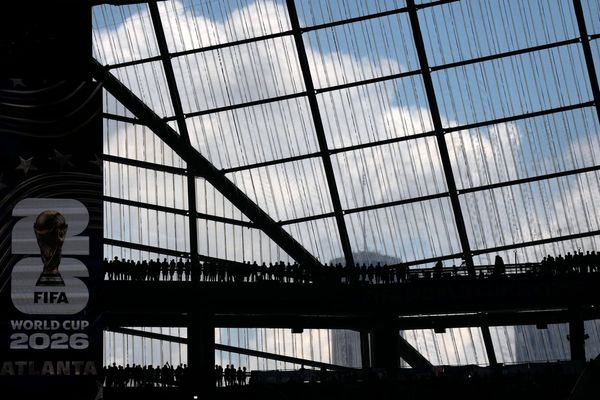
The tournament will be played across 16 venues in 16 cities. In the United States, the 11 stadiums are MetLife Stadium in East Rutherford, New Jersey with a capacity of 82,500; SoFi Stadium in Inglewood, California with 70,240; AT&T Stadium in Arlington, Texas with 80,000; NRG Stadium in Houston, Texas with 72,220; Arrowhead Stadium in Kansas City, Missouri with 76,416; Mercedes-Benz Stadium in Atlanta, Georgia with 71,000; Hard Rock Stadium in Miami Gardens, Florida with 64,767; Levi's Stadium in Santa Clara, California with 68,500; Lincoln Financial Field in Philadelphia, Pennsylvania with 69,796; Lumen Field in Seattle, Washington with 68,740; and Gillette Stadium in Foxborough, Massachusetts with 65,878.
In Canada, the two stadiums are BC Place in Vancouver, British Columbia with a capacity of 54,500 and BMO Field in Toronto, Ontario with an expanded capacity of 45,500.
In Mexico, the three stadiums are Estadio Azteca in Mexico City with 87,523, Estadio Akron in Guadalajara with 49,850, and Estadio BBVA in Monterrey with 53,500. The final will be held at MetLife Stadium in East Rutherford, New Jersey on July 25, 2026.
Key dates to remember
The opening match will be played on June 11, 2026 between Mexico and South Africa at Estadio Azteca. The group stage will run from June 11 to June 27, 2026.
The round of 32 will take place from June 29 to July 6, 2026.
The round of 16 will be held from July 9 to July 12, 2026.
The quarter-finals will be on July 15 and July 16, 2026. The semi-finals will be on July 19 and July 20, 2026.
The third-place play-off will be on July 24, 2026 at Hard Rock Stadium in Miami. The final will be on July 25, 2026 at MetLife Stadium in New Jersey.
Also Read | The last dance: Messi and Ronaldo get ready for sixth and final World Cup
Who can win the 2026 FIFA World Cup: The favourites
Undoubtedly, we would see some big upsets and the rise of new heroes and underdogs, but considering the current FIFA rankings and recent form of teams, here are the leading contenders who can get their hands on the coveted trophy.
The number one is Brazil, as they are known as the powerhouse of football and have won the coveted trophy five times. Their team has depth and experience and includes some of the most prominent stars of football including Rodrygo, Vinícius Jr., and a resurgent Neymar. The team has a lot of talent and depth, and it would be really difficult for others to stop them.
In the second slot, we have defending champion Argentina, who has arguably the best player of this era Lionel Messi. But he is 38 years old and it would be interesting to see if he can once again take his team to the final and lift the cup. Messi still has it but can he do it again?
In third place, we have France, a team oozing with talent, and they have the superstar Kylian Mbappé, who is certainly at his prime, and other top stars are Tchouaméni and Camavinga.
England comes next. Can they do it this time? Well, they have a supremely talented team with stars like Jude Bellingham, Bukayo Saka, and Phil Foden, and it seems they have to shine this time after finishing as runners-up in Euro 2020 and 2024.
Then there is Germany, another European powerhouse of football. Germany is one team that is always dangerous in this tournament, and with stars like Jamal Musiala and Florian Wirtz in their ranks, they can test the very best in the business.
Spain can also pose a serious challenge with stars like Pedri, Gavi, and Lamine Yamal in their ranks, as they can beat the best in the business.
Underdogs to watch out for
Some of the underdogs who can really go deep into the tournament and create a huge upset and might even win the cup are Morocco, who made it to the 2022 semi-final, Portugal with many talented stars, and a supremely talented Netherlands.
The golden generation of stars
For football fans, there is a lot to look forward to, as there are veterans like Lionel Messi from Argentina, who is 38 years old and could be playing in his last World Cup, and his contemporary who is also one of the greatest players of all time,
Cristiano Ronaldo from Portugal, who at 41 years of age will be leading Portugal one last time. Other big stars are Neymar from Brazil at age 34, who can still create magic on the field, and Kevin De Bruyne from Belgium, who is 34 and can test the very best in business with his exceptional skills.
Manuel Neuer from Germany at the age of 40 is still a force to be reckoned with in goalkeeping. Other stars who are in their prime are Kylian Mbappé from France, the best player in the world right now; Jude Bellingham from England, a complete midfielder; Vinícius Jr. from Brazil, a top-class winger; Erling Haaland from Norway, the most lethal striker, as Norway has qualified for the first time since 1998; and Phil Foden from England, who is called a creative genius for his tremendous skills and game awareness.