The all-new 2022 Toyota Tundra hits showrooms in December, and while the automaker won’t commit to pricing yet it claims the Tundra’s cost will be “very competitive” with today’s full-size trucks. That leaves a pretty wide gap in estimating what the new Tundra will cost, but after previewing the truck 3 weeks ago we did get a chance to drive it last week in San Antonio, home of the Tundra’s assembly plant.
What we learned from the Tundra’s driver’s seat synchronized with what we expected during the truck’s preview. For a full background on the 2022 Toyota Tundra you’ll want to check out our previous story. For a sense of how the truck’s design and engineering translate to on-road and off-road driving dynamics, along with towing behavior when pulling various trailer sizes and weights, read on.
The most important upgrade to the new Tundra is the fully-boxed frame paired with its first-ever multi-link rear suspension. The stronger frame provides a 20 percent improvement in rigidity and enables a 12,000-pound towing capacity and 1,940-pound payload capacity. This more sophisticated rear suspension pairs with an optional rear height adjustable/load leveling air suspension and adaptive variable suspension to expand the Tundra’s on-road comfort and off-road capability.
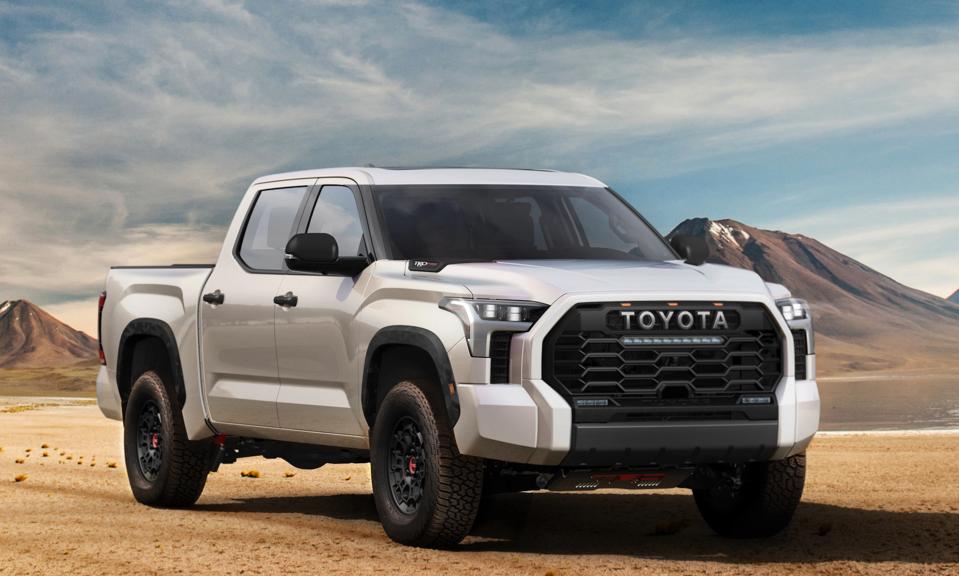
We tested the new Tundra on pavement and dirt outside San Antonio, and we even had the opportunity to drive a current-generation Tundra TRD Pro to compare it against the all-new model. As expected, on-road ride quality in the new truck felt like a luxury vehicle compared to the outgoing Tundra, with less wind and road noise, greatly reduced harshness over bumps and more precise steering and throttle response. Off road testing revealed even more improvements, offering advanced features like crawl control and downhill assist control along with the TRD Pro’s upgraded springs and shocks to confidently cross mud and ruts or scale steep inclines covered in loose rocks and debris.
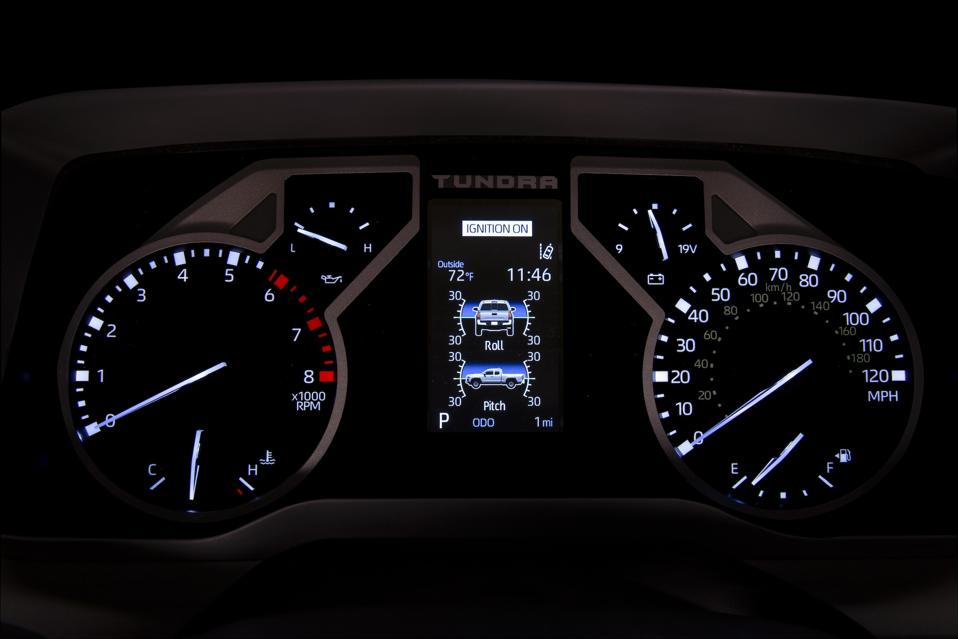
For this generation of Tundra, Toyota built the TRD Pro trim off the Platinum trim, making the off-road oriented truck far more luxurious but without compromising genuine off-road capabilities. This includes not only the more advanced suspension, electronic locking differential, underbody skid plates, and off-road driving aids like crawl control and downhill assist control, but also multi-terrain select modes to modulate wheel spin on different surfaces.
The other big news for 2022 is the Tundra’s two new engine options. The i-Force 3.5-liter twin turbo V6 produces 389 horsepower and 479 pound-feet of torque, or 4 more hp and 75 more lb-ft than the previous Tundra’s V8. This engine, backed by a new 10-speed transmission, will be available when the new Tundra goes on sale in December. A few months later the i-Force Max will debut, offering 437 hp and 583 lb-ft of torque through a 3.5-liter V6/parallel hybrid system using a motor-generator housed between the engine and 10-speed transmission. With either engine, Tundra 4x4 models include a two-speed transfer case.
The new hybrid drivetrain has an internal clutch that can couple or de-couple the motor as needed, based on torque demands. It uses a battery below the second-row seat, which impacts the storage area compared to the standard V6 drivetrain. However, hybrid Tundras offer an alternative storage area behind (instead of below) the second-row seat.
Driving both of the new V6 engines, especially right after experiencing the previous Tundra’s V8, was quite telling. While the outgoing V8 delivers a more pronounced exhaust note there was still an appealing growl coming from the standard 3.5-liter V6. The V6 also felt quite strong compared to the V8, though the 10-speed transmission’s wider gearing likely lends a hand here. As capable as the standard V6 felt, hopping from it to the hybrid version quickly revealed the extra 50 horsepower and 100 pound-feet of torque. The Tundra hybrid is downright quick, and its extra toque will be readily recognized — and appreciated — by truck buyers looking to do serious hauling or towing.
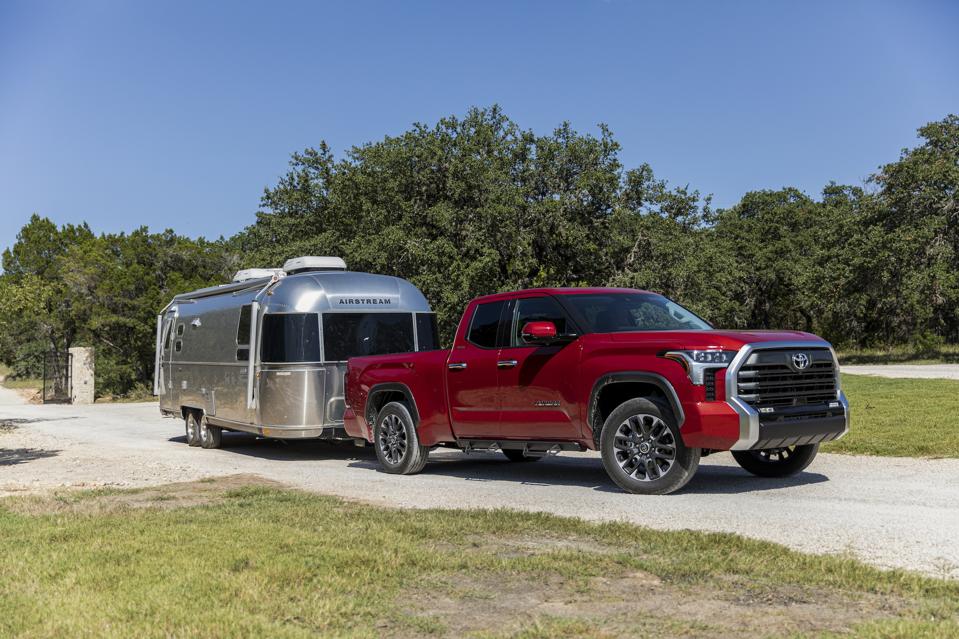
Which brings us to Tundra towing experience. Toyota included a wide range of standard and optional towing technology in the new truck. Features like trailer sway control and a trailer brake controller aren’t particularly innovative, but the Tundra’s new trailer backup guide, with visual and audible warnings, is undeniably helpful. The most advanced towing tech is what Toyota calls Straight Path Assist, and it’s essentially meant to take over steering inputs while automatically keeping the trailer in a straight line while backing up, once a direction has been set. Picture backing a boat trailer into the water launch or a trailer into its camp site.
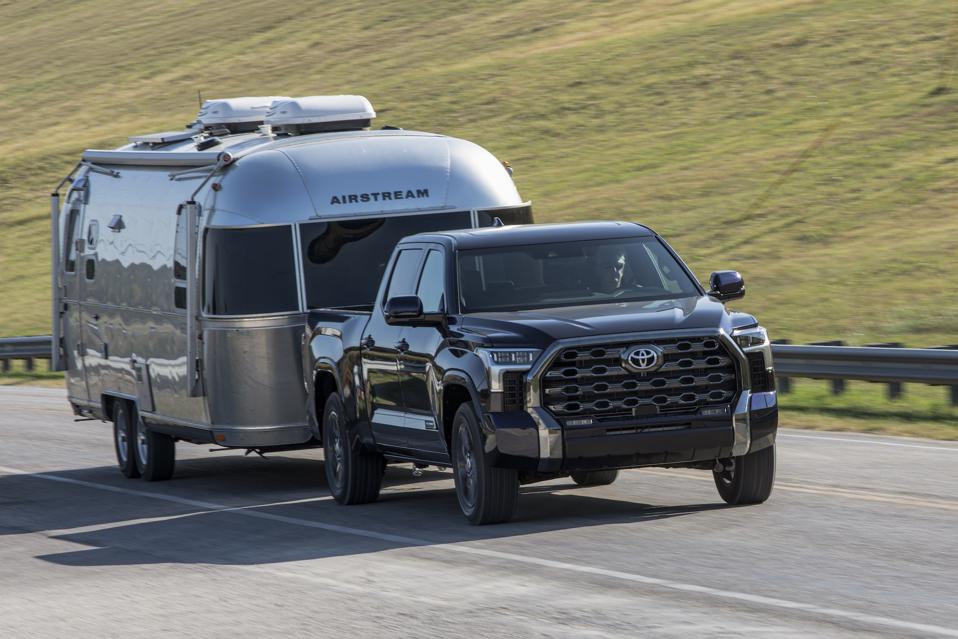
We tried straight path assist out with a relatively short trailer and found it less than 100% consistent in keeping the trailer straight, though variables such as calibrating the trailer could have played a role in its performance. The idea behind straight path assist is definitely a worthy feature for truck owners, and we’ll be interested to see how its received by customers. When not backing up the new Tundra provides an undeniably smoother and more confident towing experience compared to the previous model. A tow/haul mode keeps the transmission in lower gears, and the adjustable brake controller made it easy to modulate braking between the truck and trailer. Of course the extra grunt from the hybrid drivetrain had the Tundra pulling a large, 30-plus-foot Airstream trailer without hesitation.
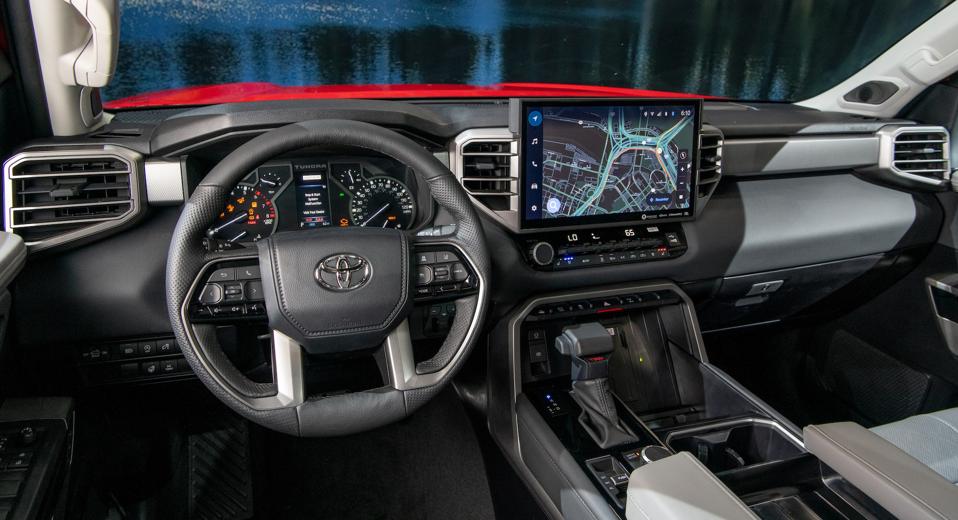
With six Tundra trim levels, and dozens of configurations across cab types, bed lengths, and drivetrain options, it was impossible for us to try out every version of Toyota’s latest full-size truck. But we did appreciate the new, optional 14-inch touchscreen and its intuitive control interface. We also like that Toyota provides a distinctive grille for each model, and we’re happy to see the 6.5-foot bed now offered with the full four-door (Crew Max) cab. Finally, the power rear window that completely retracts isn’t new this year, but it’s still pretty damn cool. These features, along with the 2022 Tundra’s more sophisticated ride quality, make it a viable daily driver and family hauler as much as a serious off roader or tow vehicle.
That’s a good thing, because the full-size truck market is a brutal playing field. Toyota understands this as well as any truck brand, and its newest Tundra is the automaker’s most widely appealing entry yet.