Player comparisons are an inevitability in every draft evaluation process. Some find them useful, others think they’re useless. But they give people a good general thumbnail of a prospect’s traits and attributes.
That said, we’re going a bit outside the box with these comparisons. Here, we align 2020 draft prospects with their fictional football doppelgangers.
Joe Burrow: Jonathan Moxon, Varsity Blues

Joe Burrow is regarded by most as the complete quarterback in this draft class, and almost a lock to be the first player drafted when the NFL Draft begins.
Jonathan Moxon, however, was a backup. The caddy to Lance Harbor, the All-State quarterback with a scholarship waiting for him at Florida State. While Harbor was throwing touchdown passes all over the field for the West Canaan Coyotes and making the student body swoon with interesting pep rally speeches, Moxon was waiting on the sidelines, reading “Slaughterhouse-Five” instead of his playbook on Friday nights.
But when Harbor goes down due to a brutal knee injury, Moxon gets his chance. One of the things he installs in the new Coyotes offense in the movie’s critical final game – an offense he tried to install earlier, much to the chagrin of old school coach Bud Kilmer – is Mississippi Valley State’s “Oop-de-oop” offense. A five-receiver system that as Moxon points out, has MVS averaging over 44 points per game. Of course, it leads to Kilmer delivering a rather amazing comparison in this clip (which, by the way, is not exactly safe for work, but since you are likely working from home, just make sure the kids are in another room):
Now, it is important to remember for this comparison not that Burrow was an afterthought in the Ohio State quarterback room, which led to his transfer to LSU, but rather the offense that Burrow ran last season. Under Joe Brady, the LSU Tigers were predominantly a five-man protection scheme. Very similar, in that regard, to that vaunted Mississippi Valley State offense. That made Burrow responsible for the sixth man in any potential defensive pressure scheme. What does that look like on film?
That is going to have Burrow ready for whatever he will face in the pros.
Jalen Hurts: Shane Falco, The Replacements

Shane “Footsteps” Falco. A former All-American at Ohio State at quarterback, who fell to pieces after a disastrous Sugar Bowl outing. When the Washington Sentinels bring retired coach Jimmy McGinty back to coach replacement players during a players’ strike, McGinty goes looking for the former quarterback, finding him in scuba gear, scrubbing barnacles off of “rich people’s toys.”
But while Falco still had the arm and athletic ability he displayed while playing at Ohio State, there was something else he brought to the group of replacement players: “Heart,” as McGinty termed it. Falco became a leader in that locker room very quickly, and the other players soon learned to follow him on the field and off. When the strike ends and the team’s original starting quarterback returns, it is clear almost immediately that the rest of the replacement players will follow only one quarterback: Falco.
Leadership matters at the quarterback position, and one of the things that Hollywood gets right about football movies is this fact. From “Any Given Sunday” to “The Program” to “The Replacements,” quarterbacks need to inspire those around them. In both versions of “The Longest Yard,” a critical plot point is whether Paul Crewe has his own interests at heart, or those of the team around him.
Jalen Hurts is rising up draft boards, to the point where he could be the fifth – or even fourth – quarterback selected in this draft. Why? Because of his character and leadership skills as much as his athletic prowess. Football coaches look at how Hurts handled the situation at Alabama, and then how he became a leader in Oklahoma, and want that kind of player in their locker room. They can know full well that when Hurts steps into a huddle, he will command the attention and respect of the ten men in there with him.
Just like Falco did when he earned the trust of the replacement Sentinels.
Malik Harrison: Daniel Bateman, The Replacements

Another position that the silver screen tends to get right is linebacker. In a way, it makes sense. Many of us have that glamorized view of an old-school linebacker. A player like Mike Singletary, who comes crashing downhill on a pivotal short yardage play and gets the team a critical stop, handing the football back to the offense – and the similarly well-crafted quarterback – for one final game-winning drive.
Now, in the modern NFL linebackers are often tasked with more responsibilities, such as running with tight ends on vertical routes and playing some kind of pattern-matching coverage against route concepts. But until Hollywood finds a way to make that look glamorous, we are going to be relying more on the traditional linebackers.
We begin with the first of three LBs to make this list, Malik Harrison from Ohio State. Harrison is one of your traditional thumpers at the position, a player with an attack-first mentality who is going to come down to the line of scrimmage and lay the wood on a ball-carrier. He is at his best playing downhill, and you can imagine a scenario where he comes flying down to the line of scrimmage and just stops a play before it gets going, giving the ball back to his offense.
Kind of like this:
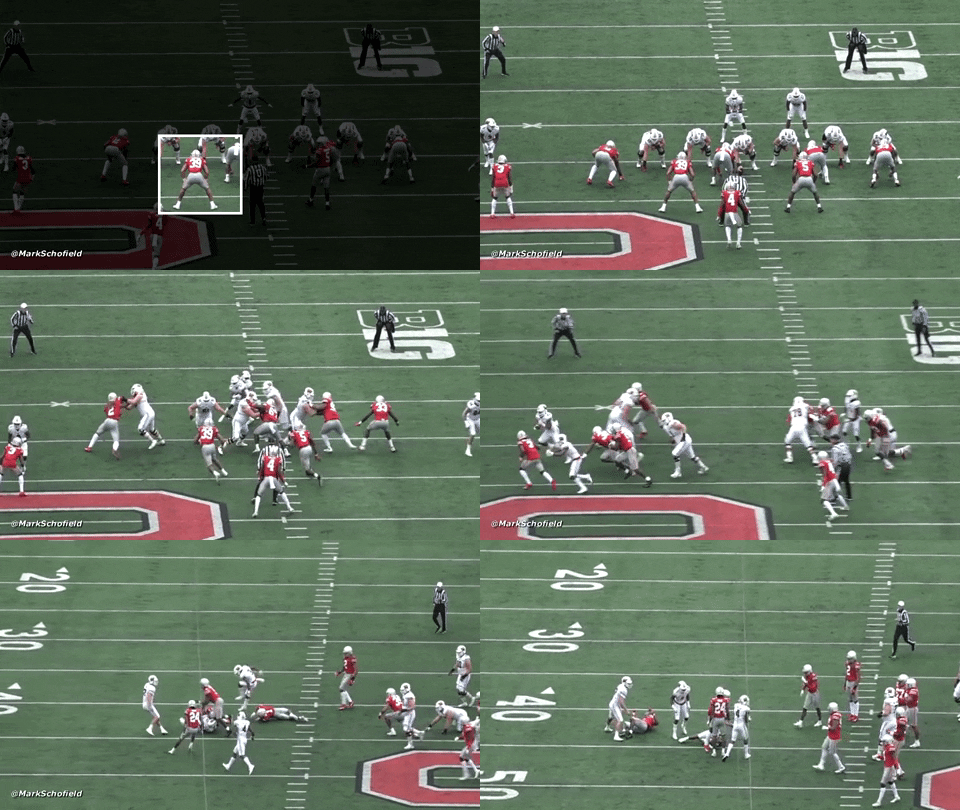
On this play, Harrison comes flying downhill, forklifts the pulling tackle into the path of the ball-carrier – nearly tackling the running back with the lineman – forcing the RB into traffic and a tackle behind the line of scrimmage. Now it is not exactly a frame-for-frame play like this from Bateman, the SWAT officer turned replacement linebacker, but it is close, specifically in terms of how both Bateman and Harrison destroy the lead blocker:
That is a play described as “All-Madden” in the movie. Harrison has those kind of All-Madden moments in his future, at least against the run.
Jordyn Brooks: Alvin Mack, The Program

Perhaps the impetus for this entire piece was this comparison, in the soon-to-be-released Touchdown Wire Top 11 linebackers. So, I am getting ahead of myself a bit…
But think to “The Program,” and Alvin Mack, the heart of the ESU defense. Sure, Mack was not concerned with a lifetime appointment to the nation’s highest court, but he sure knew how to execute his assignments:
Mack was a ferocious downhill player who was fearsome against the run but also was able to attack the opposing passer as a pass-rusher. In ESU’s defense, he was not consistently asked to drop into coverage, but from the explosiveness we saw from him, and his deep understanding of coverages and assignments, we can extrapolate his ability to execute that part of the playbook.
Brooks is a similar player. He has a quick trigger down near the line of scrimmage and can run through contact en route to the ball-carrier. When tasked with underneath zone coverage he displays solid processing ability and is always scanning for the nearest receiver in his zone. He can play between the tackles with ferocity, much like Mack. “Find ball, hit ball” is his mentality, which is why Sam Winters trusted him at the core of his ESU defense.
Kenneth Murray: Bobby Boucher, The Waterboy

If there was one player in this linebacker group that I would just assign the task of “destroying worlds” on a given play, Kenneth Murray would likely be that player.
After all, if you work through his game film you see that when Oklahoma let him just attack, that is when he was at his best. When he can diagnose a play in front of him and just explode downhill, he has the ability and power to stop plays before they even start. Pro Football Focus described him as a “hunter” in the middle of the field, and that is exactly what he does on plays like this:
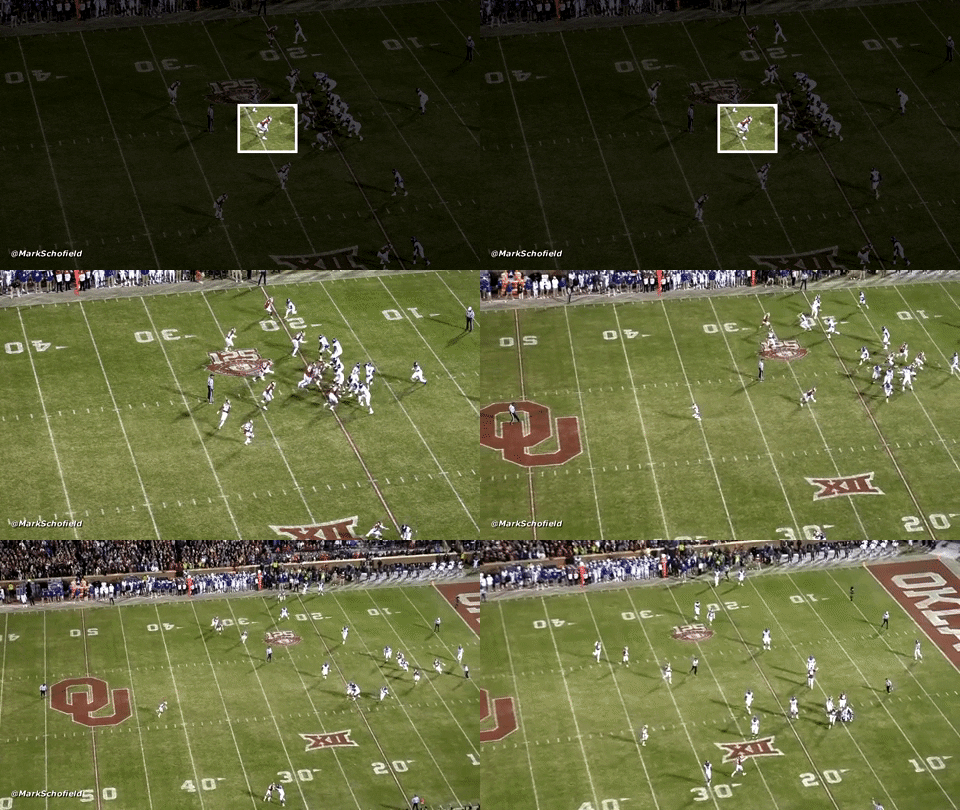
When Murray is able to attack a pocket as a pass-rusher, or diagnose a screen and come downhill to destroy it, he is at his best.
Now, from all the research I have done into Murray’s background, there is little evidence of an interest in the aquatic arts. But there is a parallel between how he plays the position, and the unknown water consultant who turned the South Central Louisiana State University Mud Dogs into a feared defensive unit. Both Murray and Boucher have the ability to single-handedly stop an offense in its tracks.
For Murray to have similar success in the NFL, however, he might need a coach with the vision of Coach Klein to pull it out of him.
Denzel Mims: Clifford Franklin, WR, The Replacements

Returning to the Washington Sentinels, when venerable coaching legend Jimmy McGinty was assembling his roster of replacement players, he had in mind a pure burner for the wide receiver position. Clifford Franklin, described by the coach as “…the fastest (sob) I’ve ever seen.” Of course, there was a slight catch, pun intended:
Franklin eventually overcame his…difficulties…at the catch point. But what got him into the locker room and made him a favorite target downfield was his blazing speed.
Mims has enjoyed one of the best pre-draft processes of any player in this class. He was at times the best receiver down in Mobile during the Senior Bowl. The former high school track star then set the turf at Lucas Oil Stadium ablaze with a blistering performance, including a 4.38 40-yard dash and a 6.66 three-cone drill.
The one area of concern? The drops. Pro Football Focus charted him with a 12.9% drop rate over the past two years, having dropped 18 passes on 139 catchable passes. While Franklin struggled all the time, however, the saving grace for Mims is the fact that while he might drop an easy slant here and there, he has a knack for coming down with the more difficult throws in the downfield passing game.
Justin Jefferson: Rod Tidwell, WR, Jerry Maguire

Sports super agent Jerry Maguire had a problem.
He came to the realization, perhaps in a bit of a mid-life crisis, that his lot in life was almost meaningless. While he was a powerful agent who enjoyed the success that came with representing some of the best athletes in the world, he was failing at building personal relationships. In a middle-of-the-night panic, he writes a vision for the future of the sports representation business. His peers love it, until he is almost immediately shown the door.
In a panic, he tries to hold onto as many clients as he can to strike out on his own, adn the only one who stays with him? Rod Tidwell. A wide receiver for the Arizona Cardinals viewed as a bit of a diva. But what the league does not take into consideration, but Tidwell and his family do, is the receiver’s willingness to play over the middle. To make the tough, contested catch in traffic. To put his body on the line for the throw.
Inspired by his sole client, Maguire puts the future of his new firm – and his own reputation – in Tidwell’s hands. Tidwell plays on the final year of his contract, continuing to put his body on the line to earn one more big deal. In a huge Monday night game, Tidwell catches a touchdown but seemingly gets knocked out in the process, before coming to his feet to celebrate.
Justin Jefferson from LSU has that same fearless mentality working over the middle. In LSU’s offense he was tasked with running a large number of crossing routes, finding space against zone coverages or running away from man defenders. He played with a care in the world when running these routes, sometimes taking a shot and getting up to celebrate as well after the play:
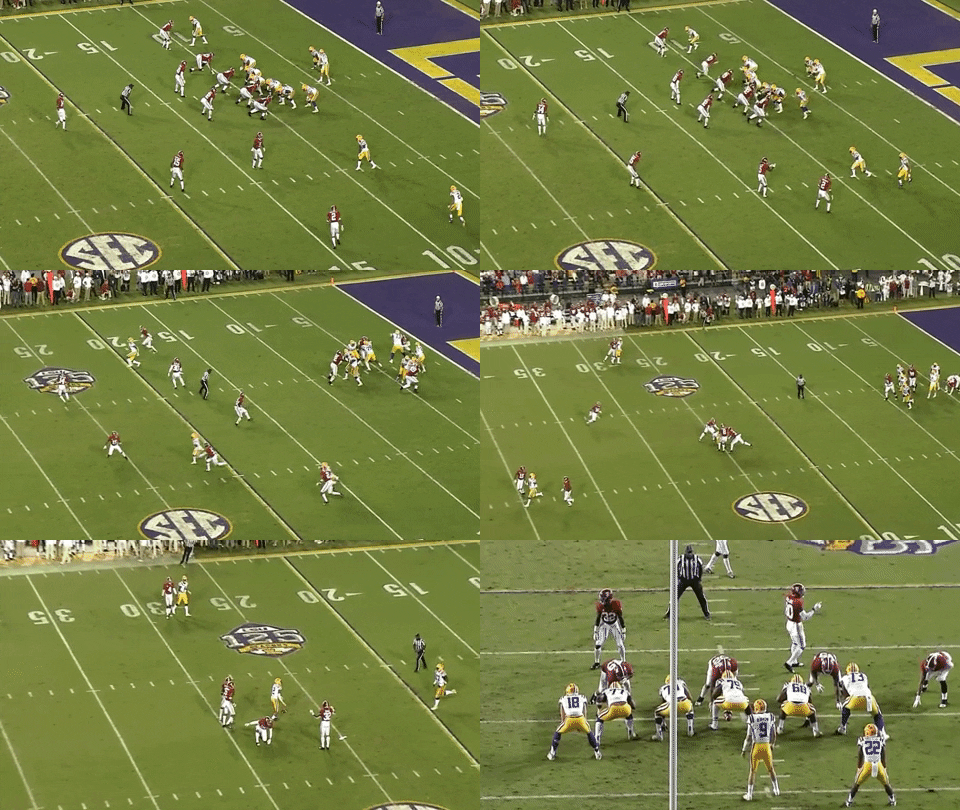
Jefferson’s ability to play over the middle and put himself on the line is one of his more impressive traits as a receiver. It is also a trait that helped Tidwell earn that last big deal, and retire as a Cardinal.
D’Andre Swift: Darnell Jefferson, RB, The Program

ESU head coach Sam Winters had one major recruiting target after the Timberwolves’ losing record the season prior, leading the program to miss out on a bowl game for the second year in a row: Running back Darnell Jefferson. Jefferson, out of the Philadelphia area, was a highly-regarded recruit. His 108-yard kickoff return against Taft was one of the best runs Winters ever saw a high school player make…or so he said. Jefferson was armed with a plethora of scholarship offers, but in the end decided to enroll at ESU, with a promise to his family that he would earn not just a starting job, but a degree.
He found playing time in the Timberwolves’ offense tough to come by at first, with Ray Griffen already entrenched as the team’s starting tailback. But Jefferson found other ways to contribute. Using his speed he became the team’s punt returner, and started to earn more playing time when quarterback Joe Kane was suspended. He had a 62-yard touchdown against North Carolina to help ESU keep their bowl hopes alive. But in the end, it was what he was able to do as a receiver that got the Timberwolves a conference championship and back to a bowl game (again, the dialogue is not exactly safe for work):
Jefferson’s feel for route-running gets him open in the end zone, and Kane hits him for the game-winning score.
That is where Swift comes in. The Georgia running back can be a home run hitter as a ball-carrier, but he also is a threat out of the backfield. He runs a complete route tree, from almost any alignment, and has tremendous hands out of the backfield. Pro Football Focus charted him with just three drops on 76 catchable passes during his Georgia career. His long speed, similar to Jefferson’s, is going to make him a threat in a variety of ways in the NFL.
Adam Trautman: Brian Murphy, TE, The Replacements

While Hollywood handles positions like linebacker and quarterback well, there are not a ton of options when it comes to the tight end spot. Makes it similar, in some ways, to this draft class. But I digress…
In “The Replacements,” Jimmy McGinty taps Brian Murphy from Gallaudet University, as the Washington Sentinels’ new tight end. As McGinty explains it to his assistant coaches, Murphy would have been a first-round selection in the league’s draft out of the small District of Columbia school if not for one reason: Murphy is deaf. Outside of that, Murphy is the complete package at the tight end position. He can be an inline blocker that is rare to find coming out of college, while still being a threat in the passing game. On the pivotal moment of the movie’s final game, it is Murphy who is the target for Shane Falco for the game-winning, and playoff-clinching, touchdown.
Adam Trautman, while not deaf, has a somewhat similar small school to big stage story. Trautman was an option quarterback for a school in northern Michigan, and given the offense he ran, not many big schools came calling. He enrolled at the University of Dayton as a quarterback originally, but put on some weight and moved to TE. There, he became a force. He set a number of school records, and by the time his senior year around, he was making plays like this against Valparaiso:
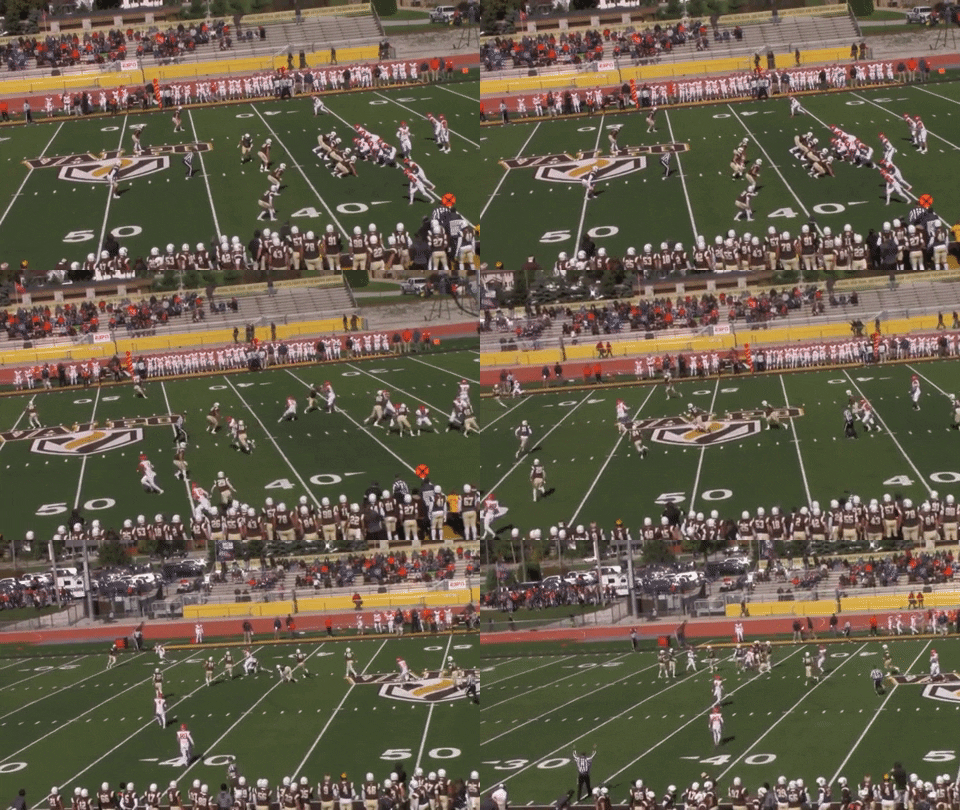
Like Murphy, Trautman is the all-purpose kind of tight end that does some of his best work as a blocker. Trautman made a point of telling the media both at the Senior Bowl and at the Combine that he loves nothing more than putting a man on his back on a running play. But it is Trautman’s ability to change directions and be a receiver that is going to get him drafted earlier than some expect. And who knows, if it were not for his own small school background, maybe he too would have been a first-round pick.
Robert Hunt: Bud Kaminski, OT, The Program

Louisiana-Lafayette offensive lineman Robert Hunt brings an interesting playing career to the NFL Draft. Hunt began his time at ULL as an offensive guard, serving as the team’s starter at the left guard position. But he switched to offensive tackle for his final years with the program, perhaps because the Ragin’ Cajuns featured a starting quarterback who was a left-handed passer. Putting Hunt on the right side of the line left him in position to protect his quarterback’s blind side.
While on the field, Hunt is a very aware blocker in pass protection, but he also brings “throw you out of the club” power to the position. He moves very well laterally, and anchors extremely well against power moves and bull rush attempts. He has good footwork too, as he displayed with this hinge block on the backside of an outside zone running play:
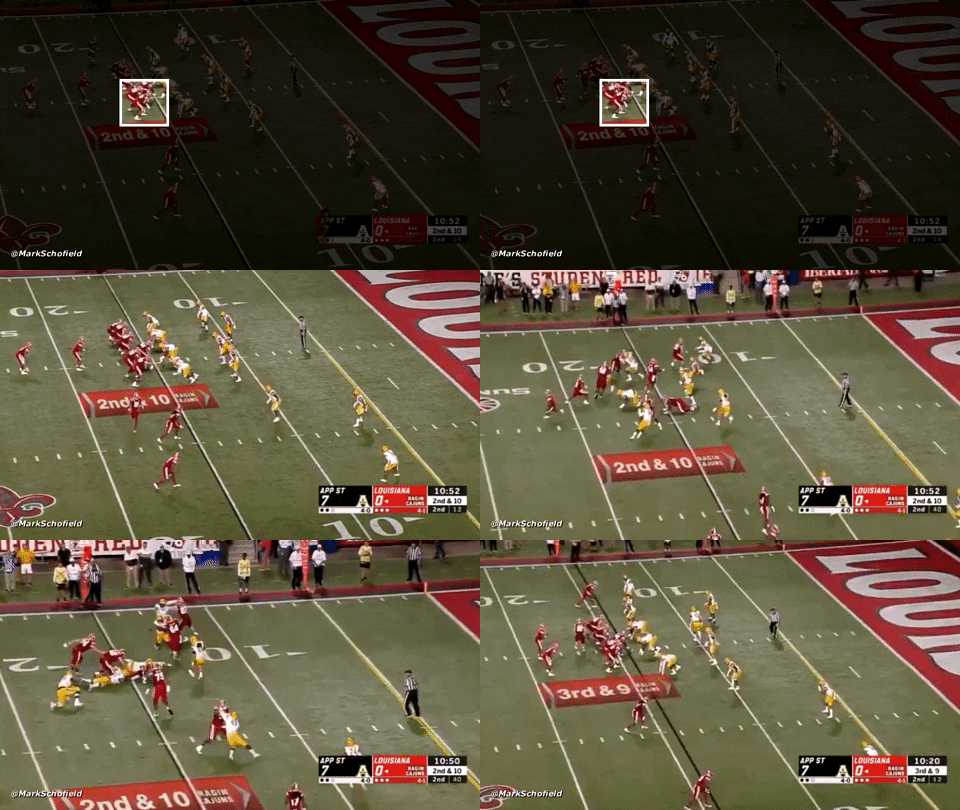
One of the things I enjoyed the most about studying Hunt was how his power seemed to impact the players across from him. It did not make it into my breakdown of him, but watch this play against Appalachian State:
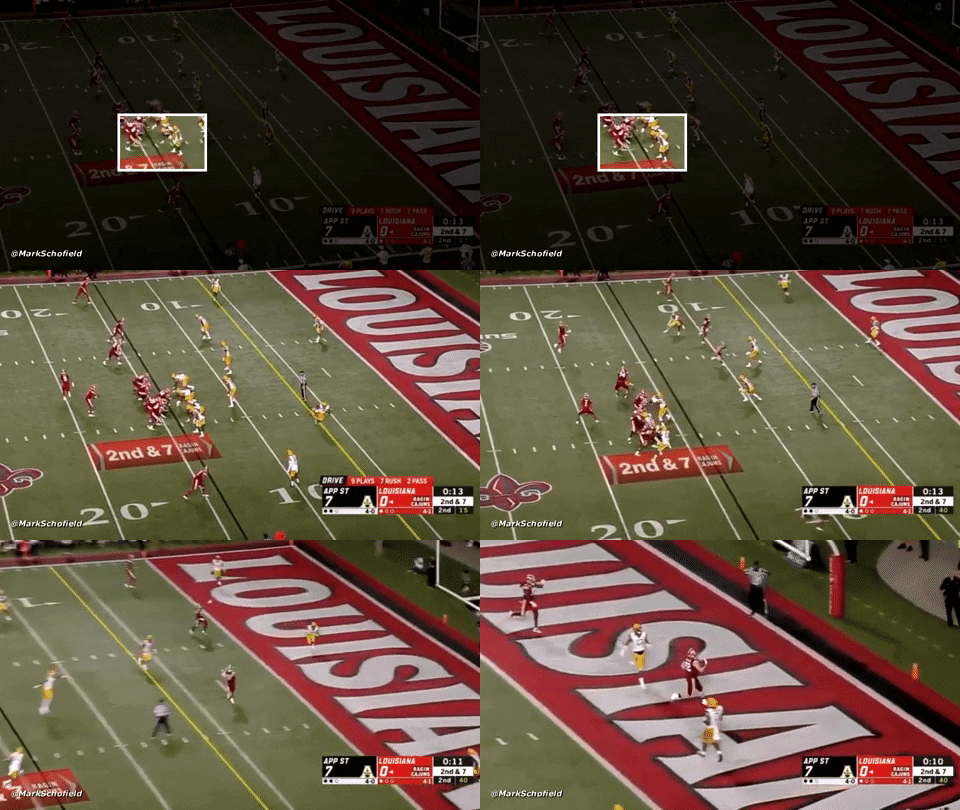
I loved this play from Hunt. He is tasked with pass protection and there is pressure coming off the edge, but it seems the mere thought of him striking the edge rusher has that defender coil back in fear, rather than continue his path.
That is reminiscent of Kaminski, the personal protection for ESU Timberwolves’ quarterback Joe Kane. Kaminski protected Kane’s blind side for a number of years, and relished in the trench fight. He loved to talk before, during and even after the play, and if you rewatch the final play of ESU’s win over Georgia Tech you will hear Kaminski with his in-play commentary. Watching Hunt, particularly on this play, reminded me of the ESU tackle.
Lloyd Cushenberry/Damien Lewis – Andre and Jamal Jackson, OGs, The Replacements

We then return to the Washington Sentinels, and while this draft class does not give us a pair of twins to choose from, we can find the next best thing: A pair of teammates.
Andre and Jamal Jackson were a stout pair of offensive guards who, when they could not make a career in professional football stick, turned to a life of private security. But when Jimmy McGinty came calling, the twins returned to the gridiron. When they were not clearing a path for the Sentinels running game, they were making sure that their quarterback was protected on and off the field.
While Lewis and Cushenberry are not known for defending Joe Burrow’s ride in the parking lot, they did a tremendous job protecting him this past season during LSU’s ride to a National Championship. With Cushenberry at the center spot and Lewis at right guard, Burrow was kept clean most of the time he dropped to pass. But both players – like their silver screen counterparts – relished the fight in the trenches, and more often than not came out on top in those battles.
Trevon Diggs: Dr. Death, CB, The Best of Times

We close this out with perhaps my favorite football film of all time: “The Best of Times.” Anyone who played the game, at any level, probably has that moment they would love to have back. That is the plot line running through this Robin Williams comedy. Williams, as Jack Dundee, had a chance to deliver a huge play for Taft High School during his senior year. Taft finally had a chance to beat their bitter rivals Bakersfield, led by quarterback Reno Hightower. But on the game’s final play Dundee drops what would have been the game-winner.
Now living as an unhappy, middle-aged banker working for his father-in-law – who just happens to be Bakersfield’s biggest booster – Dundee wants one final shot at redemption. So he convinces everyone in town for a rematch of that final game, hoping to get his shot at one more big play.
Standing in his way? A fearsome press cornerback named “Dr. Death.”
Trevon Diggs does not have the…colorful past that Dr. Death brings to the reunion game, but in this class of cornerbacks he is perhaps the best press corner to be found. As Pro Football Focus described him in their draft guide: “There are long corners and then there’s Trevon Diggs. He looks like he missed his calling as a defensive specialist in the NBA. Diggs’ ability to end wide receivers at the line of scrimmage is something that NFL teams are going to love.”
Something that looks like this I bet:
Well, for his sake hopefully without the final play.