Great sport enjoys two lives, one ephemeral, the other enduring. The first comes at the moment of inception in a flash of drama or inventiveness. This is the original, pure experience, uncorrupted by memory or replays, description or analysis. But it’s not enough. And it has never been enough. Because, like all the best things in life, sport demands reflection. It’s emotion recollected not in tranquillity but sentimentality.
I first became aware of this when I was a child and, having been to watch a Spurs game, I would eagerly await the Match of the Day highlights of what I’d already seen, and then consume the Sunday paper match reports of a game that, by then, I’d watched live and in an edited TV version. I would also scour the Monday papers for any additional information or, failing that, a recapitulation of old information.
By the end of this activity, a new game would exist, quite different to the one I’d watched, usually better, more coherent and meaningful.
And it’s this second life of revisitation and reconsideration that I think provides the answer to sport’s special appeal. Its true measure is not its immediate impact, but how it lives on in the memory. We may crave the shock of the new but it’s the process of absorbing it that turns the unbelievable into the unforgettable.
Nowadays, with the recording of so much and the ability to replay on phones, YouTube, with instant rewind on TV, and even immediate review on screen at live sport, looking back has never been more readily present.
With that in mind, I’m going to make an utterly subjective reappraisal of my sporting highlights of 2014, and select the moments of action that seared themselves – until amnesia intrudes – into my consciousness.
The year started on a high note with Stanislas Wawrinka winning the Australian Open. The Swiss doesn’t look like an elite athlete. He looks like the bloke who fixes your boiler. But no one – not even his peerless countryman Roger Federer – possesses a more lethal single-handed backhand.
In the final he played Rafael Nadal, the then world No1, to win his first ever grand slam in four sets. But the moment that captured my everlasting admiration was the first point of the second set. The Swiss had taken the first set comfortably and he knew, as we all did, that Nadal would come out like a bull in the second.
Sure enough the Spaniard poured everything into that first point, which went to 22 rounds of heavy artillery shot-making before Wawrinka triumphed. Although Nadal was later injured, it was in that exchange I think that Wawrinka knew he had the mental, as well as physical, strength to withstand Nadal’s fearsome willpower. That’s when he persuaded himself – and Nadal – that he had what it took to be a champion.
If sport was just about the spectacular, then Gareth Bale’s winning goal for Real Madrid against their arch rivals Barcelona in the Copa del Rey final would be a defining moment – and certainly Bale’s defining moment – of the year. After all, he ran so far off the pitch to get round the right-back that he risked being booked for embracing the crowd.
But it’s also about rising to the occasion and a month later in Lisbon, in the Champions League final against Real’s neighbours Atlético Madrid, Bale performed that task with stunning literalness.
In truth, the Welshman had a disappointing game by his elevated standards, missing a series of good chances and running repeatedly into dead ends. Yet he never gave up and 20 minutes into extra time he made one more lightning dash to leap impossibly high and get his head to the rebound from Ángel di María’s saved shot. It was effectively the winning goal. A player who just over four years earlier was seen as a losing jinx at Tottenham delivered when it mattered most at the very top in Europe. And that’s a sight to be savoured.
The World Cup in Brazil in June and July was a fabulous tournament but oddly unmemorable. Yes, Germany thrashed the hosts 7-1 in their semi‑final (it should have been more) and the Brazilians won’t forget that in a hurry. And Robin van Persie’s header and Luis Suárez’s bite are well worth remembering.
However, it seems that one player has to stamp his mark – like Pelé, Cruyff or Maradona – for a tournament to qualify for immortality. And the two main candidates – Cristiano Ronaldo and Lionel Messi – were spent from their extraordinary club efforts.
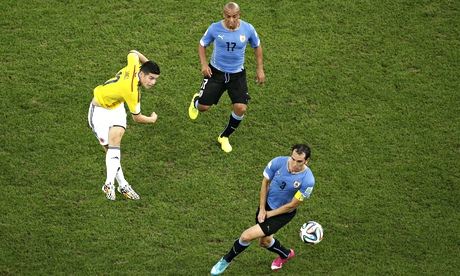
That said, a special talent did announce himself. With the sublime goal he scored against Uruguay, James Rodríguez attracted the attention not just of Real Madrid but the whole watching world. While his control and technique were exquisite, what made the No10’s 25-yard missile a moment to treasure was the busy manner in which he found “the hole” between Uruguay’s defence and midfield and then the total calmness with which – his back to goal – he swivelled to score.
In the now futile Sports Personality of the Year debate – Rory McIlroy or Lewis Hamilton – I went for McIlroy on the grounds that neither his clubs nor caddie were as instrumental in his success as Hamilton’s car and mechanics. In a dream year of attacking golf, McIlroy’s finest moment was defensive. It came towards the end of the final round of the Open with Sergio García and Ricky Fowler closing in on him. Three years earlier he had folded like a banknote in the final round of the Masters, having led for three and a half days. Now, at Royal Liverpool, having once again dominated from the start, he missed the green on the 17th hole. Cracking under pressure was very much an available option. Instead the 25-year-old chipped up to the cup to rescue a par. Golf is a precision game that demands exceptional technique. At the very top, though, it’s also about holding your nerve when it’s hard enough just holding the club. McIlroy showed he could do that, and in doing so he gave himself the psychological edge to withstand Phil Mickelson a month later and win the US PGA.
All these memories have become overlaid with revisions and post hoc narrative-shaping. That’s the point of them. Every reader will have different highlights. But whatever moments are chosen, they are as much a work of our retrospective imaginations as they were initially the creation of a sportsperson’s exceptional skill.