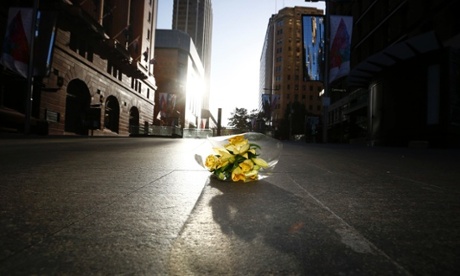
The year was much more than the Lindt cafe, though 2014 will come to be remembered for little else. Most years have their hostage dramas, usually pathetic affairs that end with the sacked worker or the estranged husband putting down his gun and disappearing into jail. But this was the work of an Iranian-born madman in a year that’s seen the world alarmed by a new brand of terrorism with many names: the Islamic State, Isis and Isil.
All the easy predictions for Australian politics in 2015 were junked in the hours of the siege. The killings in the Lindt cafe didn’t change Australia, but they will change the tenor of public life in this country for a long time. The theme song of politics is no longer the budget blues. The harsh critiques of Tony Abbott’s first full year in office now look provisional.
Even so, 2014 was a terrible year for the new prime minister. Great trade pacts were signed; G20 brought the world leaders to Australia; the carbon tax is dead and gone; the seaborne invasion of Australia by refugees has been defeated; the Palmer United party has splintered under the strain – yet Abbott and his government have languished in public esteem.
Pollsters have no precedent for such a slide in the fortunes of a first-term government. By New Year’s Day, the voters who put Abbott in office had already changed their minds. The Liberals are departing. How the Lindt cafe will play into this we don’t yet know. There was a moment after the terrorism scare in September when the graphs steadied. They may steady again. But in 2014 after that brief pause, the gap between the parties measured by Essential, Ipsos and Newspoll widened steadily month by month.
In late November the Australian put its protege on notice. The paper has chided Abbott once or twice since he came to power. Those were mere tugs on the reins. The November editorial “The Abbott government is doomed without a narrative” marked rumbling in the political foundations. No Australian prime minister needs to be reminded of an iron rule of politics in this country: News Limited backs winners.
No one disputes Abbott’s achievement in one key area in 2014: shaping political language. He has given the nation “team Australia”, “shirtfront” and – particularly lately – “death cult”. George Brandis offered his own take on “metadata” and Scott Morrison entrenched “on-water matters” as Canberra’s new way of saying: “Get lost, we’re not going to tell you”.
A plague year
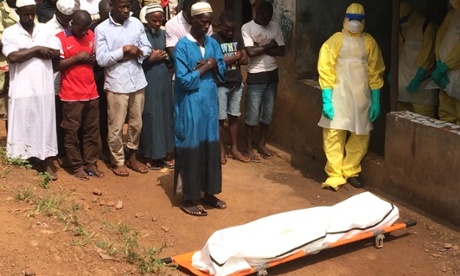
This year began early with the death of a child in a village in Guinea. Children die easily in that country and no particular heed was paid, but two-year-old Emile Ouamouno was patient zero. His mother died a few days later, then his sister Philomène and, on New Year’s Day, his grandmother. All had shown the same terrible symptoms: fever, vomiting and black diarrhoea.
The village of Meliandou lies in a remote corner of the country near the borders of Sierra Leone and Liberia. Mourners returning home from the grandmother’s funeral carried the disease with them to their villages and a nearby city. Death began to stalk the region. Nurses died. Doctors fled. But it was more than two months before a team from the Ministry of Health arrived to investigate.
Blood samples were sent to Lyon and Hamburg. On 24 March, news broke that the mysterious killer in Guinea was Ebola. By year’s end, nearly 7,000 people in six countries had died. Ebola reached the US and Europe. For a few weeks it seemed the disease might even land here. First and foremost, 2014 was a plague year.
Australia’s response was grudging. This is new. Humanitarian gestures used to be our glory. But 2014 was a year we showed ourselves especially discriminating in the face of world challenges. Ebola: excuses, delay and a little money. Global warming: excuses, delay and slippery promises. Refugees: a shark net flung across the oceans. Foreign aid: cuts of $11bn over the next four years. Isis’s conquest of Mosul: deployment of the RAAF.
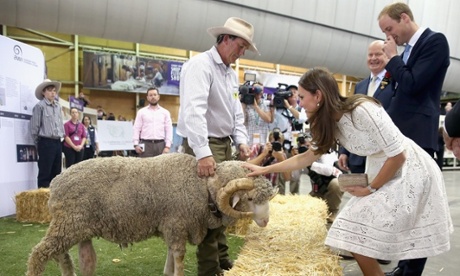
Some years rush by. Not this 2014. It’s hard to believe, in December, that Schapelle Corby was released from her Bali prison in February. Kate and William were surely spinning their strange magic in another century? No, the royal tour was in April. Though an almost forgotten figure these days, the premier of New South Wales, Barry O’Farrell, glassed himself with an old bottle of Grange only in April.
Time played this trick because, until its dramatic end, the year was strangely shapeless. It was one of long, slow slides. The slide of slides was the iron ore spot price: from US$135 at the start of January to below US$70 now. Iron is taking the nation down. Growth is slowing. Tax revenue is falling away. So are confidence, the share market and the dollar.
The slide took Gina Rinehart 11 places down the Forbes list of the world’s 100 most powerful women. She now sits 27th, one spot behind Nancy Pelosi, the Democrat leader in the US House of Representatives. It’s tough for the Rinehart children: if the price of iron ore slips much further, there may be little point in them suing their mother.
Savings have had to be made in Canberra, savings that show where the government’s heart lies. Not sacrificed in the welter of small economies was $245.3m to put chaplains into high schools for the next five years. How can such largesse be funded? Easy: by matching cuts of $254m from the ABC over the same five years.
Even so, religion has had a mixed year, with a royal commission putting Christianity through the wringer. One cardinal, several bishops, priests, ecclesiastical officials, church lawyers and hellfire preachers found themselves in the least likely situation for men of the cloth: a witness box being cross examined about children raped and abused, their abusers sheltered and assets hidden from victims. The grim work continues.
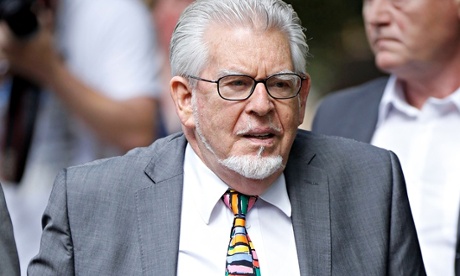
Rolf Harris, 84, was jailed in July on 12 counts of indecent assault of young women and girls. Other great judgments in 2014 include Oscar Pistorius, 28, for culpable homicide; Craig Thomson, 50, for stealing $5,650 from the Health Services Union; and Freya Newman, 21, for leaking details of the $60,000 scholarship awarded by the Whitehouse Institute of Design to the prime minister’s daughter Frances in 2011. No conviction was recorded in her case.
Burqa panic amid anti-terrorism laws
Islamophobes in government ranks were hobbled. At the last minute, the minister for social services, Kevin Andrews, abandoned plans to deliver the opening address to the World Congress of Families in August where Islam, euthanasia, divorce and homosexuality were to come under hardline attack. Other no-shows were official congress supporters and Liberal senators Eric Abetz and Cory Bernardi.
Bernardi is not easily stopped. After the dawn raids of September he tweeted: “Note burqa wearers in some of the houses raided this morning? This shroud of oppression and flag of fundamentalism is not right in Aust.” Thus began the brief great Canberra burqa panic of 2014.
Note burqa wearers in some of the houses raided this morning? This shroud of oppression and flag of fundamentalism is not right in Aust
— Cory Bernardi (@corybernardi) September 17, 2014
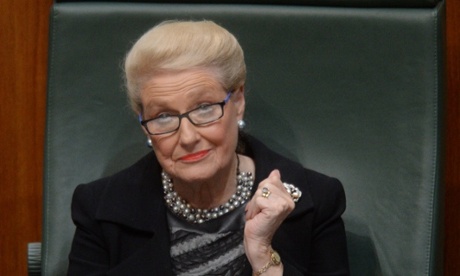
Bronwyn Bishop, responding to the senator’s fears and baseless talkback rumours of black-clad demonstrators descending on parliament, ordered the segregation behind glass in the public galleries of all women with covered faces. None in burqa had ever been seen in parliament before. None appeared now. After an agony of public embarrassment which seemed to last far longer than a fortnight, the Speaker reversed herself.
The raids that gripped Bernardi and the nation were carried out by 800 or so NSW and federal police, backed by Asio officers, in 16 suburbs of Sydney and Brisbane. Arrested and charged was Omarjan Azari, 22, whose tapped telephone call a few days earlier had provoked the security sweep. He’s now facing trial for preparing to commit a terrorist act. His barrister, Winston Terracini SC, claims the phone call was mistranslated. “There was at least one appalling error which goes to the absolute crux of whether this man ever actually acquiesced in the carrying out of a terrorist act.”
Parliament passed two anti-terrorism laws in the aftermath of the raids. One gives the government power to punish Australians for travelling to no-go zones abroad. The second threatens journalists – among others – with prison for up to 10 years for unmasking undercover Asio agents or exposing Asio’s new “special intelligence operations”.
Abbott has, after the shootings in the Lindt cafe, commended a third bill waiting in the wings: “We do face a very real threat from people who want to do us harm and who invoke this death cult ideology as a justification, and that’s why we put forward the metadata retention laws, that is why we are determined to deal with them as quickly as we can in the new year.”
Freedom Abbott has not survived transition to government. “We are the freedom party,” an exuberant Abbott told the Institute of Public Affairs in opposition. “We stand for the freedoms which Australians have a right to expect and which governments have a duty to uphold.” To be fair, he was speaking at a particular time with a particular purpose: encouraging the Murdoch press to weather all scorn in the pursuit of Julia Gillard over her dodgy boyfriend Bruce Wilson, her home renovations and a 1992 AWU slush fund.
News Limited sleuth Hedley Thomas had a cache of fresh documents and the revival of the scandal at this point was gold for Abbott. Thomas hardly needed the leader of the opposition’s encouragement. Over the years since he has written – or had a hand in writing – a further 89 stories about Gillard, Wilson and the slush fund totalling some 85,529 words.
Unimpressed by this gargantuan effort was Dyson Heydon of the royal commission into trade union governance and corruption. Last week he concluded: “Julia Gillard did not commit any crime and was not aware of any criminality on the part of these union officials.”
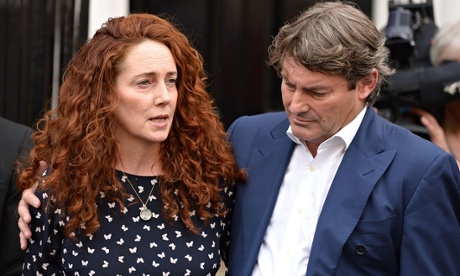
This was a year that proved predictions wrong. In March, after 12 years in office, the Labor government of South Australia survived another election. In June flame-haired Rebekah Brooks was acquitted on all charges arising out of the News of the World phone hacking scandal. In November, officer Darren Wilson of Ferguson, Missouri, was not sent to trial by a grand jury for killing unarmed black teenager Michael Brown. Riots followed. And later the same month, the former president of Egypt Hosni Mubarak had charges over the sale of gas to Israel and the slaughter of protesters dropped by a Cairo court.
Still awaiting justice in Egypt is Peter Greste, who is accused with two al-Jazeera colleagues of defaming Egypt on behalf of the Muslim Brotherhood. Despite there being no evidence against him, Greste was sentenced to seven years in June. The Abbott government has pledged every effort to have the Australian journalist out of jail and home by his 50th birthday. He turned 49 in December.
Brickbats and bouquets for Australia
Frankly, 2014 was not a year in which the applause of the world rained down on Australia. Particularly narky were international refugee and human rights bodies that failed to enter the spirit of Australia’s war against the boats.
The United Nations high commissioner for refugees, Antonio Guterres, took Australia to task for towing refugees back to Indonesia; for forcing refugees to live in camps on Manus Island and Nauru; for conditions in those camps; for doing a deal to offload refugees on Cambodia; and for repudiating, late in the year, the principle of non-refoulement, the historic obligation under international law not to return victims of persecution to their persecutors.
“Would you have me abandon the policies that are working?” asked the minister for immigration, Scott Morrison. There’s another word for the lexicon of recent Australian political English: “working”.
In December, Senate crossbenchers caved in to a threat so grubby it has already entered the history books: Morrison told them he would keep holding 100 or more children in detention on Christmas Island until they gave him absolute power to decide the fate of refugees in Australia. Malcolm Fraser raged at the senators for handing Morrison these “dictatorial, tyrannical powers” and “tearing up international conventions, practices of international law, all necessary if we are ever to establish a better and a safer world”.
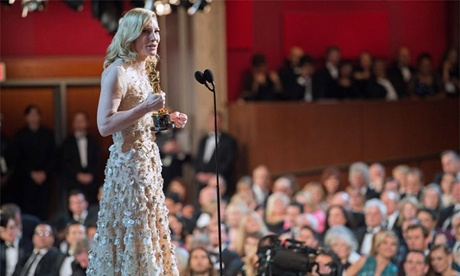
Of course 2014 wasn’t all brickbats. The world also had a number of bouquets to present Australia:
- In March, we collected a record haul of Oscars with Cate Blanchett declared best actress for her role in Woody Allen’s Blue Jasmine, and Catherine Martin winning two more for production and costume design on The Great Gatsby.
- On 7 October, the OECD declared Canberra the best place in the world to live.
- On 14 October, Tasmanian Richard Flanagan won the $90,000 Man Booker Prize and on 8 December, thanks to the personal intervention of the man himself, a $40,000 share of the Prime Minster’s Literary Award for his novel A Narrow Road to the Deep North.
But Stockholm disappointed. Though we had no Nobels in 2014, some splendid discoveries announced this year promise prizes down the track:
- In July, scientists from Sydney, Harvard, Stanford and MIT announced they’d found a way to bio-print artificial vascular networks. The hope is to produce, one day, organs for transplant at the press of a button.
- In October, Flinders University palaeontologist John Long, having looked hard at fossils of extremely ancient fish, declared: “The very first act of copulation was done sideways, square-dance style.”
But nothing beats Rome for discoveries. Pope Francis and Emeritus Pope Benedict joined forces in St Peter’s square in April to reveal that their predecessors, John XXIII and John Paul II, were saints. John has only a single miracle to his name but the recovery of Sister Caterina Capitani after stomach surgery is considered astonishing enough to earn his canonisation.
Despite the removal of the nun’s stomach, pancreas and spleen, she continues to lead an active life having applied to her fistula a fragment of the bed sheet on which John died. According to reports, the dead pope appeared to her in a dream and declared: “Eat what you want.”
No let-up in bewildering trends
On the food front: kale passed its peak. Cupcakes are dead. Mexican restaurants are opening on every corner. Meals are served on breadboards. Sharing is mandatory. Yotam Ottolenghi went mainstream. Ribs are big. Peruvians can no longer afford quinoa. While the 2:5 diet cuts a swath across Australia, real men are staying on Paleo.
Topknots and woodcutter beards are it this year. Skin is still inked, a trend stimulated by the sight of rapper 360 (aka Matt Colwell) on Q&A in October with his tattooed neck in a suit, shirt and tie. Ties are back. Ditto suits, but tight. Men’s clothes are tight. Pants short.
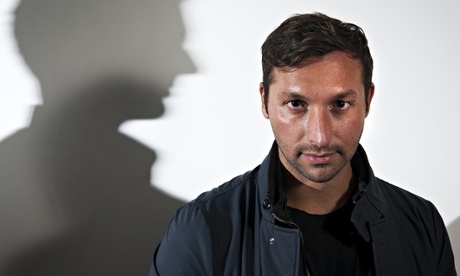
In July Ian Thorpe declared: “I’m not straight.” Despite his star power, coming out did not become fashionable for sportsmen in 2014, though the assumption that men’s professional sport is an absolutely heterosexual world was left looking more ragged than ever. The Sydney Convicts won the international gay rugby competition, the Bingham Cup. Attending the match in August was the governor of NSW, Dame Marie Bashir.
Talk about camp: 2014 saw Tony Abbott bring back knights and dames. He called this “an important grace note in our national life.”
Women’s fashion is dominated by sports luxe, that is, dressing as if always on the way to pilates. Hipster women try to look like librarians, sweet librarians. Twin sets and pearls are not out of the question. Dots are big. The fashion lead given this year by royalty is rather confusing: broderie anglaise and G-strings.
Architects report their world is post-beige. Instead of limestone floors, Moroccan concrete tiles. Corrugated iron endures. Brass is back. The dressing room has swamped the walk-in wardrobe. Downstairs the look is industrial: black walls, knife-edge stainless steel and rough wood. The indispensable kitchen appliance of 2014 was the sub-zero fridge.
For the love of coal
The world continues to warm despite the best efforts of the Coalition. Last year was Australia’s warmest and the World Meteorological Organisation predicts 2014 will be the hottest recorded on the globe. The 21st century has so far delivered 13 of the hottest years ever recorded. And, by the by, investment in renewable energy in Australia this year dropped 70%.
Abbott’s resolve in the face of these figures was, for much of the year, absolute. He withdrew funding from the Climate Council as soon as he was elected and in March abolished the Department of Climate Change. With the backing of coal miner Clive Palmer, the carbon tax was abolished in July and the Coalition’s Direct Action plan, which will cost $2.55bn over the next four years, became law in October.
True, the Senate baulked at further destruction of Labor’s strategies, but these were significant political victories. At the opening of the Caval Ridge coalmine in central Queensland in October, Abbott declared: “Coal is good for humanity, coal is good for prosperity, coal is an essential part of our economic future, here in Australia, and right around the world.”
But the prime minister was not bringing the public with him. Essential polls revealed in November that only 28% of us consider Australia is taking the right approach to climate change. And a bare 1% see bushfires, floods and cyclones as less likely in the future. Now, figures like that resonate with a prime minister. A ministerial tag team eventually flew to Lima for the UN climate change conference in December, and Abbott kicked $200m into the UN’s Green Climate Fund.
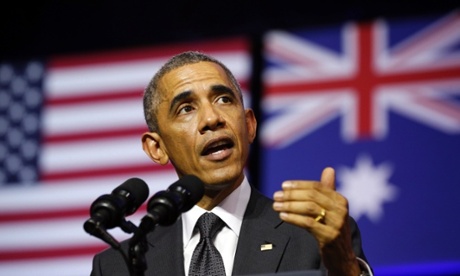
In an Australian first, two ministers reproached a president of the United States. Barack Obama’s deal with China on his way to G20 and his pep talk to Queensland University students the day he arrived made him the least welcome US president since anti-war protesters lay in front of Lyndon Johnson’s motorcade in Sydney. But this was not 1966 all over again. This time, the students applauded and the government was outraged when Potus warned: “The incredible natural glory of the Great Barrier Reef is threatened.”
A grim sweep of war and death
This was a year of invasions.
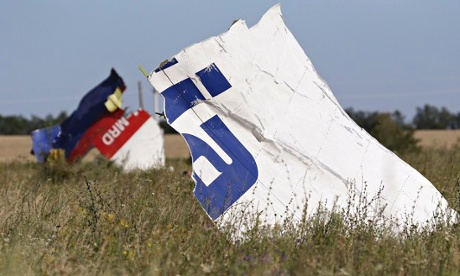
Crimea was in Russian hands by March. At this point, Russia also had troops fighting in eastern Ukraine. According to the UN, fighting there has already claimed 4,000 lives including 38 Australians among the 298 killed when flight MH17 was shot out of the sky. The foreign affairs minister, Julie Bishop, confronted Vladimir Putin in Milan and at G20 over the crash. He would promise only to assist access to the crash site. Fighting continues.
Isis swept across Iraq in June, killing, raping, beheading and bombing in the name of the Caliphate. The rebels swiftly seized Iraq’s second city, Mosul, and established a regime of extreme Islamic law. According to the UN, more than 5,500 had been killed in the fighting by October.
After kidnappings and rocket fire, Israel invaded Gaza in July. This was the third invasion of the Palestinian territory by Israel in the past seven years. The invasion ended in August, leaving 71 Israelis and 2,100 Palestinians dead.
In November, in the far depths of space, after a 10-year journey, the European Space Agency placed little Philae on the comet 67P/Churyumov-Gerasimenko. Alas, it bounced and landed in the shade.
Death cut its usual swath through Hollywood in 2014. Many gathered were of great age: Shirley Temple, Mickey Rooney, Joan Rivers, Eli Wallach and Maria, the last of the Trapp family singers. But some were too young to go: Robin Williams, 63, took his own life and Philip Seymour Hoffman, 46, was carried off by heroin, cocaine, benzodiazepines and amphetamine.
Truly astonishing was the slaughter of great conductors in 2014: Claudio Abbado, once of La Scala and the Berlin Philharmonic; Lorin Maazel of the New York Philharmonic; Frans Bruggen of the Orchestra of the 18th Century; and Christopher Hogwood of the Academy of Ancient Music.
Departing also was a phalanx of world leaders long past their years of power: General Wojciech Jaruzelski of Poland; Ian Paisley of Northern Ireland; Eduard Shevardnadze of the Soviet Union and Georgia; General Ariel Sharon of Israel; Jean-Claude (Baby Doc) Duvalier of Haiti and Gough Whitlam.
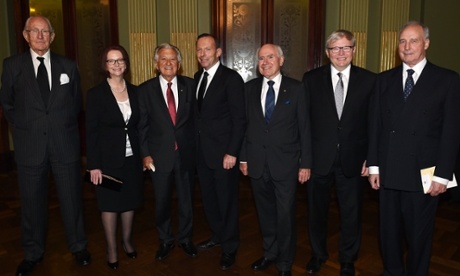
Whitlam’s death in October provoked a truce not unlike – and not much longer than – the football games in no man’s land at Christmas 1914. For a brief time public life was seen at its best. Politicians behaved. Great speeches were delivered. Commentators – not all of them – put aside their old agendas. This couldn’t last, of course, but in death as well as life Gough reminded us of what we might be.
But 2014 ended with flowers heaped in Martin Place in Sydney to remember two citizens killed by a madman who, for a moment, captured the attention of the world. Tori Johnson was the young manager of the Lindt cafe and Katrina Dawson, a barrister who worked upstairs, was among his many customers that morning buying chocolate and coffee. It isn’t time yet for them to rest in peace. The new year will be dominated by the search for answers to a single question: why did they die?