New Zealand is one of a handful of countries where community transmission of COVID-19 has been eliminated.
But with two new cases announced on June 16, we have learned that elimination is not the end – rather, it’s the start of the next phase.
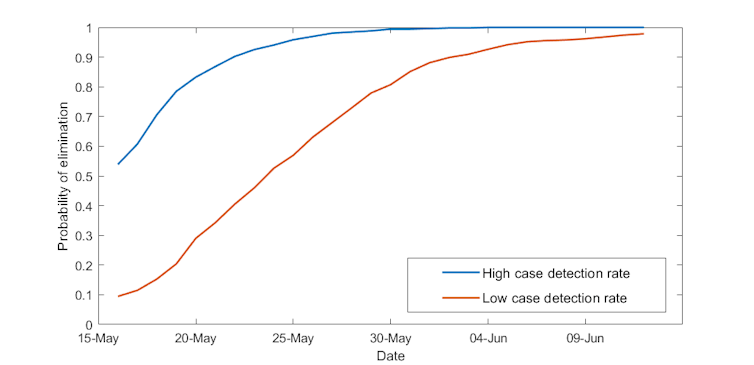
After 23 consecutive days with no new cases, the June 16 announcement that two people returning from overseas have tested positive does not mean New Zealand’s elimination strategy has failed. Just two weeks ago, we estimated we were likely to see one or two cases a week at New Zealand’s border.
À lire aussi : New Zealand hits a 95% chance of eliminating coronavirus – but we predict new cases will emerge
The two travellers in question came from the UK, where the disease is still very active.
The two women arrived in New Zealand on June 7, via Doha and Brisbane, and stayed in a managed isolation hotel in Auckland. But they were granted an exemption on compassionate grounds on June 12 to travel to Wellington to visit their dying parent.
Such compassionate exemptions from managed isolation have now been temporarily suspended.
This development shows how important our border controls are. Currently, all new arrivals must remain in quarantine for at least 14 days, unless they receive an exemption. It’s unlikely someone is still infectious after 14 days without showing symptoms, so this should minimise the chances of spread from overseas arrivals.
But as these cases show, this doesn’t mean the risk is zero. Whether from an exemption on compassionate grounds as in this case, people working at the border, or from people getting infected shortly before leaving quarantine, it is inevitable that new cases will make it across the border.
As we explained in our previous article, to stop the virus coming back, we need more than just good border controls. New Zealanders will need to keep avoiding the three Cs of possible infection - closed spaces, crowded places and close contact - as best they can. And it’s crucial we keep meticulously tracking where we’ve been and who we’ve been in contact with.
It also shows the importance of getting tested. One of the travellers reported mild symptoms, but didn’t associate these with COVID-19. Anybody with symptoms should get tested and stay home until the results come through, especially if they have had contact with someone who has been overseas or work in a high-contact job.
Now that New Zealand is at alert level 1 and 40,000 people can go to the rugby, it’s more than important than ever that we don’t let our guard down.

Shaun Hendy receives funding from Te Pūnaha Matatini, New Zealand's Centre of Research Excellence in complex systems, and is on the Council of the New Zealand Association of Scientists.
Alex James is affiliated with the University of Canterbury and receives funding from Te Pūnaha Matatini, New Zealand's Centre of Research Excellence in complex systems.
Audrey Lustig is affiliated with Manaaki Whenua Landcare Research and receives funding from Te Pūnaha Matatini, New Zealand's Centre of Research Excellence in complex systems.
Michael Plank is affiliated with the University of Canterbury and receives funding from Te Pūnaha Matatini, New Zealand's Centre of Research Excellence in complex systems.
Nicholas Steyn is affiliated with Te Pūnaha Matatini, New Zealand's Centre of Research Excellence in complex systems..
Rachelle Binny is affiliated with Manaaki Whenua - Landcare Research and receives funding from Te Pūnaha Matatini, New Zealand's Centre of Research Excellence in complex systems.
This article was originally published on The Conversation. Read the original article.