The government has released a series of economic indicators that reflect the recent state of the economy following the consumption tax rate hike. Although some observers are cautious about the future of consumer spending, the government's measures to support the economy have been effective to some extent. With the damage caused by Typhoon No. 19 still lingering, it has become more difficult to assess the impact of the tax rate hike.
Cautious take on data
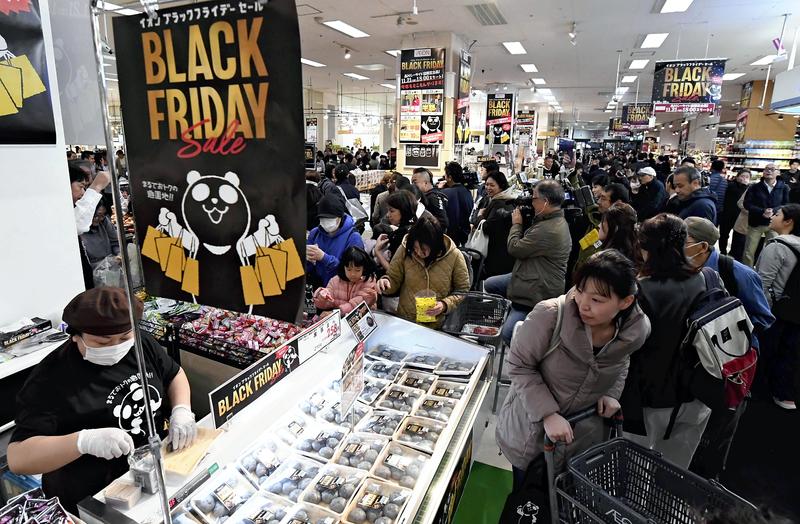
Aeon Retail Co. held a five-day sale in its 400 stores nationwide from Nov. 22, modeled after "Black Friday" on which the year-end shopping season traditionally begins in the United States.
In an effort to stimulate consumption, which was declining due to the tax rate hike, the retailer increased the number of half-priced items, such as down comforters, by 50% from last year.
"Shoppers found sale items to be reasonable, which prompted them to buy more. We hope this will continue into the year-end shopping season." a company official said.
According to the Preliminary Report on the Current Survey of Commerce released by the Economy, Trade and Industry Ministry on Thursday, retail sales fell by 7.1% in October from the same month of the previous year. The drop was bigger than that in April 2014 when it marked a 4.3% reduction following the consumption tax rate hike to 8%.
Among the retail sales in the latest report, sales at supermarkets fell by 3.7%, almost the same as the previous survey when it declined by 3.9%. The Japan Chain Stores Association gathered that "consumer sentiment has deteriorated."
Department stores, which experienced shoppers' last-minute spending spree on jewelry and other luxury goods before the consumption tax hike, saw their sales drop by 17.3%. This drop, which also reflects the effects of Typhoon No. 19, was bigger than the 10.5% decline in the previous survey.
The latest report "shows the effects of a last-minute surge in demand at almost the same level as last time," the Japan Department Stores Association said.
Contribution of cashless payments
On the other hand, convenience stores saw a 3.3% increase in their sales thanks to cashless payments.
According to the report on housing starts in October, which was released by the Land, Infrastructure, Transport and Tourism Ministry on Friday, the number of owner-occupied houses, including custom-built houses, fell by 5.6% from the same month of the previous year to 24,495. This drop is only about one-third of what was reported in previous data when it fell by 16.1%.
Sumitomo Forestry Co. President Akira Ichikawa said the figure "didn't decline as much as in the previous report thanks to government measures." Regarding the current situation where industries experience different outcomes, one economist said, "The impact of the tax rate hike remains to be seen."
The government maintains its view that there has been no major last-minute surge in demand or a reactionary fall as a consequence. In November's Consumer Confidence Survey released on Friday, the Cabinet Office raised its overall assessment of consumer sentiment to "showing signs of picking up" from "weakened" in the previous report.
Additional 400 billion yen. for reward points
The government plans to compile a new economic stimulus package in early December by combining a fiscal 2019 supplementary budget and the fiscal 2020 initial budget into a single 15-month budget in a bid to support the economy.
With the envisaged combined budget, the government aims to create a framework to respond to large-scale natural disasters and the risk of a slowdown in overseas economies as well as achieve sustainable growth after the 2020 Tokyo Olympics and Paralympics.
Under its economic stimulus package, the government plans to include about 400 billion yen in the combined supplementary and initial budget for a reward points program for consumers who make cashless payments.
The program was introduced as a measure to ease the burden on consumers when the consumption tax rate was increased in October. The program has been used more than initially envisioned, and with the additional budget allocation, the government aims to run it smoothly until June 2020 when it is scheduled to end.
Read more from The Japan News at https://japannews.yomiuri.co.jp/