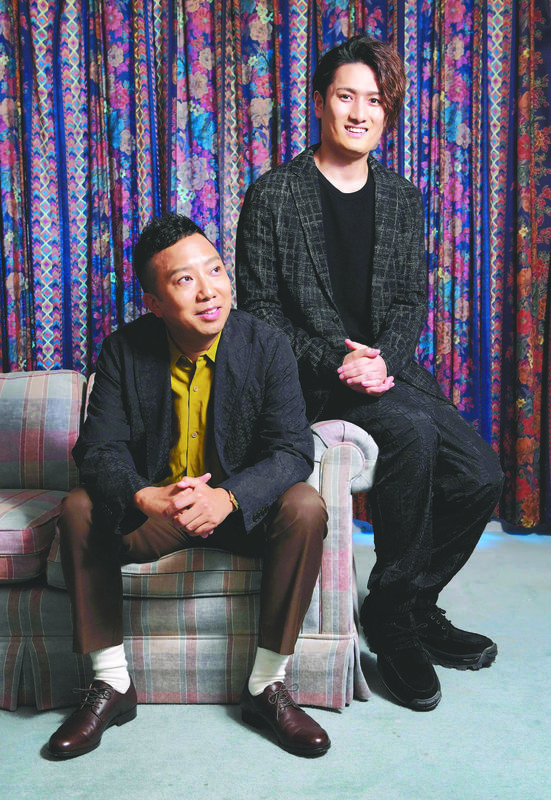
Ichikawa Ennosuke IV and Nakamura Hayato, two of the hottest properties on the kabuki scene today, have formed a strong duo to soar together in "Super Kabuki II Shinpan Oguri," now on show at Shinbashi Enbujo theater in Tokyo. The show features Ennosuke, 43, and Hayato, 25, each playing the two central roles on alternate dates. The characters they play are the protagonist, Oguri, and the equally important role of the monk Yugyo Shonin, or Saint Yugyo.
The modern kabuki spectacle of "Super Kabuki" was started by Ennosuke's uncle, Ichikawa Eno, when he was called Ichikawa Ennosuke III.
In 1991, he directed and starred in the Super Kabuki play "Oguri," which was written by Takeshi Umehara.
The play was updated considerably by the current Ennosuke, who directs the new production with Kunio Sugihara. Eno is credited as the supervisor.
Both productions are based on "Oguri Hangan," a masterpiece of the sekkyobushi narrative art that originated in medieval Japan.
Oguri is a young man with good looks who excels in both academics and martial arts. He is a free spirit and forms the Ogurito (Oguri Party) with his friends and followers. One day, the group stops the procession of a bride and takes her away. Oguri subsequently marries the bride, Princess Terute (played by Bando Shingo), but her samurai father strongly refuses to give his blessing to their marriage.
Oguri and his men are then killed by poisoned arrows, while Princess Terute is swept away in a stream. Oguri confronts the king of hell and fights with demons before being sent back to this world with his face and limbs scarred by disease.
The new production is true to the three pillars of Super Kabuki: speed, spectacle and story. It also retains key elements from the previous "Oguri" production, such as a large mirror onstage, quick scene changes and well-structured story development, while adopting the latest visual media technology. Stage flying is one of the most popular elements of Super Kabuki, and in this production the two actors fly at the same time.
Ennosuke and Hayato spoke to The Yomiuri Shimbun about creating a theatrical spectacle in pursuit of joy in the Reiwa era, ahead of the opening performance in October.
Ennosuke: The Ogurito is a group of young men living freely as a company. Kensuke Yokouchi's script makes them similar to young people today. Oguri is born an aristocrat, but he can't fit into aristocratic society. Princess Terute also abhors old conventions. They meet, feel drawn to each other and become united. After descending into hell and then returning to this world, Oguri goes through a series of predicaments and realizes that true joy is something you can find by doing things for other people, not for yourself.
Hayato:It's a big, difficult role. The lines are written in modern Japanese, but once I started rehearsing them, I found them pretty hard to understand for a young man like myself, because they take motifs from Buddhism and old sekkyobushi stories, often imbued with profound teaching. I'm trying very hard to digest them. As Ennosuke said, Oguri was at first content just with making his friends happy. He then changed into a man who offers joy to other people. I'd like to portray him by showing the process by which his inner transformation becomes clear.
Ennosuke: Hayato, you are a very serious person. You work very hard and use every resource within you to interpret the role. Oguri is a free spirit, but one must never make him look like a selfish or nasty person. He must look appealing as a lead character that the audience can feel connected to. We grew up in different times, so I guess our portrayals of Oguri will inevitably look different to someone who has watched both you and me in the lead.
Hayato: We also share the role of the monk Yugyo Shonin. He deplores this world where people aren't rewarded for good deeds, and laments, "If gods and Buddha really exist, why do people have to be subjected to suffering all the time?"
Ennosuke: Even Enma Daio [the king of hell], played by Mr. [Kazuyuki] Asano, is suffering. Every stage production becomes complete only after a live audience watches it. As we are performing for four months [in Tokyo, Fukuoka and Kyoto], the production may go through some changes. As you perform, you may make a guess, "Maybe the audience will react like this in this scene," as if it's some horse racing bet. But the truth is there are times when the audience reacts differently in a surprisingly good way, or it may turn out to be a sad miscalculation. That's the interesting thing about theater.
Hayato: True. The previous [Super Kabuki show], "Super Kabuki II One Piece," was completely different in the final performance compared to the first day. When Bando Minosuke and I played the lead roles in the new kabuki play "Naruto," you told me, "Now you can learn what it is like to have the weight of cast leader on your shoulders." I did think I learned about it a little bit at the time, but this time I really feel the enormous responsibility of having to lead the cast by myself as the protagonist, and in such an epic show with three acts. Still, it's a great opportunity for me to play a lead role at a young age. I'm going to perform with a free soul.
Ennosuke:When you take on a new work, you realize how important classic works are. If you tackle modern works without any experience with the classics, the best you can do is create a very simple character. I think you will be able to absorb more things when you return to a classic next time, Hayato. What our predecessors in kabuki left behind is wonderful and precious. I don't think Super Kabuki shows deny classic kabuki works. Rather, they shed light on the classics from behind.
Performances at Shinbashi Enbujo theater continue until Nov. 25. Further performances are at Hakataza theater in Fukuoka from Feb. 4-25, 2020, and at Minamiza theater in Kyoto from March 4-26, 2020.
Read more from The Japan News at https://japannews.yomiuri.co.jp/