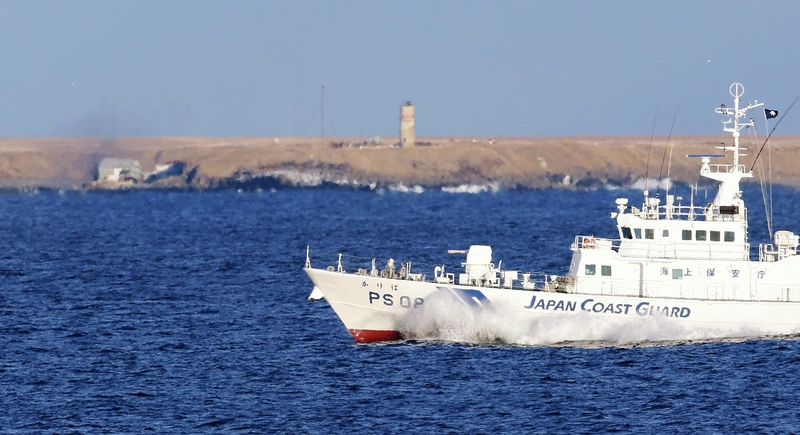
An approach in which Japan would conclude a peace treaty with the Soviet Union after the return of the Habomai group of islets and Shikotan Island -- two of the four northern territories islands -- had previously been deliberated by Tokyo in 1960, according to a diplomatic document released by the Foreign Ministry.
The so-called "two islands plus alpha" approach was referenced in the document, which had been prepared before a visit to the United States by then Prime Minister Nobusuke Kishi in January 1960 to sign the revised Japan-U.S. Security Treaty.
Ahead of the visit, the Foreign Ministry created a document on the current status of issues between Japan and the Soviet Union in preparation for a Japan-U.S. summit between Kishi and U.S. President Dwight Eisenhower. The document, which was made public Wednesday, discusses a perspective held in Japan that the issues should be resolved with a bilateral peace treaty following the return of Habomai and Shikotan, along with "plus alpha" -- meaning additional elements.
The fisheries industry was cited in the document as a key advocate of the approach. The Foreign Ministry assessed that the industry sought the conclusion of a peace treaty that only confirmed the return of Habomai and Shikotan, as long as the Soviet Union acknowledged Japan's potential sovereignty over Kunashiri and Etorofu -- the other two territories -- or guaranteed that fisheries operations could be safely conducted in waters near the islands.
Ogasawara linkage
Meanwhile, another diplomatic record revealed that Japan envisioned a strategy linking the return of the Ogasawara Islands to the return of the northern territories when Kishi made his first visit to the United States in June 1957.
According to the document, then acting foreign minister Mitsujiro Ishii cabled Japanese Ambassador to the United States Koichiro Asakai on June 21 during Kishi's visit to the United States. In his cable, Ishii noted that Japan's hand would be strengthened in negotiations with Moscow over the northern territories by explicit U.S. confirmation of Japanese sovereignty over the southern islands or a pledge to return the islands during Japan-U.S. talks.
However, the strategy never materialized. The Soviet Union opposed revision of the Japan-U.S. Security Treaty, which Kishi worked on in 1960, and repeated its claim that the issue of the northern territories had already been settled. Even after the return of the Ogasawara Islands in 1968, negotiations over the northern territories remained in a stalemate, a situation that persist to this day.
Read more from The Japan News at https://japannews.yomiuri.co.jp/