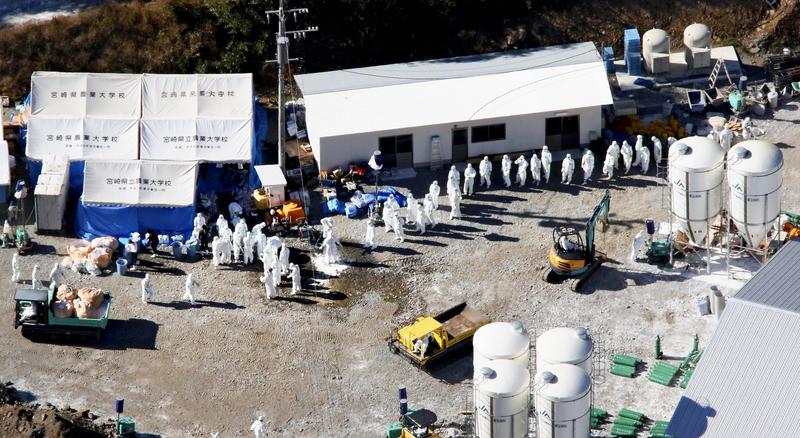
Avian flu outbreaks at poultry farms in eight prefectures across western Japan have resulted in the culling of 2.3 million chickens since the first case of the season was confirmed in early November.
The H5 flu subtype was detected in dead chickens in Oita and Wakayama prefectures according to an announcement on Thursday. Chickens that tested positive for bird flu were also found in Okayama Prefecture.
Migratory birds that are believed to have brought the virus with them winter in Japan, prompting increased vigilance in the poultry industry as the virus is expected to spread.
Avian flu was detected in Miyazaki Prefecture for the first time this season at a poultry farm in Hyuga on Dec. 1.
"The outbreaks have occurred while we were taking maximum precautions with a strong sense of urgency. It's regretful that we weren't able to prevent them," Miyazaki Gov. Shunji Kono said.
Miyazaki is the nation's top producer of broiler chicken with about 28 million reared in the prefecture.
By Tuesday, avian flu outbreaks had been confirmed in four other municipalities, including Miyakonojo and Kobayashi. A total of 210,000 chickens have been culled in the prefecture so far.
Since the outbreak in Kagawa Prefecture on Nov. 5, infections have been confirmed at 21 poultry farms in Fukuoka, Hyogo, Miyazaki, Nara, Hiroshima, Oita and Wakayama prefectures, according to the Agriculture, Forestry and Fisheries Ministry.
More than 2.3 million birds have already been culled, the largest number since 2003 when an outbreak of a highly pathogenic avian flu strain was confirmed for the first time in 79 years.
The H5N8 strain was detected in all of the outbreaks until the case in Hiroshima Prefecture.
Analysis by the National Agriculture and Food Research Organization in Tsukuba, Ibaraki Prefecture, discovered that the genes of the viruses detected in Mitoyo and Higashi-Kagawa, both Kagawa Prefecture, were closely related to the virus that was prevalent in Europe last winter.
The agriculture ministry dispatched an epidemiological research team to farms with bird flu outbreaks for on-the-spot examinations. Many of the poultry houses were found to have openings through which small animals could enter, and feces thought to be from mice were found in some of the structures. Cases of farmworkers moving from one poultry house to another without changing their boots and gloves were also found.
The ministry and others believe that migratory birds brought the virus to Japan in autumn from Europe via Siberia, Russia, and it was brought into the poultry houses by workers and mice.
The many reservoirs in western Japan that are visited by migratory birds could be one of the reasons for the disproportionate occurrence of bird flu cases in the region, according to the ministry.
Read more from The Japan News at https://japannews.yomiuri.co.jp/