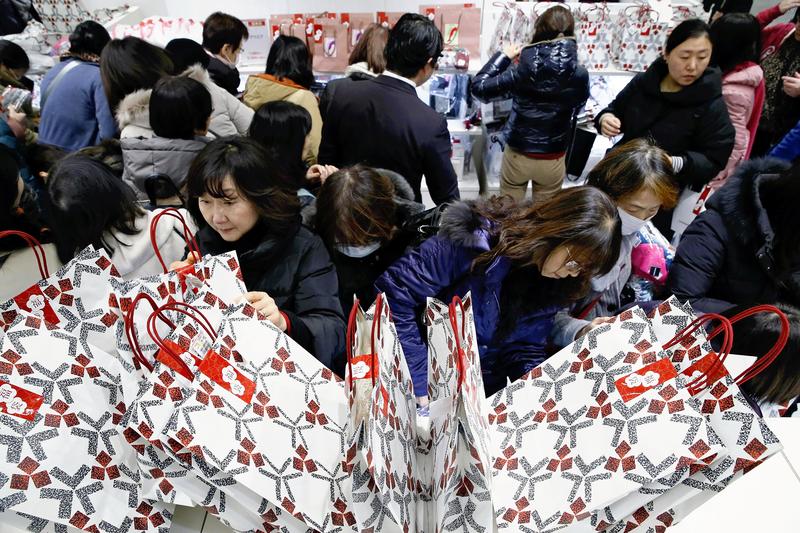
Department stores saw mixed results from their New Year "first sales" for 2019, which are said to forecast annual consumption trends. Some experienced a downturn, as customer behavior has been changing recently in the nation.
The Nihombashi Mitsukoshi main store started its New Year's sale on Jan. 2, topping its sales goal by more than 10 percent. About 5,000 people were waiting in line when the store opened that day, up 30 percent from the previous year. The store also started its bargain sale for winter goods on the same day for the first time in seven years, which is thought to be one reason for the good performance.
"The New Year's sale and the winter bargain sale had a synergistic effect," a public relations official said.
Various stores' fukubukuro lucky bags also sold well in the new year, advertised as "the last New Year's sales of the Heisei era." Bic Camera Inc. purposely put film cameras released more than 10 years ago in its lucky bags, a successful strategy that helped pushed its sales up 10 percent from a year before.
In contrast, sales at Takashimaya Co.'s 17 domestic stores declined by 6.7 percent. Daimaru Matsuzakaya Department Stores Co.'s sales also fell below last year's on Jan. 2 and 3, as coats and other winter fashion items did poorly.
Retailers had hopes for the New Year first sale season because it would mean an initial spurt in sales for 2019. According to figures compiled by the Japan Business Federation (Keidanren), the average winter bonuses for workers this fiscal year -- agreed between labor and management at 167 major companies -- rose 6.1 percent from a year before to a record high of about 935,000 yen amid solid corporate performances.
The results, however, were a mixed bag, despite the special atmosphere of a limited time event resulting from the impending end to the Heisei era.
Customer behavior seems to have had some impact on the situation. Spending by foreign visitors, which used to boost the sales performance of department stores and other retailers, has slowed at some shops. A person involved with a major department store voiced concern about the sluggish buying behavior of such foreign visitors as Chinese tourists, who used to be avid buyers.
According to Sogo & Seibu Co., the total number of foreign customers who visited their stores in December was almost unchanged from the previous year. However, the retailer's sales declined by about 10 percent.
The Chinese government has strengthened restrictions on the resale of goods bought overseas, which led to sluggish buying among its consumers. If trade friction between the United States and China intensifies further and the Chinese economy cools off, these circumstances will have a significant negative effect on consumption trends in Japan.
The downward trend in stock prices is another cause for concern. Wealthy people who hold many shares tend to be cautious about consumption in this kind of business environment.
Four major domestic department stores released their December sales on Jan. 4. Only Takashimaya improved from the same period in the previous year, while sales at Isetan Mitsukoshi Holdings Ltd. dropped by 1.5 percent and Sogo & Seibu was down by 1.3 percent. Sales of high-end goods are very likely to fall if the situation remains unchanged.
In October, the consumption tax rate will rise from 8 percent to 10 percent.
"The consumption tax hike could cause great damage to the domestic economy, as it will overlap with the bargain sale season for winter clothes, [one of the most profitable periods for retailers]," said Shun Tanaka, a senior analyst at SBI Securities Co.
Read more from The Japan News at https://japannews.yomiuri.co.jp/